
Canto rodado (Boulder), at Gallery Elena Shchukina in the Mayfair gallery district, is Mario Vélez’s first solo exhibition in London. It comes on the heels of his ambitious early-2016 installation at the National Archives, titled Atlas, and features several works from the same series. The title of the exhibition carries a dual meaning, alternating between its literal definition (canto rodado as a rock fragment sanded and made smoothly round by the action of the elements, especially water) and a more poetic one that plays with the word canto, Spanish for “song”, which adds a new level of interpretation to Vélez’s paintings and sculptures.
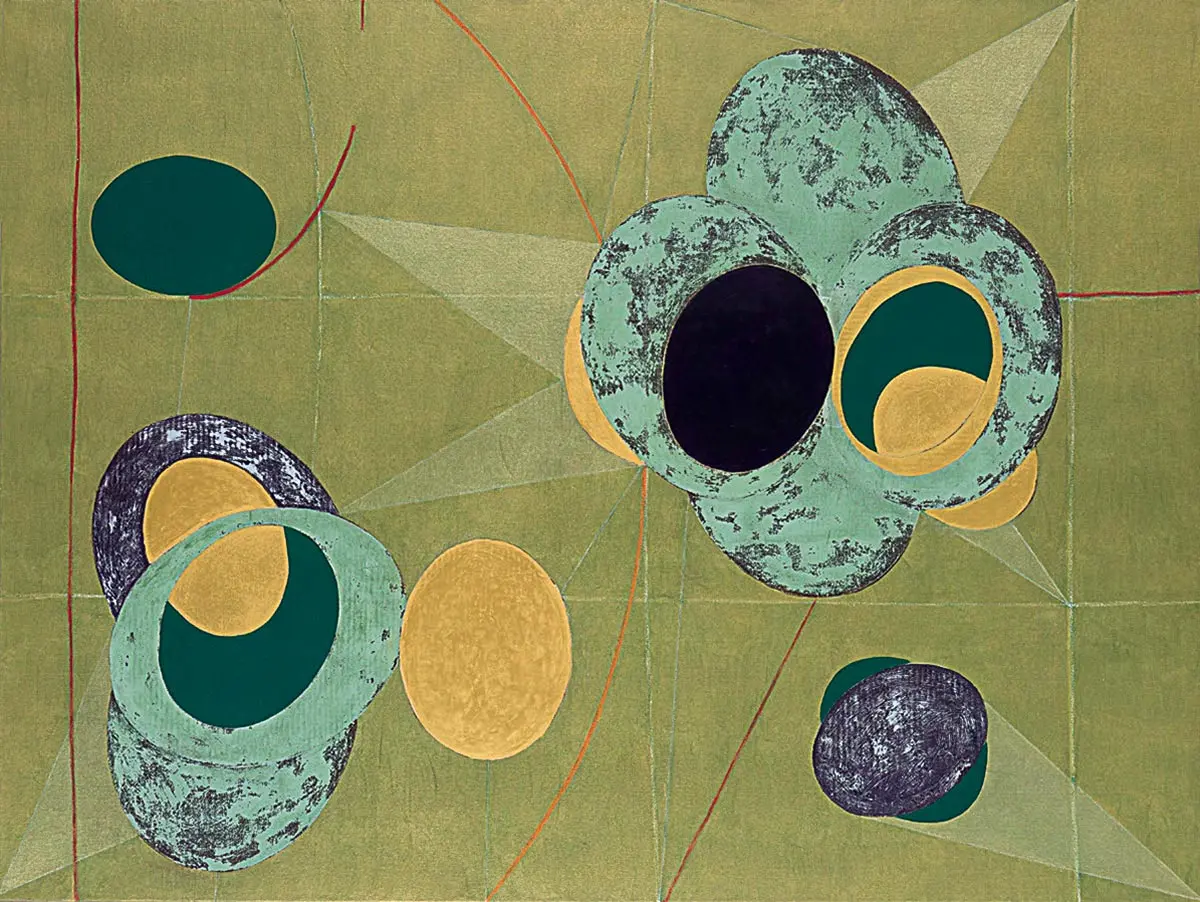
Compared to Vélez’s installation at the National Archives, the space of this exhibition is cozy and intimate. The works also behave in a different way here, losing in some instances the monumentality that we perceived in Atlas while recovering an essential dimension as manual labor, evident in Vélez’s paintings and even more so in the mysterious boulders, for example, Fuera de los Límites I, II (Outside Limits, 2015). The powerful physicality of this work has to do with its weight and shape, a kind of rock/egg whose surface and material appearance are at the same time familiar and strange.
The same shape—the infinite variations of a boulder—repeats in the paintings included in the exhibition. Vélez researches different pigments and pictorial processes in order to give his boulders a material presence. This helps his paintings transcend the two-dimensional representation of space and connect directly with his sculpture. For this reason, his works need to be seen live; reproduction can hardly convey their materiality. In the exhibition, works like Aguas profundas (Deep Waters) engage in a direct dialog with the sculptures that are part of Fuera de los límites—which may explain the latter title—and suggests that these are shapes that have escaped the boundaries of the painting.
For Vélez, this series is a way to reconnect with a primitive state and embrace the essence of a distant past, an original moment that alludes to natural materials and forms. In Más allá de los límites (Beyond Limits, 2014-15), his rocks/eggs float in space. One possibility is to read them as celestial bodies, the original material of the universe around us, particularly when it becomes a black hole, the vacuum that marks the beginning of time. In Vélez’s words, his work connects geometric abstraction with a pre-Columbian imaginary, mainly via the natural oval shape of rocks, eggs, cocoons, and celestial bodies.
The exhibition also features a series of works on paper under the title of Geografías corporales (Body Geographies). This series allows us to explore Vélez’s creative process. Geografías corporales I - Color blanco (Body Geographies I – White Color, 2009), for example, is a study of phenomena present in most of the works on exhibit. The presence of grids and geometric projections connects this work on paper with his large-format paintings. Drawing translates and deconstructs three-dimensional structures, and painting complements it with a material presence. Works like Geografías corporales I - Color blanco reveal the different instances of this creative process, from draftsmanship to the boundaries of painting.
The sculptural character and the material experimentalism of Vélez’s productions (from his works on paper, through his paintings, to his three-dimensional works) make them particularly relevant in the landscape of contemporary Latin American art. Vélez is part of a generation of artists interested in exploring the materiality of painting and who experiment with materials and techniques in order to find an essence that frees the genre from the weight of representation. Since early on in his career, in the 1990s, Vélez has been interested in the abstract-expressionist movement; he has incorporated and translated many of its tenets for a contemporary moment and a highly specific visual imaginary.
In recent interviews, Vélez defines himself as a “painter, basically a painter.” This exhibition reveals his most recent finds in a constant and disciplined process of experimentation, not only in terms of his images but also in terms of his materials and pictorial techniques. In that sense, and echoing the titles of several works on display at Elena Shchukina, his intention to go beyond limits is clear.
RODRIGO ORRANTÍA