
Two exhibitions specifically conceived in dialog with each other were on display between August and October at Espacio Odeón: Un lugar y el tiempo (A Place and Time) and Air and light and time and space. The former featured works by Spanish artists Irene de Andrés, Iñaki Chavarri, Cristina Garrido, Julia Llerena, Nacho Martín Silva and Mauro Vallejo, as well as by Jimena Kato (Peru), Maya Saravia (Guatemala), and María Clara Figueroa, Antonio Franco, Daniel Salamanca, Santiago Pinyol, Sofía Reyes, and Ivonne Villamil, all from Colombia. The latter was a project of intervention on the stage space of the former Odeón Theater (later renamed Teatro Popular de Bogotá) by Madrid-based Brazilian artist Marlon de Azambuja.
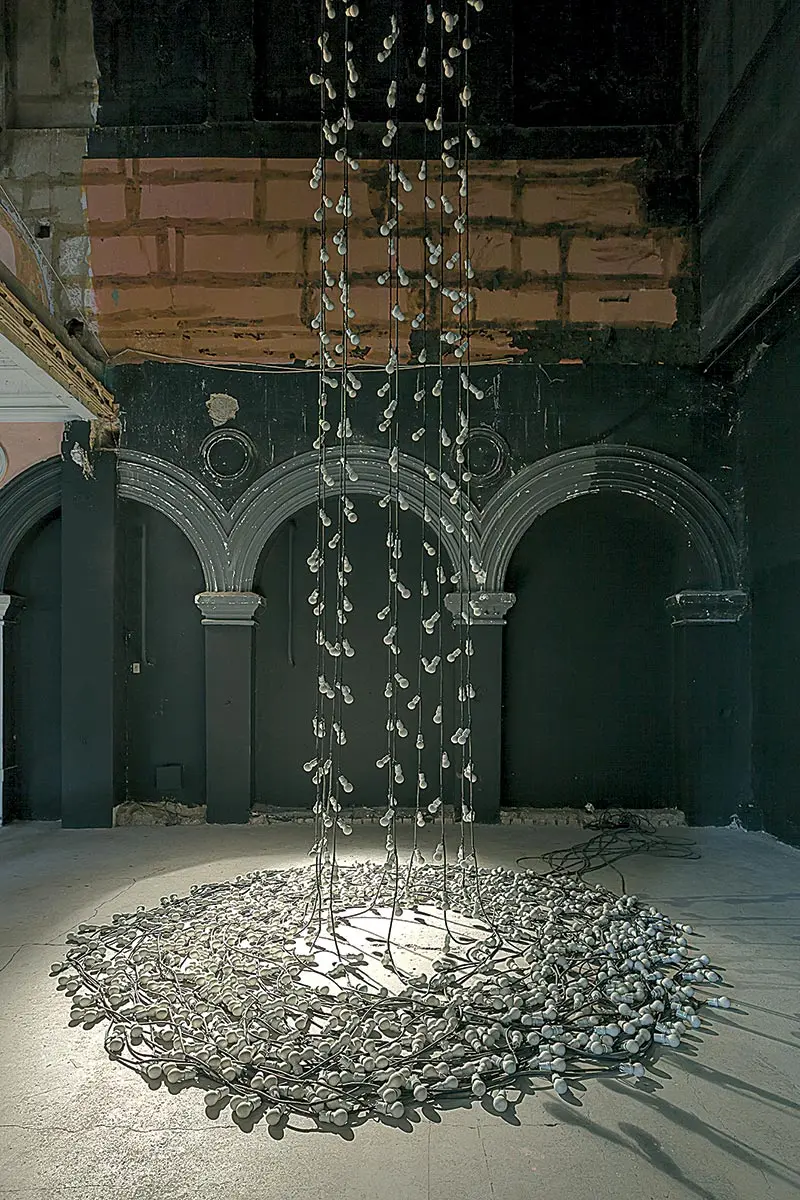
The starting point for these two projects was the conception and execution of Azambuja’s intervention, which takes its title and part of its approach from a poem by Charles Bukowski. The poem is a statement of sorts about the possibilities of creativity. It begins by considering the opportunities that a new study, large and well lit, could afford the writer in terms of space and time to develop his creative process. Later, however, it notes that whoever is willing and ready to create will do so even when immersed in the most adverse conditions. All light, air, space, and time do is prolong our existence so that we can continue to create.
Azambuja’s project takes into account the combination of decay and living experience that is the architecture of the Odeón as the theater it once was and the exhibition space that has emerged from its renovation. Its use changed, and the Odeón went from space for stage arts to space for the visual arts. In Azambuja’s intervention, light is entirely circumscribed to the dense material on which the artist made one thousand casts of a light bulb: concrete. The conjunction of those two experiences—the incorporeal aspect of light and the solidity of the concrete—opens up the possible interpretation of the work, as it seems to point in several directions at once. Azambuja says he is interested in the poetic dimension of light, its connection to different metaphorical situations such as the idea of splendor, the emergence of ideas, the notion of spectacle, and the presence of people as souls, among others. His intervention sustains a tension between transparency and opacity in what appears to be an allusion to the combination of historical ruin and functional space that characterizes the Odeón’s architecture. Azambuja’s light line is not really operative; it suspends its ability to discharge all the metaphors it carries.
The exhibition Un lugar y el tiempo was curated by Marlon de Azambuja himself, in collaboration with Alejandra Sarria, the Espacio Odeón curator, and it evolved, as we said before, from a dialog with latent principles in Azambuja’s work. The fourteen artists included in the selection placed their works in contingent situations with regards to space, which in turn activated its own temporal dimension. Iñaki Chavarri, for example, appropriates books purchased in the street and combines them with other objects in order to generate new resonances of meaning. He intervenes, however, to eliminate their covers and page folios, thus subtracting some of their social uses while reclaiming for them a new physical dimension. They are now things in the world, or, rather, situations that enter in that way into a new temporality.
This expansion of the temporality associated with codes of cultural representation, such as verbal language or the formal conventions of artistic languages, is common to most of the works in this exhibition. In general, these works seem more interested in inserting themselves into their spatial and temporal situations, such as the specific architecture around them, than in seducing with their intrinsic poetics. Or perhaps those poetics only emerge when viewers are able to relate the materiality of the works to the experiences of visibility and invisibility, connection and disconnection, or materiality and immateriality that comprise their own lives.
JAIME CERÓN