
Miguel Rothschild’s work never disappoints and always amazes. In his most recent solo exhibition in Paris, titled Contre vents et marées (Come Winds or High Water) by the artist himself, Rothschild—who was born in Buenos Aires in 1963 and is now based in Berlin—engages a set of issues that for him are not only geography or climate but also emotion in form and matter. Coined in a naval context, the expression Contre vents et marées dates from the Seventeenth Century and is used today mostly as a metaphor, as an inducement to overcome life’s obstacles by countering the hesitations that often undermine our conquering drive. We encounter Rothschild’s ability to deploy every sense of the expression (both as meaning and as sensation) in all of the works on display, which are at the same time exercises in profound material inventiveness, poetic fragments, and testimonies of the complexity of our feelings.
Miguel Rothschild is an inquisitive and meticulous artist, interested in the infinite possibilities of objects and materials that he connects, integrates, or detours as in the conceptual and aesthetic discourse they can express in response to, or echoing his own existential, emotional, and artistic interrogations. Yet in this desire to live beyond the “images” there is a degree of playfulness, a knowing—and, at times, mocking and even self-mocking— sense of humor (let’s remember the group exhibition Continental Shift at the Ludwig Forum in Aachen, Germany, in 2000, where Rothschild proposed a meditation on pain and pleasure: a bed covered in surgical tape evoked suffering and emotional wounds, while a sensual pink-colored armchair, with a thousand mouths in relief, invited impossible kisses.) Rothschild’s creative work is undoubtedly very personal, yet it does not loop onto itself like most autobiographical art. On the contrary, it remains open to all senses and prompts all kinds of probing and exploration, since it is particularly imbued with emotion, which makes it more intimate and empathetic.
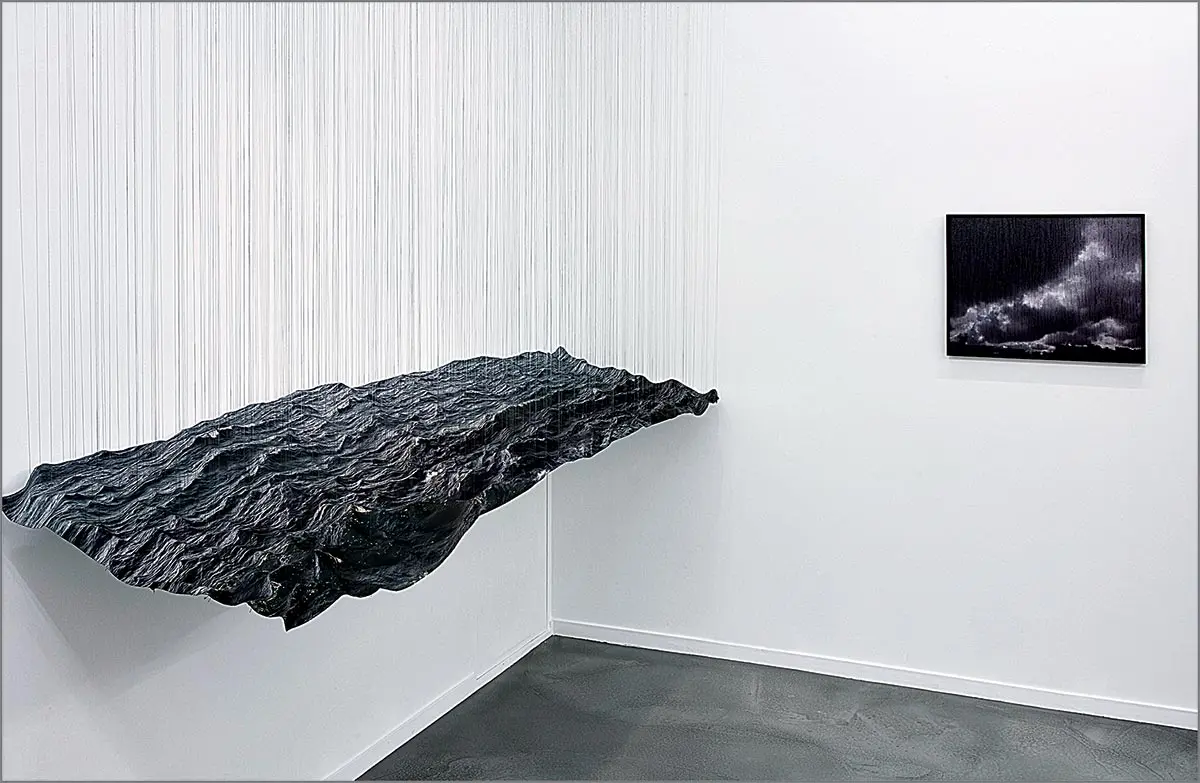
Inside the first exhibition gallery, which features four intervened photographs and an installation, we are impressed by the reduced polychromy of the works on display. Rothschild’s colorful passion disappeared under a range of grays, opaque whites, or shining blacks; an almost monochrome symphony, similar to a dramaturgy, envelops visitors and drags them into a watery, nebulous, entirely dream-like maelstrom. The broken security glass, the Plexiglas, the confetti, the nylon thread—all contributes to the transparency and reinforces the sensation of a virtual motion guiding the artist’s subjacent discourse.
They might be frayed and unstable clouds from which nylon threads emerge, or a fine jet of foam or water surging forcefully from the work on the ground as in Lluvia (Rain, 2016,) or even from a sky loaded with ominous black clouds in front of which rages a frantic storm simulated by the irregular opacity of the Plexiglas covering the photograph like a film of raindrops (Fenêtre, Window, 2016). Be it a security glass broken into thousands of veins that cover the image like a rain curtain and break our visibility (Outre-mer, Overseas, 2016) or a turbulent, threatening sea whose incessantly shifting, marbled whirlpools—which could be the wind or the surf—are highlighted and given pace with foam droplets equally outlined in the image and launched, confetti-like, into space (Contre vents et marées, 2016), the fury and the violence of the elements dominate and accentuate the instability of the viewer’s perception.
But Miguel Rothschild’s full poetic and inventive capacity is best revealed in his installation Sans titre, D’après William Turner (Untitled, according to William Turner, 2016), a light yet dense work where the sea and the rain give shape to an indivisible whole. This is not only an aesthetically beautiful work of art, but also an imaginary fragment of reality, impression, sound, and motion. Like a “magic carpet” floating at some 80 cm from the ground, the “sea” (printed on silk) is held in place by a large number of transparent threads hanging from the ceiling.
The exhibition continues in a second gallery with works in which we encounter color, this time in red and orange hues. While in the first gallery Rothschild launched a challenge to the elements, in the second he proposes a different kind of meditation. Two photographs show the interior of churches or gothic cathedrals, from which a multitude of threads with the colors of stained glass emerge, hanging from the photographic paper, projecting themselves into space, and falling to the ground. Blood or fire, suffering or consumption, the metaphor is always about the human condition. The sole object-sculpture in the exhibition (160.040.5 Carat, 2016) lies on the ground like a solitary diamond, like a transparent cosmogony, or like a spider web waiting for its prey.
CHRISTINE FRÉROT