
The Palais de Tokyo in Paris presented, from June 23 through September 11, a monographic exhibition by Mika Rottenberg (Buenos Aires, 1976). After studying in Israel, Rottenberg completed her education at Columbia University, in New York City, where she lives and works.
The paradox of the content she presents is the result of a multicultural concept with abundant art references. Rottenberg has expressed the desire to offer her audience a complete, all-encompassing experience: “I want to penetrate their spirits through the back door, by means of the unexpected…” And that is indeed the sensation viewers are left with after experiencing the 1,000-square-meter exhibit, which can’t be fully covered in a single visit. One could say that there is no front and no back, no beginning and no end, only the weight of the body in motion, enduring the different elements comprised in Rottenberg’s subject matter: stress, monotony, oppressiveness.
“False ceilings are filled with mystery,” Rottenberg says. “What hides in them? What is contained in the space they enclose? They suggest oppressive spaces, generally with low ceilings. In a way, they reduce us psychologically.”
Different aspects of consumer society are brought to light in a kind of compartmentalized structure: production, distribution, alienation. Exploiting every mechanism of intrigue, the scheme is restricted to the present time, and it arouses deep mechanisms in our consciousness. Subjecting visitors to the laws of a fortuitous motion suffices here; ultimately, what highlights ambivalence is ambiguity.
One of Mika Rottenberg’s main sources of inspiration is the Marxist theory of value. For Marx, the only source of surplus-value is human labor, understood in a scheme of alienation from which it cannot be freed individually.
Rottenberg’s digitally printed images are presented in an environment built with variable-size panels that could be different parts of the body. Each “window” corresponds to one interior and exterior aspect of multiple necessities. Aspects and practices that construct human survival, and its organic functions and sensations: synesthetic, tactile, nourishment, breathing, sexual, motor. Aesthetic as well? Devices and objects: old conditioners, a ramshackle worker’s room, a sports hall, or a video parlor reveal unexpected aspects of society. They are conjoined in order to underscore the presence of discarded objects and of the disorder of the anti-aesthetic, in a denunciation of absurd wastefulness, a ridiculing of the commodity’s paradoxical universe.
Rottenberg’s filmed scenes of the cultivation of pearls in Asia give concrete meaning to the exploitation of living things. As a whole, the images are deeply striking. The actions require maximum attention on the part of the viewer, who apprehends philosophically the antagonistic aspects of reality. At a point when everything seemed to have already been done in the arts, here come surprise and estrangement.
The contrasts in the video scenes, the features of characters from different ethnic groups, cultures, and remote villages in various parts of the world allude to globalization. The titles—Squeeze, from 2010; TSSS, from 2013; TSSS TSSS TSSS, from 2014—are almost organic cacophonies.
A subtle note in reference to liquid desire, the different states of matter, and the motion of the body and its parts are involved in Bowls Balls Souls Holes, from 2014.
A remarkable semiotic play takes place between the not-knowing of Nonoseknows (Artist Variant), from 2015-2016, video (22 min), sculpture, and installation, and the character’s sneezing filmed in Sneeze, from 2010, which makes reference to Fred Ott’s 1894 film. Complex emblems of meaning, of not knowing or not being able to gain awareness of the totality.
Some scenes display open spaces, where circulation is organic. Actors who are not such in real life and images that move in apparently absurd situations acquire concrete meaning via an attentive observation of the labyrinth-like particleboard structure, completed by a passage between different spaces and creations.
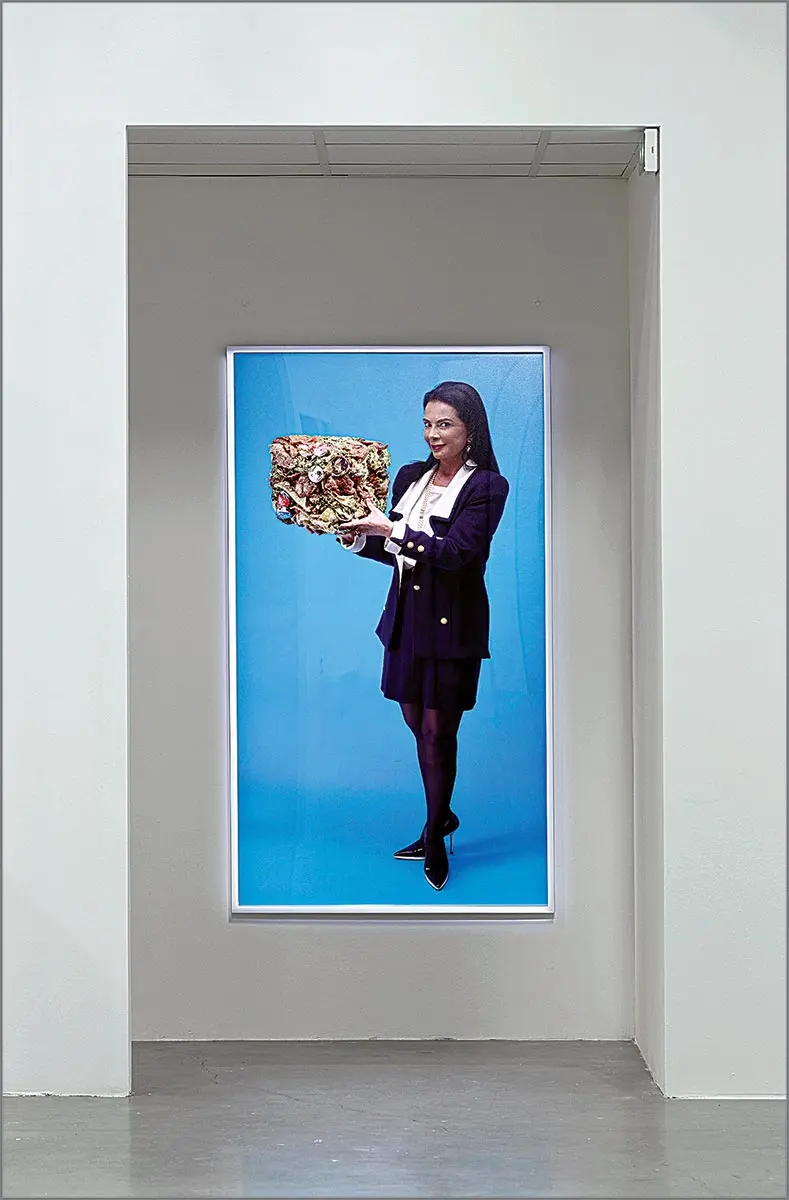
The portrait Mary Boone With Cube, from 2010, stands apart: Rottenberg’s daring shot of the elegant New York art dealer breaks with the genre’s every canon. The work supports an element of this fragmentation, of the production stages already revealed.
In this portrait, Rottenberg emphasizes the contradiction between the two paradoxical elements that produce virtual volume. Exquisiteness and luxury pitted against each other as elements of synthesis. Variant: in an exercise in compression that would make a neo-realist like Arman proud, or which could perfectly belong alongside Oiticica’s non-objects, Dalí’s delirium, or the inescapable Duchamp.
Since the turn of the century, Rottenberg has exhibited in such prestigious institutions as PS1 Contemporary Art Center (New York, 2004), the San Francisco Museum of Modern Art (2010), and Amsterdam’s De Appel (2011), among others, and has participated in group shows at the Taipei Biennial (2014) and the Venice Biennale (2015), where her work gained international notice.
SUSANA SULIC