
Lessons, an exhibition by Nicolás Gómez-Echeverri presented at Casa Proartes, made me feel as if I had entered an elementary school classroom. Specifically, it reminded me of my own experience as a child, the seductive feeling of a place filled with color and things put there for reasons unknown to me. My relationship with school supplies was always problematic, given that they are designed to be desired and eye-catching while also being part of imposed standards and rules that make them practical tools, thus turning their potential for play into work.
Lessons addresses in its very title an action that is never generated in the exhibition space: namely the “transfer” of knowledge from someone who knows to others that do not know. The absence of this gesture fills the exhibition with questions and, as it occurs in the classroom when it is vacated, the nature of things change as they lose their normative codes and the lesson is postponed for the next class. In my opinion, the exhibition by Nicolás Gómez-Echeverri is between two lessons, thus the plurality that at times is able to synchronize a series of themes.
Acumulaciones (Accumulations, 2013) is a large installation made with rulers that accumulate paint pigments and that, according to Gómez-Echeverri, are reminiscent of topographic visions and geographic configurations. It is interesting to note that, in the context of the entire exhibition, this piece becomes an element without a precise code and its connotations permeate and are combined with the other works. In fact, the group of rules in the space becomes a horizon, a line that changes according to the distance from which we observe it. This line is accompanied by the mural Sin Título (Untitled, 2016) that consists of a large number of world maps on plaster. These maps appeared to be transforming into a sort of wallpaper, an impartial and regular pattern that exacerbated the representation of the world, even as no one was present to resume its conventions.
I enjoy thinking about that moment when one “does not understand” something because it elicits one of those common sensations that drives us to formulate the best possible questions while believing that we are after the correct answer. Placed between the teachings of a past and future class, Lessons could be thought of as the right stage to formulate a question. The latency of the things left behind (installed, hung, used, displayed, accumulated, filed), whether in the classroom or in the exhibition room, is determined by that which I may ask. The geographies suggested by Gómez-Echeverri perhaps encourage us to wonder about the real place that it may reference, namely, the place in the world that it represents. I believe that every accidental pigment represents a place on a small scale measured with the lines of the ruler but under the disguise of appearing a mockup or the miniaturization of a mountain.
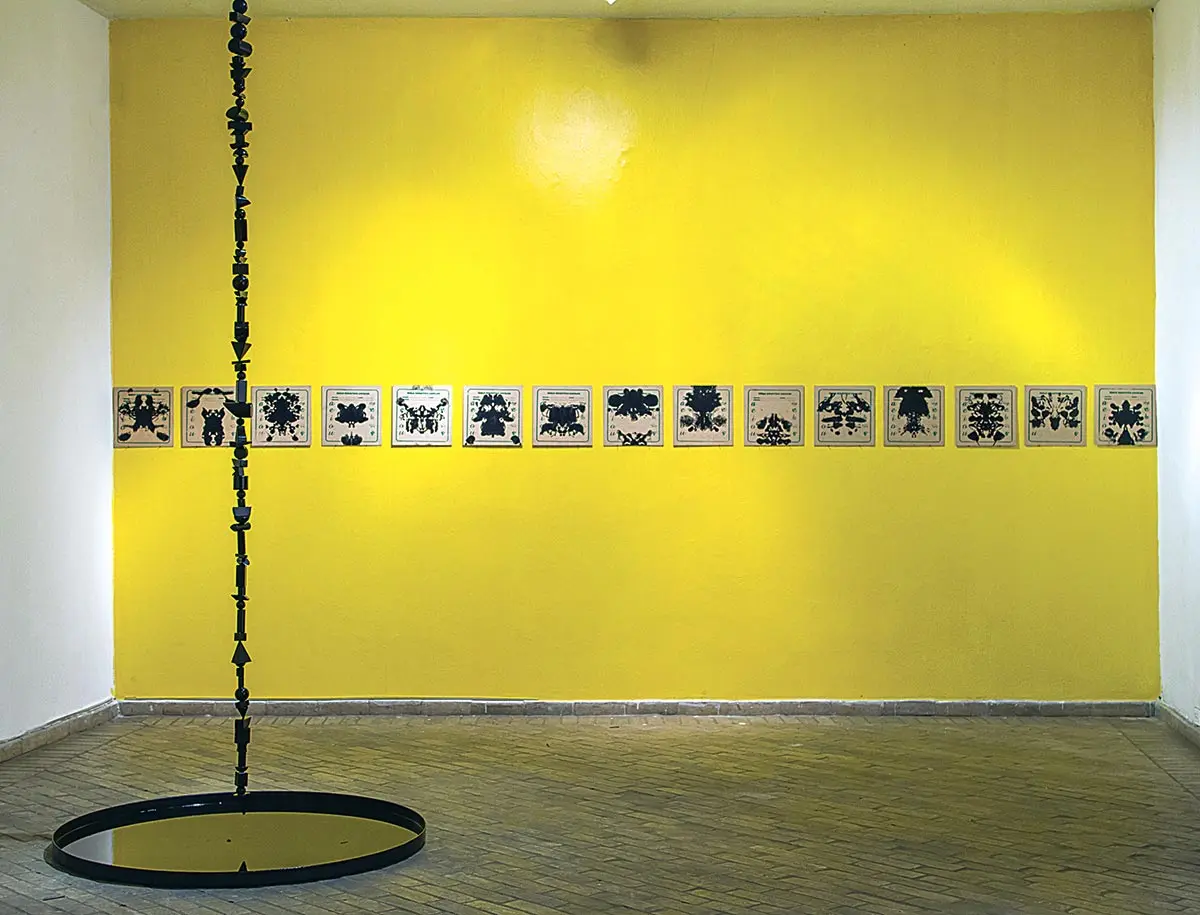
Brújula (Compass, 2016) consists of a stick suspended from a thin thread. A cone and a cube are attached to either side of the stick, which moves every time a visitor gets near it. This work that appears to barely offer a hint—in fact, it avoids any overt pointing—possesses the same fragility of arguments, sensitive to any vibration of the space. Boceto de Manifiesto (Sketch of Manifesto, 2016) is a vertical assemblage with many geometrical figures that hang like a pendulum and rest at the center of a tray filled with burnt oil that reflects and multiplies the objects into another plane. The reflection on the oil is so flawless that it appears as if a hole opened to show a universe identical to ours. It is a somewhat tragic conclusion that reminds me of the eternal return of the same thing, even if such sameness questions us. For the installation of these pieces, Nicolás Gómez-Echeverri painted some of the walls of the exhibition room yellow, perhaps with the intention of emphasizing the sculptures by flattening the gaze with a contrasting color in a “two-dimensional” background—like the neutral background of school printed material or encyclopedic illustrations.
Curso Básico (Basic Course, 2013-2014), displayed in the exhibition room located on the second floor, consists of a series of didactic graphics with pictorial interventions that invite visitors to identify imperfect, random, and volatile signals; in other words, those things that would not be included in a lesson. These pieces share the space with the work titled Cartilla Didáctica (Teaching Card, 2016), a group of school tables—those with the vocals used to mold Plasticine—that are also pictorially intervened, but this time with black, abstract, stains (like burnt oil) reminiscent of the Rorschach Test images—which establishes a connection with that moment when we want to understand, a very short instant when we become unsure of who we think that we are.
BREYNER HUERTAS