
Vertical Horizons, the first solo exhibition in New York by Nicole Franchy (Lima, 1977) was on exhibit at The Chimney, curated by Carla Lucini. Franchy’s works—six photo-collages and silkscreens in varied formats, made on canvas, film, and vinyl—seem to float in space, as though suddenly frozen in their descent from the gallery’s high ceiling to the viewer’s eye level or above. Our bodies, immersed in the square, industrial gallery space, surrounded by brick walls, wanted to touch those translucent films printed digitally by means of collage, maybe to stop the wind that came in through The Chimney’s uncovered façade, in order to read, and see, the images of palm trees and “exotic” waterfalls juxtaposed to texts extracted and crossed out from the Encyclopedia Britannica. Interrupting a series of systems of knowledge built by the West via the deployment of visual and textual relationships, Franchy, like Borges or Ranciere1, posited the concept of imagination as an alternative to the progressive and “vertical”—hence the show’s title—the rhetoric of modernity, repeatedly straining the categories of the universal, the rational, and the ultimately true.
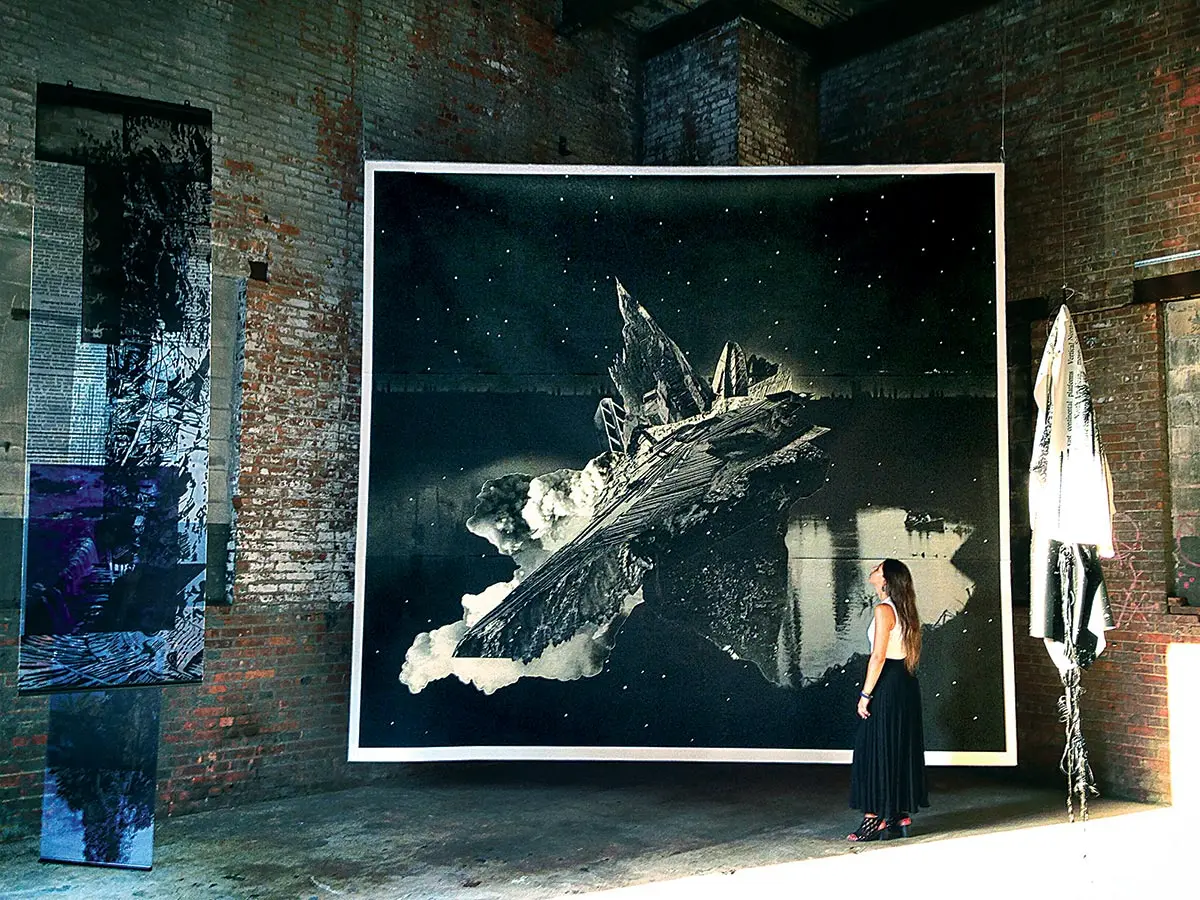
Since 2009, a year after moving to Belgium for her graduate studies at the Higher Institute for Fine Arts, Franchy has not ceased to reflect on the way in which we relate to graphic, textual, and mental images, and to weigh on that basis her ways of doing and her relationship to representation. “I am interested in the representation of places and territories as part of the construction of internalized cultural discourses, [flipping] it all by means of collage,” the artist has said. Now, a monumental, pointed landscape, Black Wasser (from the German for water), is the central work in Vertical Horizons. It is an uncomfortable, catastrophic place that at the same time wants to be seen; thus, a screen of stars on the surface of the collage traverses and covers the landscape, without necessarily protecting it. In the distance, at the end of a plot of land, a large, futuristic, sci-fi security camera monitors and controls the order of dominant epistemologies with a lens directed at our gaze, at the viewer’s perception. After that, there is smoke, strangely corporeal clouds starkly outlined against a lagoon that, now becalmed, reflects a non-existent vertical structure. Such verticality, Franchy insists, is nothing but a cultural construction involving time and space, and, with them, the world-system’s radically asymmetrical power relations. And thus, we continue to look. We notice, to the left of that reflection, a group of three people rowing on a Sunday boat, anachronistically and in contradiction with the disaster of modern architecture in the plot of land. Above the boat, in a skyline of shadowy skyscrapers, thin, sharp white lines ran across the upper section of the photo-collage, echoing the strange combination of speed and silence to which Franchy invites us. For several years now, the artist has dubbed these her “Associative Landscapes”. She says, “The concept is intended to describe what I do, [alluding to] an important part of my practice having to do with the process of memorizing the images with which I work and at the same time unlearning them in the very gesture of collage.”
The images of Inca volumes, antique fairs, published engravings, texts, and sundry images of varied origins collected by Franchy create, as in Black Wasser, imaginary worlds in a collage that resist and at the same time signal Western norms for representation and their ways of seeing and thinking, an issue that becomes even more evident in the works hanging from The Chimney’s ceiling beams. Set on surfaces either translucent or opaque, the texts are taken from the Encyclopedia Britannica are not crossed out in order to nullify them, as some kind of expiration or breakage, but in order to highlight and resist the vertical narratives of so-called universal knowledge. We read, always interrupted by the drastic cut of the edge and the juxtaposition of tourist-consumption postcards, fragments such as:
“The task of domination”; “powerful groups–European, Creole (South America but of European ancestry)”; “Roman universalism”; “Extreme individualism”; “Civilized Indians.” In the Eighteenth Century, when the first edition of the Encyclopedia Britannica was being published and as the concepts of aesthetics and enlightenment evolved, another colonial power, Franchy says (in line with Latin American critique tradition), was replacing the exhausted Spanish crown in the Americas.
As the Peruvian sociologist Aníbal Quijano has reminded us often, “we live within, but against.” Quijano’s thought is indeed cited in Vertical Horizons, which interrogates and critiques power relationships in a sustained epistemological struggle based on the imagination and the updating of the archive and of memory as nonconformity and aesthetic possibility. Franchy’s exhibition is a sharp, complex, and deeply imaginative—in every sense of the word—series of visual and textual decisions we should continue to reflect upon in the context of contemporary Latin American art.
NOTE
1. Jacques Ranciere. The Politics of Aesthetics, pp. 35–41 (London: Bloomsbury, 2004).
FLORENCIA SAN MARTÍN