
“Symmetry is the foundation of my constructive language; I’m looking for the same weight on both sides.” Rubem Valentim
The pictorial-sculptural work by Rubem Valentim continues to be present in the context of Brazilian art as synonymous with an authentic geometry and constructive reason that is particular to the Latin American scene. Relentless about visual exploration, Valentim was an explorer who organized his visual references within the project of a truly Brazilian stroke.
The forms created by Valentim represent a compositional ideology whereby certain guidelines materialize his visual thinking through a vocabulary organized by symmetry.
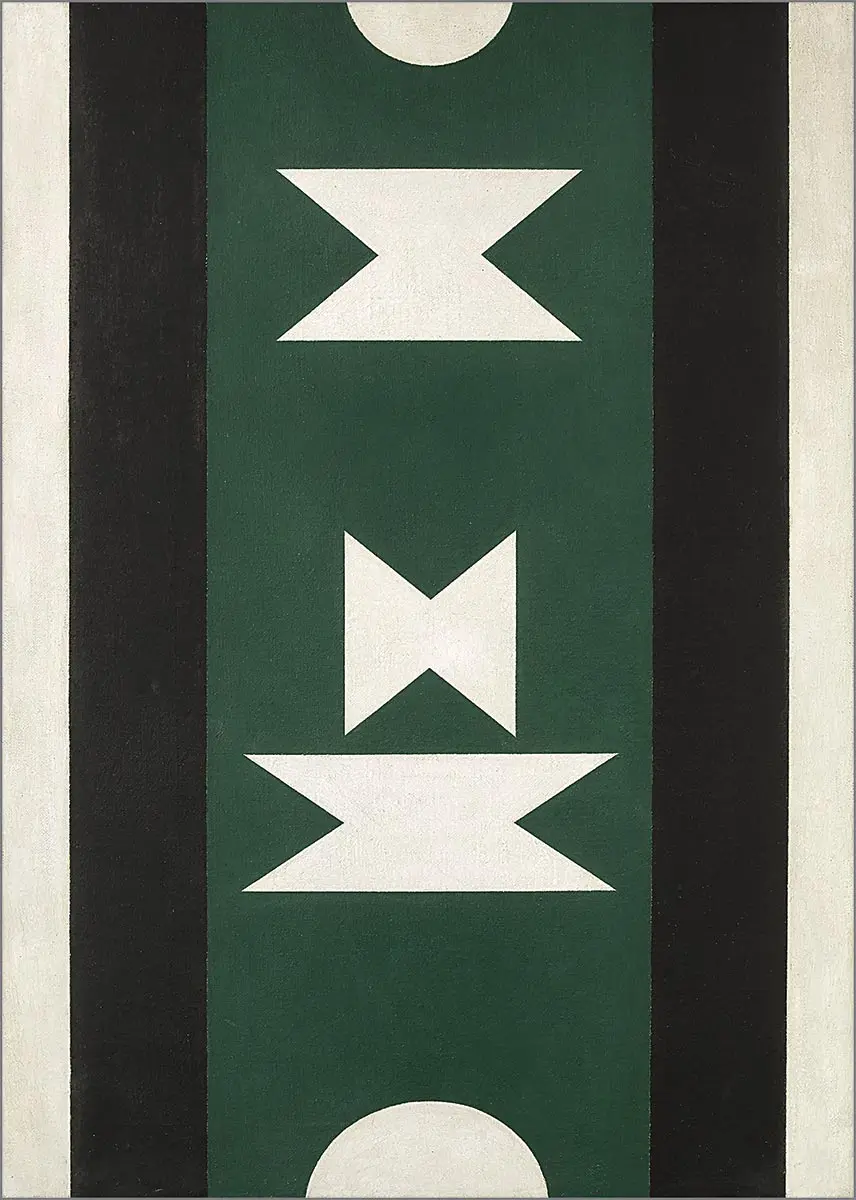
Throughout his artistic production, symmetry is recognized as a constant necessity that results from the constructive commitment guiding his interests since the 1950s. Order and geometric equilibrium are important elements in his trajectory, and their use involved thoughtful decision-making to define the visual poetry of this artist from Salvador, Bahia.
For the recent exhibition titled Rubem Valentim. Painting Pulsates organized by the Galería Berenice Arvani in São Paulo, the walk-through of this creator’s production—which includes a group of works created between the 1960s and the beginning of the 1990s—offered a dialog between painting, drawing, relief, sculpture, and wood relief emblems.
It is a careful initiative by the gallery—presented concurrently with the circuit of visits to the São Paulo Biennial, which animated the program of events in the city—given the educational interest that Valentim’s artistic production arouses, in part as a result of being present in Brazilian collections like the Pinacoteca do Estado de São Paulo, the Museu de Arte Moderna in Bahía, and the Museu Afro Brasil, among other cultural institutions.
As we know, lately the reinvigorated approach to creation by Valentim has generated great interest among international museums and collections from around the world.
Widely present in Latin American painting, geometry in Valentim’s work is the product of his experience with popular art and Afro-Brazilian liturgy, with the African matrices reworked as foundational elements of his visual memory.
Since his first solo show in 1954—at the Galería Oxumaré, in Salvador, his birthplace and where he shaped his artistic vision—Valentim searched for a particular syntax, as he developed a coherent body of work driven by his aesthetic inquiries, a geometric language that translated his sources.
The creative power in Rubem Valentim’s work has been recognized by art critics since the 1960s. It is manifested through formal compositions continuously reaffirmed by almost xylographic linearity in the areas of color, in a combination of visual patterns that are records of his cultural experience.
It is worth mentioning the analysis by Giulio Carlo Argan of Valentim’s career. Argan entered into close contact with his work in 1965, in Rome, at the Galeria d’Arte Della Casa do Brasil. His interest in Valentim’s production helped attract the curiosity of other art critics: “The choices that are at the root of Rubem Valentim’s painting result from his own statements: his signs are deduced from the magic symbology that is transmitted through the popular traditions from the black culture in Brazil.”1
An important work from the period when Argan first entered into contact with Valentim’s creation is the canvas titled Pintura VI (Painting 6, 1964-65). The central piece in the exhibition Rubem Valentim. Painting Pulsates, this work incorporates many of the elements of his visual poetic: a vibrantly colored background and a wide variety of geometric forms distributed across the surface of the painting within a composition based on symmetry.
Every element on the canvas, whether circular, rectangular, and/or triangular, offers a sensation of order to the whole aimed at enhancing the greens, yellows, blues, and ochres that, bound by clearly defined borders, structure the synthesis of the work.
Having already participated in several groups and solo exhibitions in Brazil and abroad, Valentim was recognized in the 1976 São Paulo International Biennial with the Biennial Foundation Award because of the “maturity of his contribution to art in Brazil, his invincible coherence, the significance of his pictorial proposal as possible characterization of a Brazilian cultural identity, and because of his ability to successfully transfer truly regional iconographic and symbolic foundations to the universal realm through an abstract language internationally recognized.”2
The decisive nature of abstraction is recognizable in each of the constructive processes that are part of Valentim’s creations. It is only natural that the deliberate decision of using signs and symbols strengthens this central idea in his work. The visual record is thus a geometric or angular element, particularly in the works produced after 1965.
As we were able to observe in the selection organized by curator Celso Fioravanti for the exhibition Rubem Valentim. Painting Pulsates, the group of works favored pictorial compositions created between the decades of 1960 and 1990 and included some examples of the artist’s incursions into three-dimensionality, sculpture, and emblems in relief.
Carefully placed in the context of the show, the wood scale model for the sculpture titled Marco Sincrético de la Cultura Afro-Brasileira (Syncretic Framework of Afro-Brazilian Culture), a study piece for the monument created in the 1970s that stands at Praça da Sé (by the São Paulo Cathedral), underscored the ordered mark of the vertical axes in his work.
When art critic Theon Spanudis commented about Valentim’s geometry and rigorous formal approach, he was pointing to a singular aesthetic inquiry within the Brazilian art scene: “[…] the geometric forms by Rubem Valentim are more symbols than geometries per se. A triangle, for instance, is merely a triangular surface that, when rationally unfolded, only performs a rational and (eventually) aesthetic composition. In Rubem Valentim’s work, a triangle is never just a triangular geometric surface; it is always something infused with life, density, tension, and expression […].”3
The geometric choices and his attitude to explore the sources that emancipated the creator from the man were central for the establishment of a poetic that resorted to symmetry articulated as an essential component.
In this manner, the oeuvre by Rubem Valentim conveys references to a liturgy reconfigured for the Brazilian context, for the mythological African matrix of Candomblé, through reliefs and pictorial compositions that reveal all the vitality of an authentic invention.
NOTES
1. Giulio Carlo Argan, 31 objetos emblemáticos y relieves emblema (31 Emblematic Objects and Emblem Reliefs), Brasilia: Fundación Cultural del Distrito Federal, 1970.
2. “Rubem Valentim se lleva el Gran Premio de la Bienal” (Rubem Valentim Takes the Grand Prize at the Biennial). Diario del Paraná, Curitiba, November 10, 1976.
3. Spanudis, Theon, “La pintura de Ruben Valentim” (The Painting of Rubem Valentim), Diario de Noticias, Rio de Janeiro, July 2, 1961.
CLAUDIA FAZZOLARI