
In recent years, the work of Víctor Julio González (Valencia, Venezuela, 1961) has been focused on a revision of landscape painting, in propositions that revisit the genre’s most traditional elements, which González’s rearticulates through contemporary eyes.
In the exhibition Bandera lejana (Distant Flag), this dichotomy of his approach to the landscape was reinforced and enriched. The works on exhibit emerged from a previous experience of González, who in the 1990s often watched a flag flying in the distance through his studio window. His fascination with the motif drove him to record a video—included in the exhibition—of this poetry-tinged vision. One day, González decided to approach the flying flag, and he was surprised to learn that it was not really a flag but a bunch of old rags swaying in the wind as they hung from a pole.
This experience drove him to reflect on the nature of the illusory and, above all, that which we recreate beautifully in our minds but has no correspondence to reality. In our nation’s current context of crisis, inhabited by so much disillusion, González revisited that experience, since the illusion of that distant vision was indeed that of a symbol—the flag—that is intimately connected to the idea of the nation.
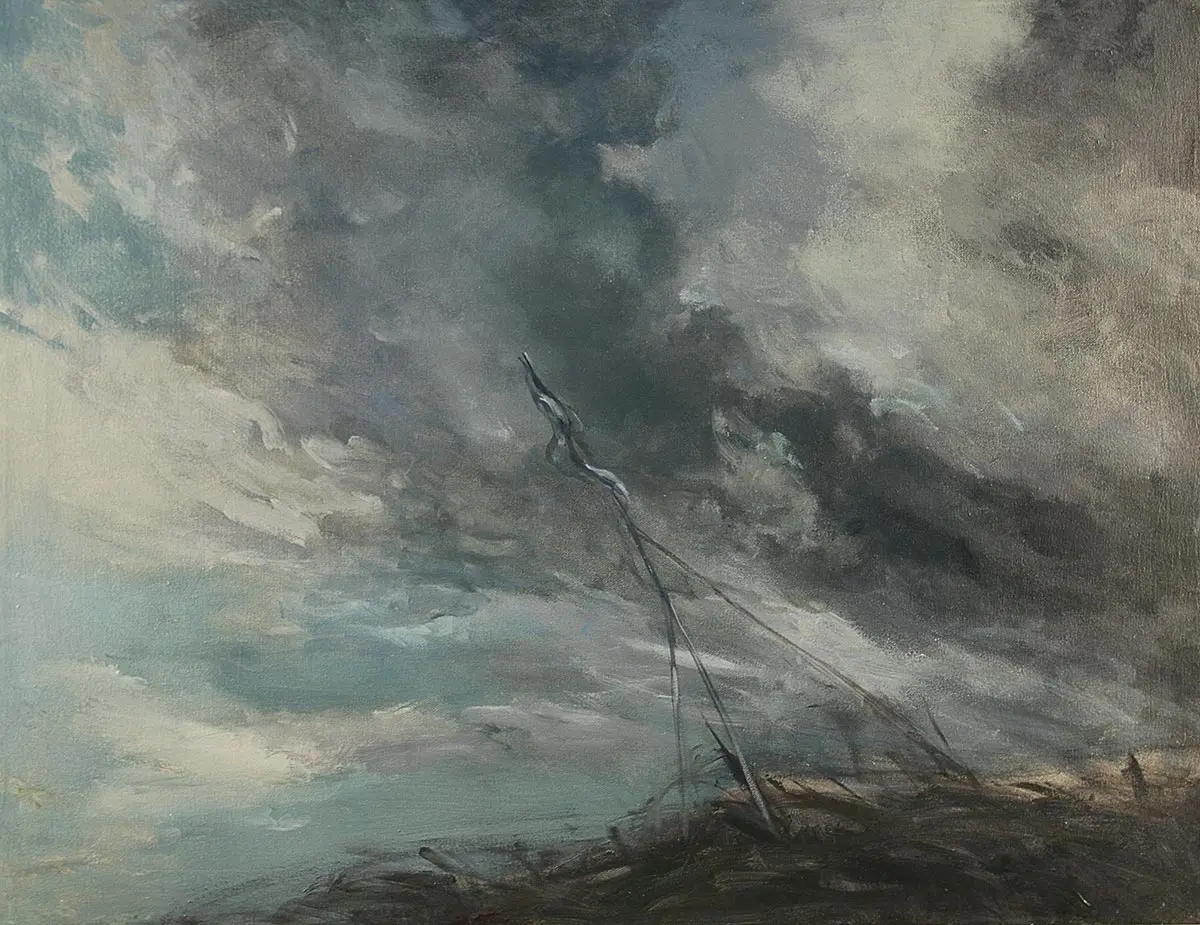
The exhibition featured four series of works in small and medium format. The first of them, titled Bandera lejana, combined eleven depictions of that “rag-flag” mentioned above. It is an important series for the wealth of connotations it carries. Filled with subjectivity and personal memories, it also embodies a deep feeling for national history. The flag, planted on the ground by a diagonal pole and fluttering against dramatically cloudy skies, looks like a spear and makes the establishment of visual relations with some of the icons of Venezuela’s patriotic painting, which celebrate the forging of the republic, inescapable. González unfurls here his best expressive resources, displaying a skillful use of colors that flow, with restrained expressiveness, along with a range of grays, blues, and ochres. The flag is thus presented as a symbol that has become a mirage; the drama this implies has resonances in the presence of a country transformed by an unprecedented moral crisis.
The series Horizontes (Horizons) comprised twenty-one works where the landscape is determined by the horizon, and where the separation between sky and land manifests itself as a compositional canon. As in all of González’s current painting—and even in his photographs—what is relevant in these works is the artist’s passionate approach to the landscape, via a technique that takes delight in the creation of color- and matter-rich planes. In this series, this can be appreciated above all in the representation of the soil. In a tribute to the country as the land where one is born and lives. These are unspecified Venezuelan landscapes; they could belong to any one of the country’s regions, and we recognize them not only because they have a referent in reality, but because they dialog with the images of Venezuela’s great tradition of landscape painting, which, by the way, they update and carry forward.
The series Carne (Flesh), the only one outside the boundaries of landscape painting proper, was inspired by Rembrandt’s Slaughtered Ox. Its inclusion here reiterates the subject of death as the final disillusionment, crudely represented by visceral rending. Human pain and sacrifice are referred to here as elements necessarily intertwined in history. González’s appropriation also reminds us of the sources that nourish him as a student of classical painting and the Great Masters.
The exhibition ends with the series Quema (Burning), which beautifully symbolizes devastation. The works that emerged from burning processes the artist witnessed in his childhood, and in them, the visual beauty of the destruction is transferred to the canvas with great expressiveness. Color contrasts and skillful use of brushstrokes and glazing are important tools in González’s recreation of the atmosphere of a violently vanishing landscape.
Bandera lejana is perhaps one of the most important exhibitions in Víctor Julio González’s career: the works on exhibit demonstrate his maturation into an artist who has acquired the precise technical mastery required for his expressive interests.
In González, the landscape ceases to be a beautiful environment to be portrayed and becomes a realm that reveals, also, a subjective way of being a nation, made from remembrances and images, of symbols, of history and suffering.
KATHERINE CHACÓN