
A continuous roll of paper hangs in the museum lobby. Coming closer, the viewer identifies declassified documents, with several redactions in black. Those at eye level are legible (in English); those that float above are not.
Voluspa Jarpa (Rancagua, Chile, 1971) plays with that duality, the legible and the illegible, in order to engage issues or citizens’ access to the secret political history of Latin America. And she does this based on thousands of documents declassified by the CIA, about its covert operations across the Americas between 1948 and 1994. Assassinations, coups, exile—in sum, the fate of whole countries in the hands of the US’ Central Intelligence Agency, a set of facts secreted away and published decades later, with heavy redactions. It is that black box that interests Jarpa, not only as an act of concealment but also for its aesthetic characteristics. The import of this exhibition, then, is both artistic and political, and it generates a platform for thinking about the way in which the fate of large populations has been decided for decades, without their knowledge, from a distant nation. Jarpa sheds light on such interference, shrewdly, in her video Translation lessons (2012-2016). There, the artist attempts to learn English by reading, with the assistance of a teacher, the CIA archives. It is a simple yet forceful work of art: in order to know the deep history of Latin America, one needs to learn a foreign language.
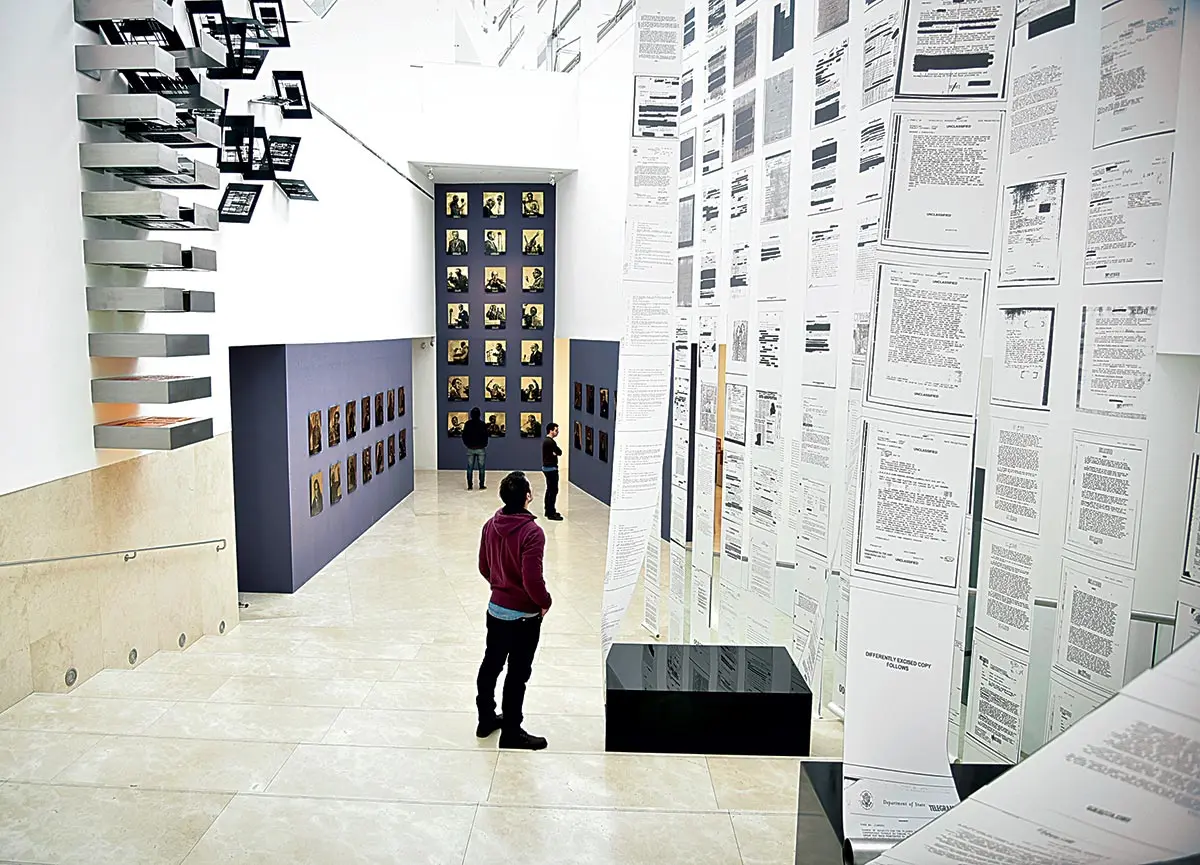
Since 2010, when she presented La biblioteca de la No-Historia (The Library of Non-History), Jarpa has worked in different ways with the declassification of archival documents. Occasionally her approach to such documents has excessively emphasized their aesthetics over their content. Here, the wide range of possibilities she explores shapes a suggestive way of engaging the issue. Mi carne es bronce para la historia (My Flesh is Bronze for History, quoting Salvador Allende) features a series of bronze plates with the portraits of leaders or personalities whose assassination has yet to be explained. Their names are not provided, but most are clearly identifiable: Luis Carlos Galán, João Goulart, Pablo Neruda, or Omar Torrijos. They all appear in front of a microphone: although they were killed, their voices still resonate.
I am most ambivalent about the gallery devoted to declassified documents, set up in connection with the minimalist works of Donald Judd. Jarpa appropriates Judd’s best-known works and uses them to present various CIA records, information about politicians assassinated during the Cold War, thus connecting the period of the Agency’s crudest covert meddling in Latin America with the evolution of the arts in the US during those same years, dominated by Minimalism. The antagonism posited here is that between political violence versus the aesthetic purity of the minimalist style. My objections have to do with this linkage between Judd’s work and the murders committed by the agents of his native country. I don’t think Judd would be too happy, were he alive today. It might have been more accurate to use Abstract Expressionism in the same connection; although it does not provide the visual coldness that Voluspa Jarpa seems intent on proposing, it was indeed deployed by US policymakers for ideological propaganda purposes. Or, to be even fairer, it would have been better to investigate the relationship between the CIA and Latin American cultural agencies: cases of censorship and collaboration.
Those objections notwithstanding, En nuestra pequeña región de por acá (In Our Little Region Over Here) is an important show that deals with a rather long chapter of history—one that remains veiled and distorted—in multi-directional, subtle ways. An art exhibition displaying significant social and political responsibility that nevertheless does not neglect the visual component or the allegorical element. An invitation to engage the traumas of history from the standpoint of creativity.
JUAN JOSÉ SANTOS