
Venezuelan artist, poet, and hacker Yucef Merhi (Caracas, 1977) present Interceptaciones (Interceptions), an exhibition focused on his investigation of the vulnerability to which we are exposed by the many diverse platforms that allow us daily to operate, ponder, retransmit, and communicate enormous packets of information. The repercussions of this susceptible and seemingly imperceptible condition are redirected by the artist so that, instead of alienating us, they guide us towards a profound questioning of ourselves.
Merhi “insolently” digs out supposedly confidential information, breaking through all kinds of security controls with the purpose of revealing their nature. When that skill takes a political tilt, as in the show at hand, the results are fascinating and ambivalently terrifying. Nevertheless, the fruitful alliance between poetry and programming language has been one of his goals: to move us towards that which lies beyond what we perceive and what we are, essentially calling us to “consciousness.”
MIT professors Nick Montfort and Ian Bogost describe Yucef Merhi as a pioneer in the use of videogames in the context of artistic production. Works like Atari Poetry (2005) allow Merhi to program, from multiple playful platforms, a robust body of work, a language of his own, on the basis of which he has articulated a remarkable career in the contemporary art scene.
In the twelve proposals that comprise the Interceptaciones exhibition, Merhi is able to balance his intuition, sarcasm, intelligence, and critical spirit as he sneaks into cyberspace to probe and intercept different confidential communications from socio-political and military circles in Peru.
The show opens insouciantly with Tweetalks (PPK), from 2016, where an analog monitor operates as the sieve that brings out—in real-time—ephemeral phrases in magenta from tweets by President-elect Pedro Pablo Kuczynski (PPK) and contrasts them with the reactions they provoked. Next, Diálogos (Humala) (Dialogs [Humala]), also from 2016, was personally programmed by Merhi, who hacked into the web page of the Presidency of Peru and analyzed every address given by President Ollanta Humala to produce a word cloud whose size and frequency of repetitions provide a clear vision of Humala’s intentions, from a neurolinguistic point of view.
With the projection of QuetzalPerú, also from 2016, Merhi sensitizes us to the encounter of a pre-Columbian shaman and an explorer-traveler seeking to know his own future. These images are in turn combined with political news, broadcast in real-time.
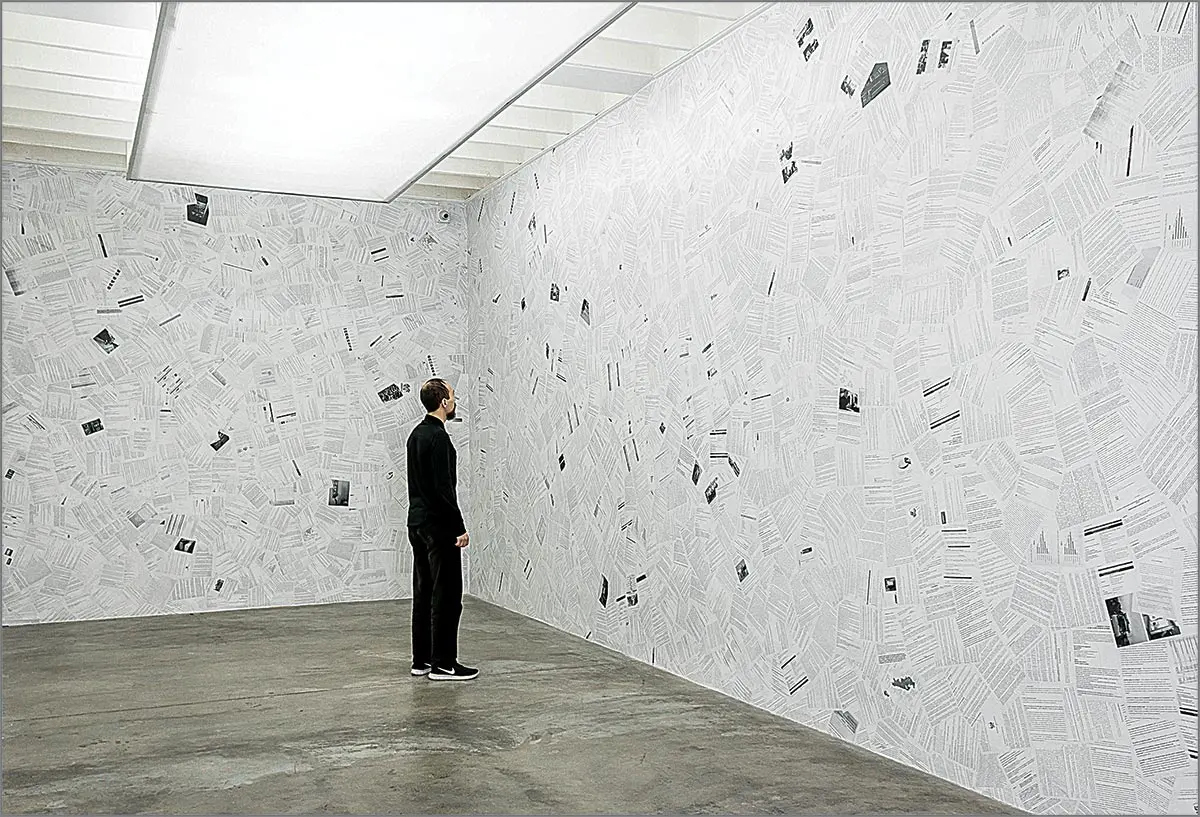
Also worth noting is Seguridad interior (Interior Security, 2012-2016), an immersive installation whose walls support hundreds of emails intercepted and organized according to the criteria of the datagram, a pattern conceived by Merhi, who proposes different levels of reading, from the initial abstract blot of information in the distance to the magnetic attraction felt by those who stick their eyes to the wall and go layer by layer to disentangle the phrases culled from the no longer encrypted emails.
Recently, Yucef Merhi has participated in several exhibitions and biennials at the same time. Between October 18 and 21, the School of Fine Arts of the Universidad de Castilla-La Mancha hosted his Discursos (Chávez) (Discourses [Chávez], 2016), in which thousands of words from discourses given by the late Venezuelan President are gathered and set in a scale reflecting the frequency of their utterance, against a fluctuating, metaphorical, viscerally purple tide dominated by the word yo (I). Also in Cuenca, Merhi took part in the La Situación 2016 arte por-venir International Meeting, presenting Facial-Poetry, where the gestures of several participants are translated from a gestural language to a musical and even poetic one, in a way describing a much more elaborate concept of ourselves, like a “mirror of consciousness.”
Between October 14 and November 10, Merhi developed two different projects for the H15TORI1A_IRR4C1IONAL_D3_UN_CONJUN78_D3_M3DID4_NUL4 group exhibition at the Centro de Desarrollo de las Artes Visuales in Havana, which focused on the mass analysis of data, a trend in today’s world that gains considerable importance when translated through the prism of contemporary art. On this occasion, Merhi is able to develop one of his most algorithmically complex projects: Too Good to Be News, combining headlines from The New York Times and National Public Radio with verses written by the artist to create a kind of random grammatical structure that allows data to bloom like evanescent 15-second poems.
Merhi is also presenting Quetzalcóatl 2.0.1.2., an exhaustive research project around the mythical deity of its title, worshipped by several Central American cultures and the protagonist of an unending stream of images and texts from colonial times to the present. This D.A.T.A. universe is gathered and translated in real-time by the artist into a programming language, converting Quetzalcóatl 2.0.1.2. into a work of Sound Art and ten other projects launched from a variety of platforms, and even hacking a NASA satellite in order to take us on an initiation journey into the now. Quetzalcóatl 2.0.1.2. was also exhibited at the 9th SIART International Art Biennial in La Paz (Bolivia), from October 11 to November 11.
Yucef Merhi continues to search for the code that will allow us to approach, in a direct and immaterial way, our very human condition, that which is beyond what we perceive and are: our “consciousness.”
ELISA RODRÍGUEZ CAMPO