Theorists describe the transition from a figurative language to the abstract model as a process of synthesis or distillation through which the representation of reality is transformed into an autonomous artistic conception, independent of the external world. The elements of visual expression cease to be vessels for meaning and become thematic objectives in themselves; the narrative hinges then on the means deployed for handling lines, color, planes, and other components, perceived as the protagonists of the pictorial scene. In that context, the exhibition Adrián Pujol, Apuntes abstractos (Adrián Pujol. Abstract sketches) is a point of reference for the stylistic shifts that are driving forward the artist’s process. Presented at Beatriz Gil Gallery, the exhibition features 74 small- and medium-format oil paintings created mostly between 2007 and 2013, with some sketches and studies from earlier dates.
Since his arrival in Venezuela in 1974, Pujol (Palma de Mallorca, Spain, 1948) has amassed a considerable production that encompasses several different facets. Early on in his career, he dealt with issues associated with the culture and the dehumanization that comes as a consequence of urban development, the allegory of everyday objects, and other matters connected to modernity and its supposed civilizing role. Later, in the 1980s, Pujol became interested in landscapes, a genre he explored with dedication and resolve for more than two consecutive decades. Imbued with the exuberance of tropical nature, his panoramic vistas reveal quick impressions and saturated chromatic references. This is why in 2006 he was invited to Villa Planchart—also known as Quinta El Cerrito, a paradigmatic exemplar of avant-garde architecture in the country—and to paint from that vantage his vistas of Mt. Ávila, the peak that dominates the Venezuelan capital’s grey horizon. But his encounter with this emblematic residence motivated Pujol to stamp on his canvases geometric designs interspersed with the housing spaces. Projected in 1957 by Italian architect Gio Ponti, this example of the integration of the art houses works by renowned authors of the era and caught Pujol’s eye. He had become sensitized to the concrete image years before, however, when in an unplanned manner he began to sketch grids, structures, and doodles in his notebooks, without a predefined or explicit goal, while chatting on the phone with various friends and interlocutors. After doing a comparative analysis, the artist detected parallelisms between those playful exercises and the frames he captured at Villa Planchart.
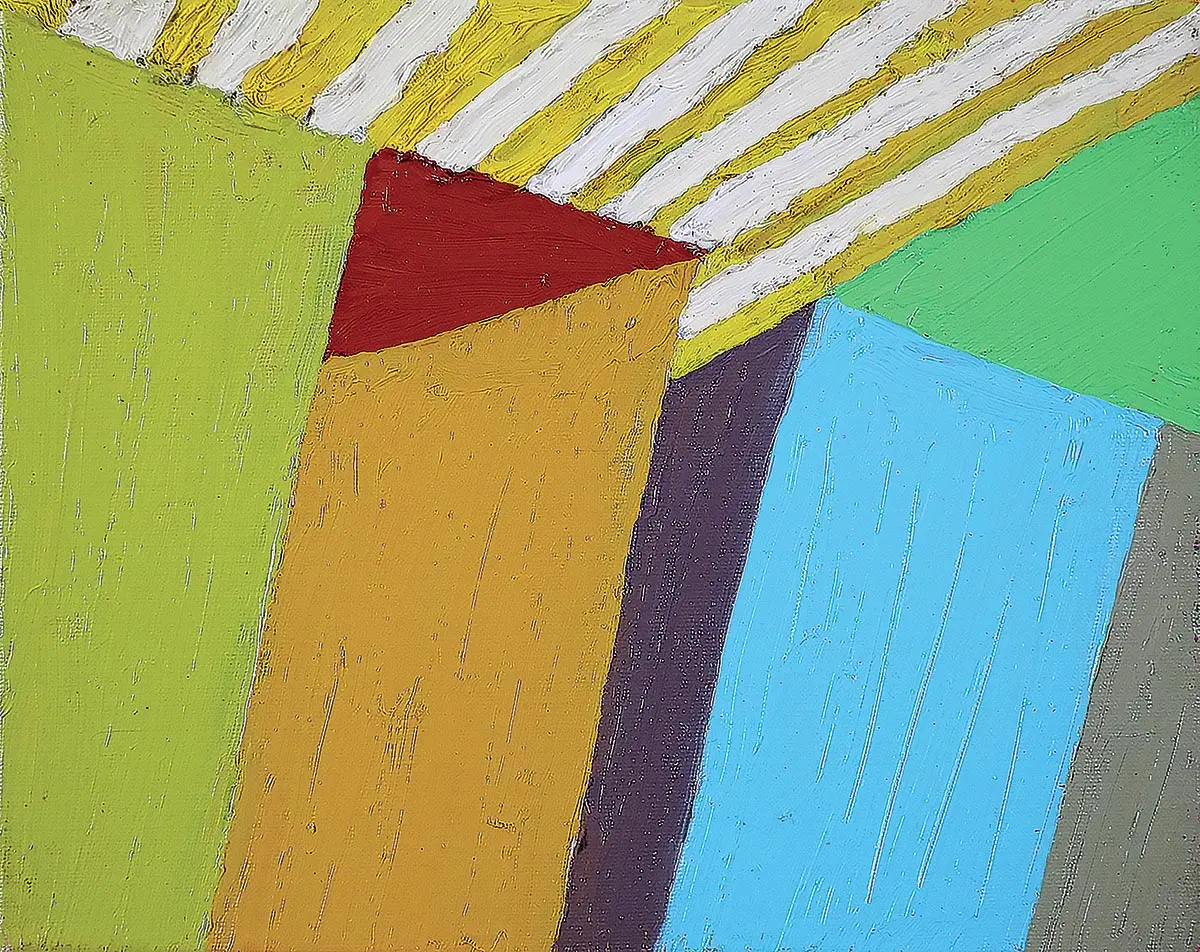
These two currents comprise the content of the exhibition, grouped into two categories: Chez Planchart and DHT (Dibujos hablando por teléfono) [DHT (Drawings Made While Talking on the Phone)]. The former alludes to the different angles of Villa Planchart, with titles such as Cocina (Kitchen), Puerta (Door), and Techo 1 (Ceiling 1), created in 2007, and Techo 6A (Ceiling 6A) and Espacio 2B (Space 2B), from 2010. In turn, the DHT series, which includes S/T, 269 and 313, among other works created mainly in 2013, is a selection of thirty graphic elements extracted from notebooks the artist has kept since 1997. Both sequences are characterized by an asymmetry that gives whole group an organic character and a suggestive displacement of forms, circumscribed to a customized range of hues. About this, show curator Ruth Auerbach writes in the catalog essay: “Pujol focuses—paradoxically—on the coincident reticular order in order to transgress its meaning of aesthetic purity in an instance of experimental freedom, dismantling the inflexible precepts of geometry, formally desecrated by means of a pictorial gesture that captures new perceptions of the represented object…”
From this perspective, his discourse formulates a new dual semantics for the proposals of constructivism, since it breaks down and details the works, installed as murals or architectural interventions, with which he interprets, from a particular point of view, the original project through techniques and scales in new dimensions. On the other hand, it suggests a rereading of the tendencies that implemented new visual codes in the Venezuelan scene in the mid-Twentieth Century. “Sixty-five years after its peak,” the artist declared to the press, “geometric abstraction is already a classic, an established aesthetics. I have seen that those who use it today don’t do it as a copy or a repetition, but in response to the evolution of the canon, with common elements, and this is why I came up with the name of ‘The Concurrent’, a term that [Claudio] Perna had used already but in a different way…” In that sense, both in his figurative period and in his most recent works, Pujol shares the revisionist positions that take into account critical thinking and a reflective attitude, distinctive features of artists who emerge in the last decades of the Twentieth century and the early Twenty-First.
GLADYS YUNES YUNES