
The small gesture as a form of resistance is the core of the exhibition titled Some Forms of Friendship, a proposal by Aimée Zito-Lema (Amsterdam, 1982) at The Goma Gallery, curated by Violeta Janeiro.
History, with capital “H,” uses ellipsis to suppress affections, emotional articulation of events, and small biographical details. Through a syntax that gathers fragments and enlarges them, Aimée Zito-Lema suggests a rereading of some events that took place in The Netherlands and Argentina (Zito-Lema was born in Amsterdam and grew in Buenos Aires). In this manner, the exhibition display perfectly accompanies the vindication that pulsates in all the works: small subversive acts as the first steps of a greater political movement.
The exhibition presents three groups of works based on this type of collaborative process. De la Serie de Gestos – El Cuerpo Suversivo (From the Series of Gestures – The Subversive Body) is one of the most striking pieces of the show, and the first one welcoming visitors upon entering the gallery. It consists of an installation with archival images of manifestation from the 1960s and 1970s. The largest photograph is a life-size image resting on a pinewood pedestal as if it were an actual person. We observe the image of a girl’s body. The references to a coffin and the physical presence are set in contrast to the proposal’s documentary and conceptual content.
Right next to it, the 2016 piece Sin Título (Maximiliano Kosteki y Darío Santillán, Asesinados por la Policía en la Estación de Trenes de Avellaneda, Provincia de Buenos Aires, 26 de junio de 2002) [Untitled (Maximiliano Kosteki and Darío Santillán, Murdered by the Police at the Avellaneda Train Station, Province of Buenos Aires, June 26 of 2002)] consists of an image of the feet of Maximiliano Kosteki, a fallen victim of police brutality during the repression of a march demanding greater social support for the most disadvantaged classes. The work is an interesting reflection on the role of visual culture as instrument for denunciation but also as generator of a specific ionosphere.
Equal parts performance and archival photography, the piece titled Rond de Jambe included photographs of acts of protest that took place in Amsterdam between 1979 and 1986 in response to the construction of the Stopera building, today destined for the performing arts. In addition to this graphic testimonial, there are photographs of a dancer accompanied by a group of participants who perform choreography based on those protests. In this manner, a line is drawn between demonstrations as a collective dance and dance as an act of physical resistance.
One of the most compelling pieces - because of its fragility - is De la Serie de Gestos - Categorías (From the Series of Gestures — Categories). It consists of small photographs focusing on details: interlocking hands in a maternal manner and resting and moving feet. It is an iconographic repertoire of gestures that articulate any movement, any union, and, consequently, any revolution. Here is the driving force in Zito-Lema’s work: the enormous strength of the body in everyday situations and its relationship with other bodies as principles for a history-altering political movement.
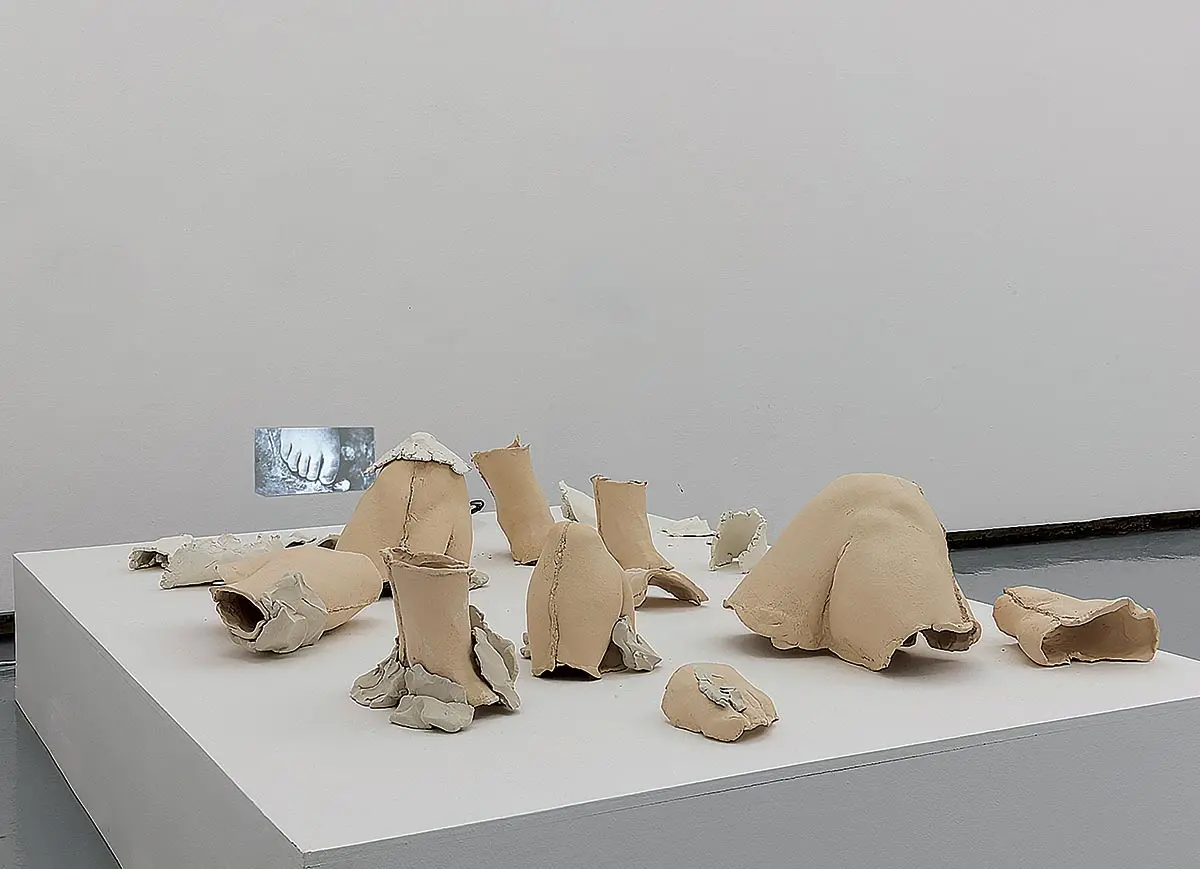
The piece titled Algunas Formas de Amistad (Some Forms of Friendship) - which the exhibition is named after - combines several ceramic pieces with a video projection. Here, we once again find the idea that articulates the entire curatorial discourse: affection as the basis for form, idea, and movement. Zito-Lema’s families and friends have modeled the pieces. Clay fragments have been added to the pieces by the artist’s own daughter. On the wall in the background, we observe the initial drafts for a Greek sculpture that alludes to the classical canon. In this manner, two visions, one alluding to the history of art and the other to the history of Western beauty, are contrasted. At play are the great stories, mimesis, and the traditional aesthetic canon (constructed with an external, bifocal, and anatomically idealized view), along with a more postmodern gaze in which the canon is interrupted with autobiographical elements, small gestures, anecdotes, and contingencies. The very manner of exhibiting the piece is very eloquent in this respect: several objects contrapose the “phantasmagoric” aspect of the black and white projection on the aseptic wall. These objects have been disorganized, mixed, and stained (by the hands of several people) as a result of the force of work and of an intimate biography.
It is not easy to write in current times about late postmodernity (if we can at all refer to our historic movement in that manner). It is not because it would appear at times as if excessive reflection on narrative, artistic, and metalinguistic mechanisms hides the aesthetic experience or the development of the artistic occurrence. Likewise, it is difficult to find curatorial proposals that do not suffocate the power of the works. The exhibition Some Forms of Friendship succeeds in constructing a clear and powerful narrative with simplicity and energy.
ANA FOLGUERA