
After a successful sojourn in São Paulo, the exhibition Alair Gomes: Percursos (Alair Gomes: Journeys) alighted in the photographer’s native city of Rio de Janeiro. Curated by Eder Chiodetto, the exhibition brought to Caixa Cultural almost three hundred photographs taken by the artist over a period that spans from the 1960s to the late 1980s.
Born in 1921, Gomes started as a photographer in 1965 and produced 170,000 images until his death in 1992; the majority of those images remain unpublished due to issues of authorial rights and of image reproduction. The photographer gained international recognition after the São Paulo Biennial devoted a large gallery to his work, curated by Luis Pérez-Oramas, in 2012. Since then, MoMA has acquired some of his works and studied his production.
The exhibition presented the Rio public with several series of photographs revealing a variety of approaches, yet all dealing with Gomes’ greatest obsession: young, athletic, nude male bodies. As one walked leisurely along with the exhibition space, the photographer’s insistence on the subject was evident in an expography that opted, fortunately, for organizing its material in ways not always linear. Although one could say that each section of the exhibition dealt with one of the various series, it was interesting to note that the sequences of images on the surface were varied and that the empty spaces between the images were incorporated as a composition element.
This observation may seem trivial, but isn’t: frequent visitors to photography exhibitions know how big a challenge it is to arrange prints on architectural space. Alair Gomes’ extensive production happened in relative isolation, be it through the photographer’s lunge towards the photographer in the most studied of his images, produced inside his apartment, be it in Gomes’ frequent act of urban voyeurism, photographing men from his window. This mode of spatial organization, it seems to me, endorses a certain “domesticity” in his images and impedes their monumentalization, given the already austere environment of the white cube.
Among the photographs on exhibit were widely circulated images, such as the Sonatinas, four feet series (1970-1980), and the Beach Triptychs (the 1980s). The former features small-format photographs that, presented in sequence, create a temporal narrative. Yet, the gestures photographed are banal and the distance between the photographer’s body and the men that are his subjects contribute to a general lack of dramatics. The use of black and white also induces a silent gaze upon those bodies; almost in every case, two youths stand one in front of the other in seeming conversation, exercising in the intervals. Already in Beach Triptychs, the use of black and white, added to the camera’s proximity to the models, enhances the image’s sculptural character of the image. If in the Sonatinas the men were part of the sports landscape of the city, here they are the main dish, presented to the public gaze as pieces of meat. These are different ways of perpetuating certain modes of expression of the male body’s virility in Rio de Janeiro.
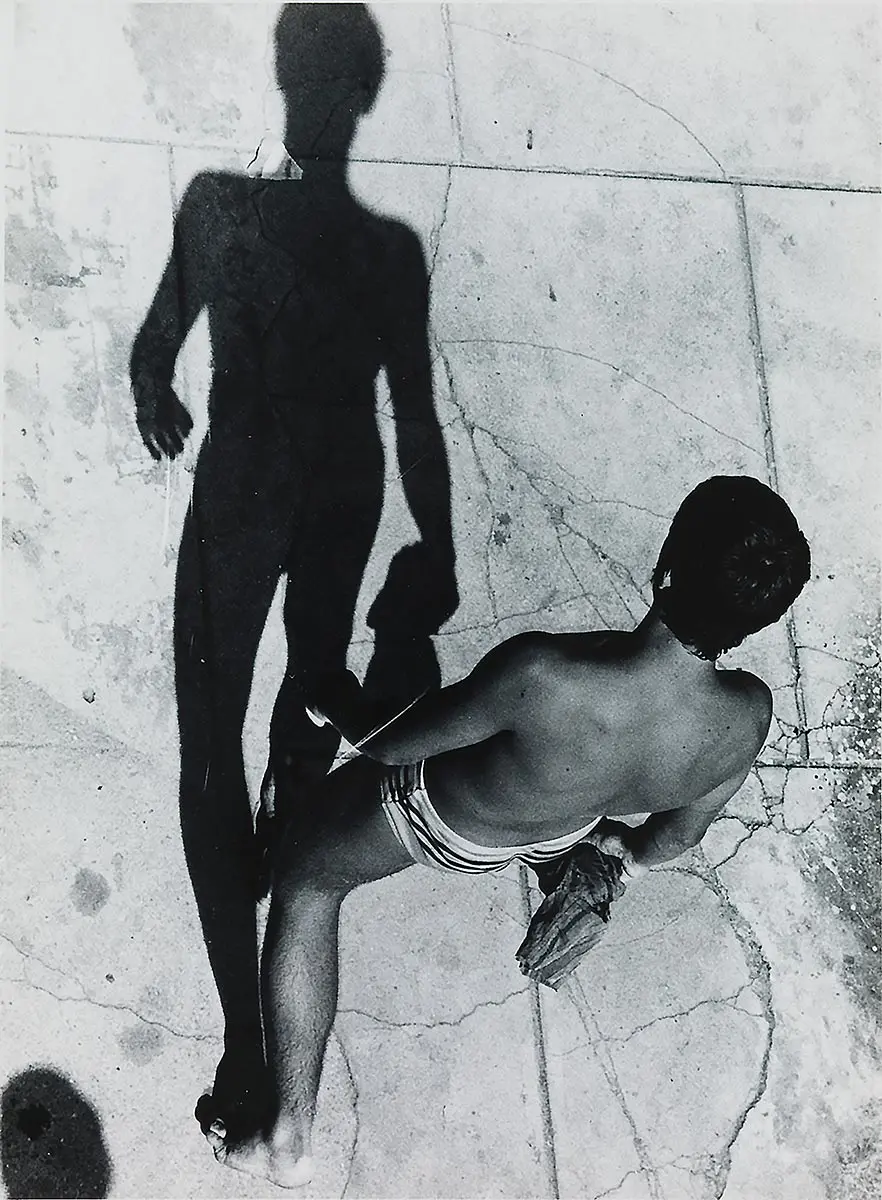
The sun is another protagonist in the series The Course of The Sun, which Gomes also created from his apartment, now with the intention of capturing a specific body in motion. Photographed always from above, the bodies again are presented in a monumental way, yet in this case in an asymmetrical perspective. The shadows extending on the ground demonstrate the power of heat in the city, and the absence of any facial frontality in these men can refer to the physical growth of the city and the number of anonymous individuals in it. From the light in public spaces to the light of reflectors in his bedroom, it is in the series Symphony of Erotic Icons (1966-1978) that the nude body appears explicitly in Alair Gomes’ work, set by the curatorship in counterpoint to the photographs he produced about classical statuary in Europe (A New Sentimental Journey, 1969). It is interesting to note that the ways in which Gomes framed the statues’ marble genitalia and that produced by physical activity and bourgeois leisure in Rio de Janeiro move in the same formal direction.
Finally, a number of seldom exhibited or altogether unpublished series were also present in this show. Esportes (Sports, 1967-1969), where athletic male bodies again jump at our gaze, and in an even more surprising way, Hippies – Feria da República (Hippies – Fair at República, 1969). The latter is particularly interesting for being devoted to observing an urban space marked by the cultural and sexual experimentation that the hippie culture fostered. These are the rare moments when the female body and the possibility of photographing age groups beyond the usual ephebes are present in the exhibition. Beyond this, the fact that the subjects of these photographs are not nude or seminude is another difference.
One leaves the exhibition with an obvious verification: Alair Gomes is a great creator of images. His sharp gaze and his obsessive wait for the ideal moment for the shot generated both great quality and great productivity. His work, however, can also be seen as in dialog with matters that appear often in the contemporary era in terms of the contemplation of images, which prompts some questions: What space remains for non-athletic male bodies in Gomes’ work? What is the place of women in his aesthetic interests? Why is it that in the series The Course of The Sun, where all the bodies were black bodies, faces were not in view?
This is not, please note, an anachronistic critique of Gomes’ work, but an effort to highlight the fact that perhaps his images are able to bring to the fore, for instance, the racial tensions that existed between Rio de Janeiro beachgoers in those years, 1960-1980. On the other hand, his images can also be seen as interesting objects of study to illuminate the machophilia that pervades Rio de Janeiro culture, in particular Rio’s male gay culture.
Many other pathways can be followed on the basis of the great Alair Gomes’ images. Perhaps a wider unveiling and knowledge of his work (as this exhibition effectively achieved) will generate new critical approaches.
RAPHAEL FONSECA