
There is more than one Andrés Orjuela. Each exhibition of his works reveals the existence of a different iteration—which, far from being a contradiction or a betrayal of his deep self, is the artist’s declaration of principles: trial and error, finding the right solution, lucidity, excess, counter-style, experimentation, anachronism, the future, a ceaseless search. Orjuela takes interruptions and free-floating drifts and makes them the distinguishing characteristics of his trajectory as a visual artist, always eschewing the temptation of “finding a style,” a common pitfall for today’s artists in an art market in need of names that can be made into brands: exotic, singular, and cohesive.
Andrés Orjuela’s exhibition at Espacio El Dorado in Bogotá presented us with three of the artist’s facets, one per floor, each corresponding to a different moment in his career. The gallery’s lower level featured a series of large-format photographs depicting Day of the Dead flower arrangements in Mexico. The beauty of the flowers, presented aseptically by the artist, against an absolute-black background, allows no glint of the mantle of suffering and tragedy behind them. The visible image of the flowers appears to us like a mirage, interrupting our direct communication with the events and the circumstances, as is the case with the majority of images we glimpse in the mass media. The second floor was devoted to a series of paintings based on headlines from Mexico’s tabloid publication Alarma: for the first time in a long while, Orjuela moved here from graphic experimentation to pictorial support. This series is part of a project created specifically for Espacio El Dorado.
On the third floor, Orjuela presented two of his most potent series: Muestrarios (Samplers) and Constelaciones (Constellations). In Muestrarios, Orjuela spent a year clipping images of blood that appeared in Mexican print media and cutting small circles of red ink and then arranged these pieces on small glass plaques of the kind used in clinical labs for blood sampling. By installing the plaques in the gallery, Orjuela gives each victim a place of dignity: pristine, diaphanous, permanent, almost minimalistic, clearly distinct from the images of wounded bodies, decapitations, and rotting organs seen daily in the Mexican yellow press, with its habitual naturalization of violence. In this series, the blood-drenched photographs found in those media go from being mere sensationalistic hearsay, a scabrous urban legend intended to shock its readers, to being a methodical, clinical, historical, and poetic register, restoring in the social realm the dead person’s humanity, which had gotten lost in the relentless succession of images of dismembered corpses.
In Constelaciones, Orjuela reconstructed the positions of the stars on the sky on different days, in the manner of an astrological chart, playing at being the prophet of an uncertain future. The stars were created using droplets of blood-red ink clipped from the Mexican press every day of the year. Each corpse and every drop of blood became a star in the sky on the day of their death, and each star is a different victim, coming together in a single tragic, sordid, gray constellation that, at the same time, is not made of real blood but of an accumulation of symbolic representations: it is air, ether. These different constellations of victims seem to configure the only possible horizon of meaning for a nation.
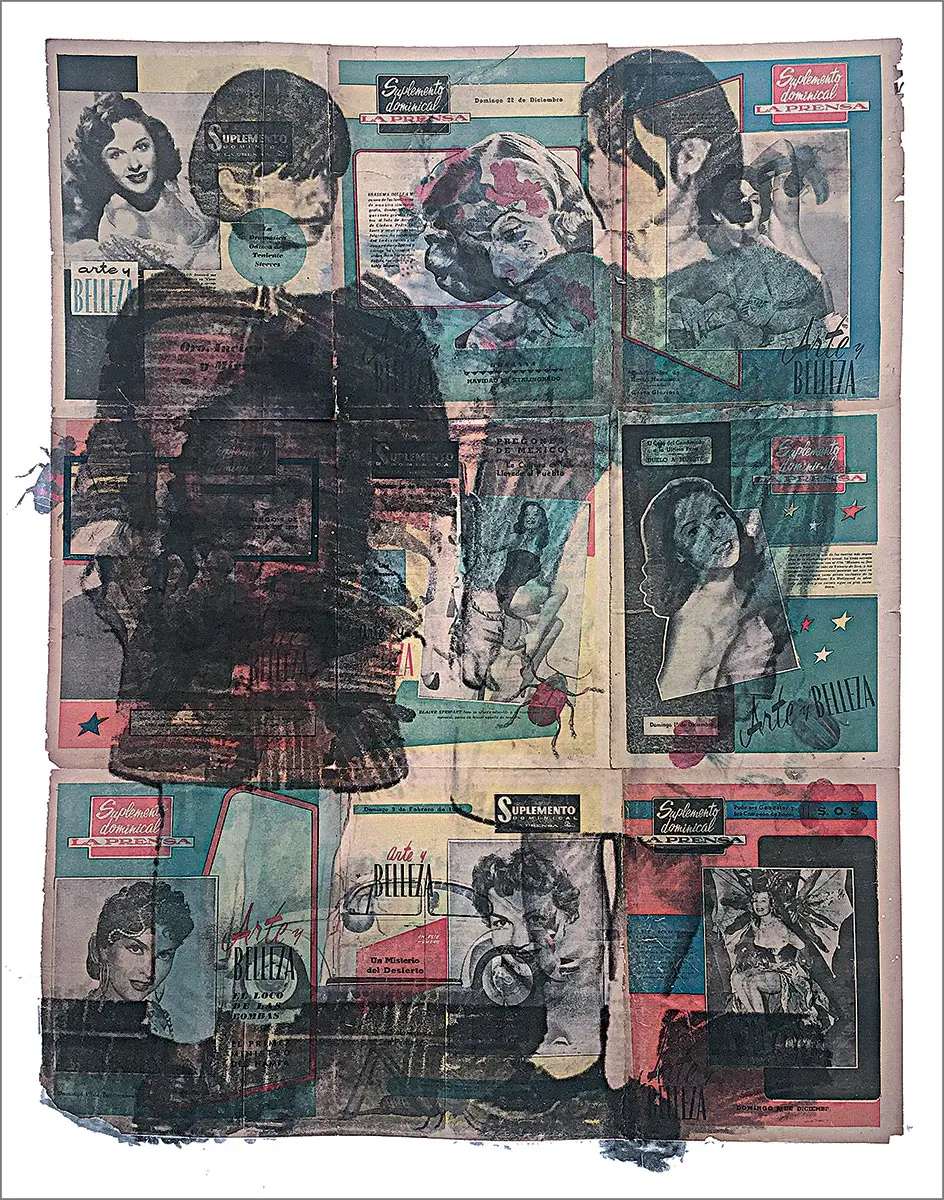
In the hallways of the gallery, Orjuela arranged several of the trials runs he made, using transfer techniques, for his most recent works. The artist used covers from sensationalist Mexican publications from the 1960s and 1970s, featuring scantily clad women in erotic poses. We are reminded that the sensationalist media plays simultaneously with the grotesque and the erotic, with blood and sensuous female bodies offered up for the satisfaction of male desire. In this new series, Orjuela sets aside the grotesque aspect of his yellow-press sources—which characterized previous photographic series like Archivo muerto (Dead Archive) or A través del espejo (Through the Looking Glass)—and focuses on their erotic side, with its hidden historical layers.
On the breasts, buttocks, and beckoning faces of the blondes on those covers, Orjuela imposed (via transfer) images, culled from photographic archives or from the press itself, of women being processed through the judicial system for their participation in social protests. On a single surface, Orjuela plays with the idea that women who are outside accepted norms are only socially palatable when they satisfy the male desire. Those shackled women going through the courts appear as ghosts on the eroticized covers, like a kind of palimpsest that is revealed for us only after we scratch the surface of the magazines in question. Orjuela helps us discover the historical and social roles that are hidden behind the models’ sensuous poses, as well as the way the sensationalist press functions as an instrument for a male-centered system of production and consumption, which in turn builds a specific imagination of maleness and plays, conveniently, with socially permitted female roles.
Despite the differences between Andrés Orjuela’s various series on exhibit here (the dissimilar supports and techniques used by the artist, which could distract visitors unfamiliar with his career and repel commercialized gazes in search for an identifiable, profitable “style”), the fact remains that, beyond its reiterated references to violence in Latin America, Orjuela’s work is a grand pronouncement about the idea of the archive, and obsessively crafted manifesto about the way in which archives have hidden layers of meaning that escape the superficial immediacy of the mass media.
Each image glimpsed for a few seconds in the print press or on TV hides histories of repression, silencing, concealment, trickery, or transposition, implicit to the reality depicted or to the photographic image itself: the support, which can at times tell stories as tragic as those of the violence it depicts. With his recourse to different printmaking or illustration techniques (critically using graphic methods of the past or creating new ones in his experimentations,) Orjuela seeks to unveil the ghosts that lie beneath the images of the archive; to bring out the specters of the past that can help us deconstruct and critically reconstruct the official story; to help us recover veiled, often abject stories, and to reinforce their inscription in the collective imagination, confounding their normalized meanings and readings and subtracting them from the frenzied circle of production, circulation, and mass consumption of representations of violence in our continent.
This thread runs through Andrés Orjuela’s work as far back as his graduation thesis, titled Republicanos (Republicans, 2004-2006), where he used plaster and liquid cement to engrave images of the Andean condor as it appears on the shields that adorn the entrance to government buildings (as well as the seals on official paperwork in the Nineteenth Century), and all the way through his series Archivo muerto, made on the basis of the original photographs of violent episodes reported in the Colombian tabloid El Espacio, whose archive was decommissioned after the publication’s demise in 2013 and later salvaged by a Bogotá antique bookseller, who gave Orjuela some of the images. The artist then blew them up to an outsize, unnatural format and colored them like old family photographs, thus magnifying and breathing new life into them, turning them into a collective family album and revealing the ways in which society loses its memory, the way in which life and photo archives perish. That interest continued in A través del espejo (2015), based on an archive of negatives obtained in the Bogotá Flea Market. The vast, varied, beautiful, and tragic repertoire the artist has gifted us over the course of the last decade will surely bring forth, as always, a new—equally varied, beautiful, and tragic—Andrés Orjuela. We shall see.
HALIM BADAWI