
In my long conversation with Antonio Turok, I am reminded of Slightly out of Focus, Robert Capa’s unforgettable first-person narrative of his adventures and misadventures in various WWII fronts told with a certain gaiety, where humor and tragedy overlap as war becomes a site for both absurdity and hope.
Turok, a descendant of Russian Jews who fled first for the United States and later for Mexico, experienced first-hand some of Central America’s most painful episodes in recent memory. He was with the Nicaraguan Sandinistas in their fight against the Contras, an asymmetrical confrontation between a small, impoverished, already war-weary country and the world’s most powerful nation. In the streets of San Salvador, he witnessed the FMLN’s intense 1989 offensive and recorded the ferocity of urban combat. He documented the indigenous genocide in Guatemala during those same years, as well as the massive displacement of the country’s population into Mexico. On October 12, 1992, the very date of the 500-year anniversary of the European arrival in the Americas, the population of the Mexican city of San Cristóbal de las Casas took down a statue of Conquistador Diego de Mazariegos, beheaded it, and dragged it through the streets. Turok’s later portraits of Sub-Commander Marcos, in hiding when a TV crew interviewed him in the rainforest in 1994, reveal the penuries endured by the Zapatista movement and its leader’s evident physical exhaustion. The contact sheet from that day, featured in this exhibition, illustrates the photographer’s skill as a portraitist, his ability to describe the psychological profile of a man whose face is always hidden.
A witness to the Cold War in the tropics and its shift towards today’s globalization, almost a decade later Turok found himself, by a twist of fate, at ground zero of our current era. When tragedy struck on September 11, 2001, he was in New York City shopping for photo equipment. That morning he struggled to get to the site, taking photographs and wondering whether he, who had seen so much war, had come to die in Manhattan.
Turok’s images of birds in disconcerted flight around the enormous column of dust, smoke, and debris caused by the collapse of the towers, and his photograph of dust-covered, exhausted firemen defeated by the sheer magnitude of the event, connect with the photographer’s long history of extreme moments witnessed. His archive of struggles and skirmishes ends with images of the 2006 teacher uprising in Oaxaca, a fiery clash that lasted over months yet is seldom mentioned today (even though it flared up again, albeit at a smaller scale, precisely ten years later, in 2016.)
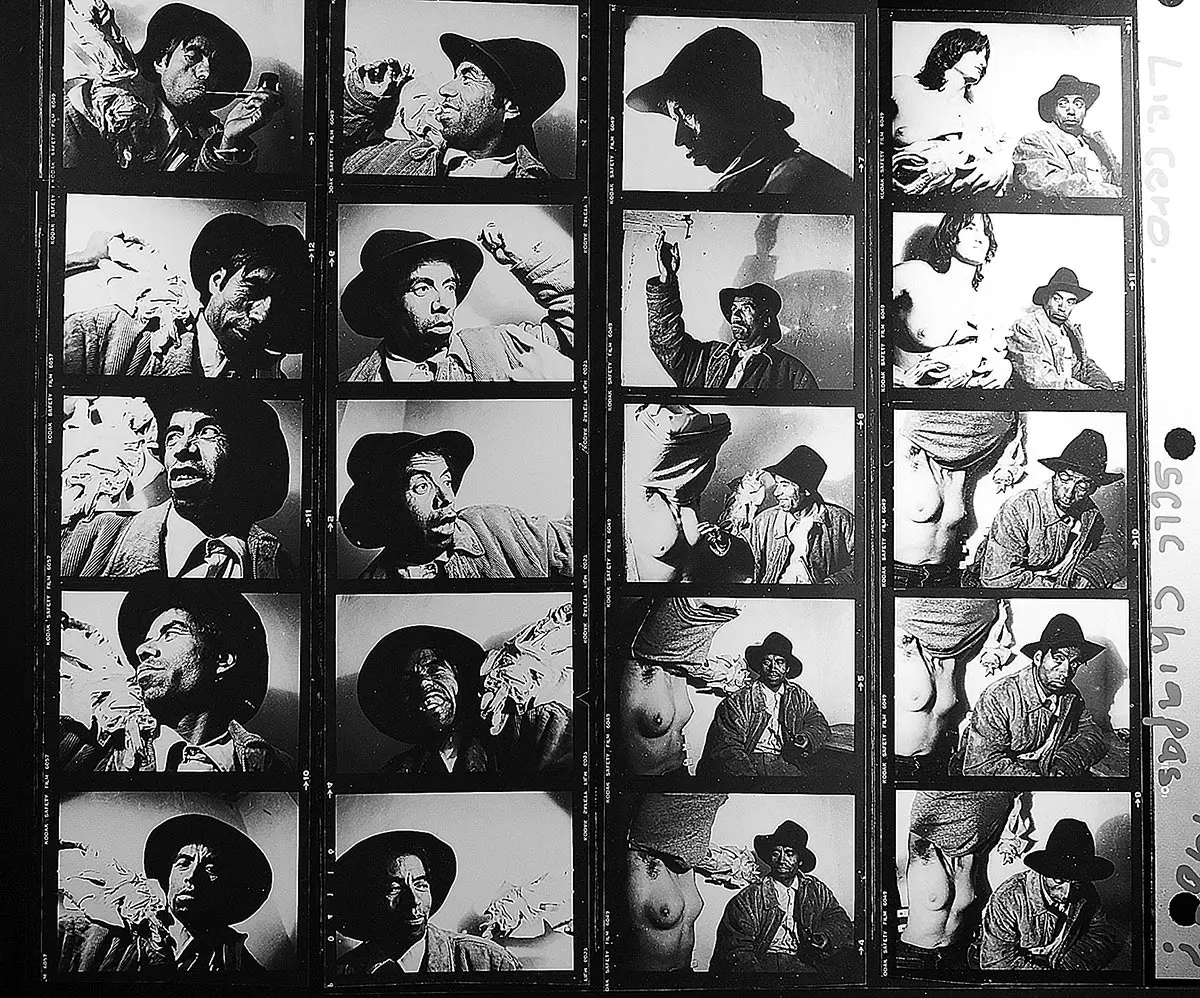
The exhibition, however, is not limited to those themes. In Chiapas—where he lived in the 1970s when that Mexican State was much less visible to the world—Turok developed a unique register of everyday life among indigenous people, which is also featured here. Among his images from that decade is the Fantasmas (Ghosts) series, comprised of long-exposure shots where elusive figures walk the village streets. The heart of the exhibition, at least for me, are the contact sheets presented alongside Turok’s archival material, in a kind of darkroom on the second floor of the Museo Archivo de la Fotografía de Ciudad de México that houses the exhibition. One series in particular: the register of a session in the dark rural night where a peasant man is portrayed next to a white woman unabashedly baring her breasts. The resulting dynamics, the young woman’s splendid brazenness, and the incredulity of the drunken man turn us into witnesses to the tension between modesty and desire; the session brings to mind the games played by the surrealists. As in his portraits of Sub-Commander Marcos, Turok’s skill in creating situations and then deciding where to place himself and where to shoot his camera in order to unveil human emotions—in this case, singularly naked ones—are in ample display here.
A privileged witness to human cruelty, Turok is also an artist capable of revealing the subtleties of our character and our mind. In his words, these sessions took place “when we were bored and started to play.” In this way, an exhibition is structured between tragedy and sweetness, between irreverence and terror, between solidarity and inhumanity, between joy and despair. Marietta Bernstorff, who created a masterful retrospective, successfully curated the show—it is perhaps inevitable to label it so—that does not move in a strict chronological sequence but responds to temperatures and climates where the geographic and the human, the social and the territorial, appear like a map of feeling and emotion. The more than two hundred images, largely in black and white, that Bernstorff chose include not only period works but also current material, which makes it possible for viewers to examine the characteristics of analog and digital photography, this is to say, the very evolution of the photographic. The exhibition includes bibliographic and field material and presents the quiet but invaluable trajectory followed by Turok’s life.
At the end of the show, it is impossible not to think of Turok’s contemporaries in the Sandinista revolution, Lou Dematteis, Susan Meiselas, and Pedro Valltierra; the later just had at an exhibition at the MACO in Oaxaca, in a show that also covered the conflicts in Nicaragua, El Salvador, and Chiapas. In sum, Turok’s exhibition drives us to reconsider the importance of those who have traveled to and witnessed places and situations that most of us refuse to confront. At the same time, as I mentioned before, Bernstorff has treated the photographer’s poetic vein, sense of humor, and propensity for controlled madness with the full respect they deserve.
SANTIAGO RUEDA