
The first marvel of this installation was the way it was as appropriate as it was elegant in how it intervened in the architecture, inviting it to give more of itself than it normally does. Thanks to its intelligence, we discovered something that routine or distractedness often make us overlook that the Museo Nacional de Bellas Artes building in Santiago de Chile is a veritable discourse in stone, the silent eloquence which triggered, paradoxically, an installation as light as to be weightless, aerial, immaterial. Titled Libertad, igualdad y fatalidad (Liberty, Equality, and Fatality), it featured the four poles of a sailboat, with their corresponding sails hanging from the museum lobby’s vaulted roof and walls. The sails were inflated by the action of discreetly camouflaged fans. The sailboat had no hull. To suspend in the air the sails of a half-real, half-imaginary boat, at the heart of a building as solid as it is anchored to terra firma, was a poetic operation. It brought together and invoked the disparate powers of metaphor and metonymy to unleash, as I said, the discourse and the rhetoric that the museum’s architecture sets in stone and its beaux-arts ornamentation were a way to intervene history with the liberating resources of poetry. And I am referring here to two senses of the term history. In a restricted sense, as a set of coherent narratives of past events. Narratives that tell us that the Museo Nacional de Bellas Artes is, from an institutional point of view, the heir to the Museo Nacional de Pintura that opened in 1880, when Chile, like Argentina, promoted European immigration to the country’s southern regions populated by their original inhabitants, the Mapuche. Narratives that tell us also that the ideals and dreams of civilization and progress that came intertwined to the policy of taking away a people’s land and giving it to others, found an exalted expression in the architecture of the original museum’s institutional successor: the Palacio de las Artes, which opened in 1910, the year Chile celebrated its Centennial as an independent republic.
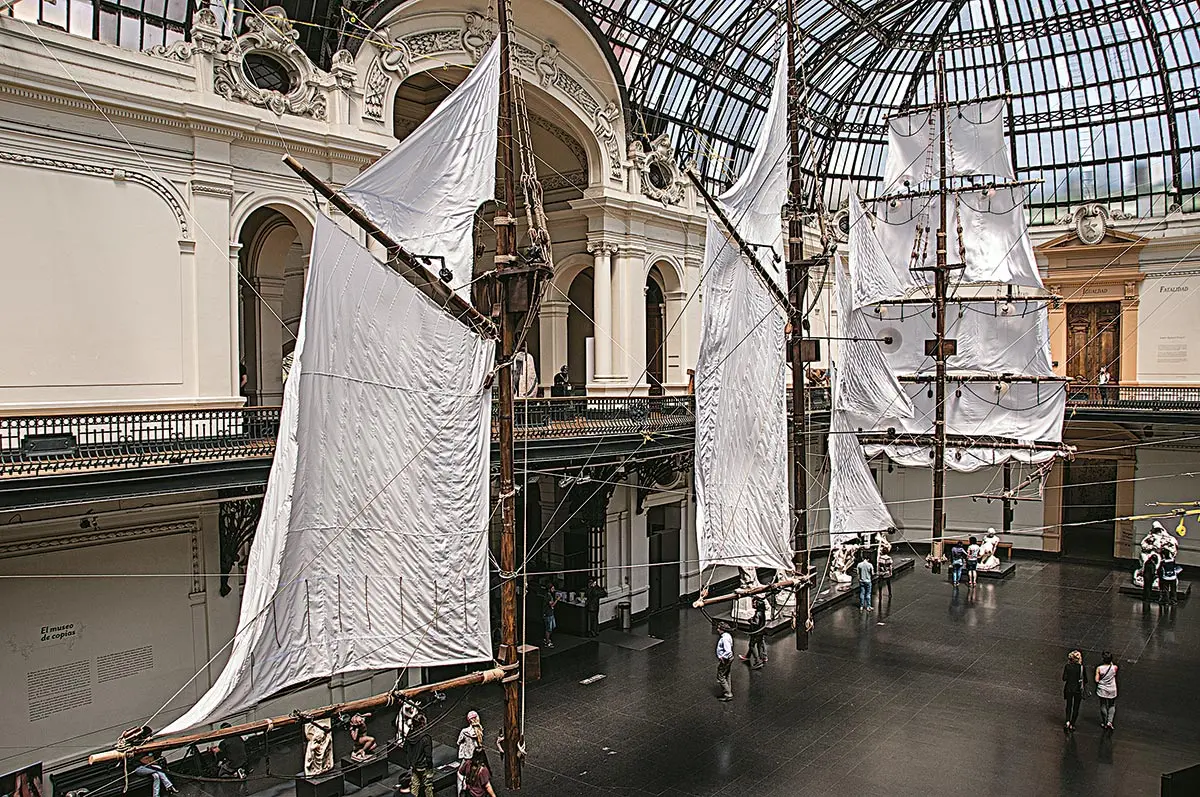
Emilio Jequier, the Palacio’s architect, was the son of a French engineer employed by the Chilean railway; having traveled to France in 1870 to study Architecture and Fine Arts, he was part of the team that designed the Petit Palais, which formed, along with the Grand Palais, the monumental core of the Universal Exposition of 1900, where France sought to present the world with an overwhelming demonstration of its greatness. The influence of that formative period is in evidence in the architecture of the building that Jequier designed as a palace for the arts, now the Museo Nacional. We can even say that it is a mixture, at a reduced scale, of the Grand Palais and the Petit Palais, and that as such it is a child both of its Parisian models and of the Chilean elite’s slavish admiration for them at the time. But this history does not often consider the fact that the ideals and dreams of progress so convincingly embodied by the architecture of the museum could not have had the same meaning for the European workers brought in by those same elites who so fervently adhered to them. For those workers, migration to Chile was the result of an intolerable situation in their own land, so intolerable in fact that they were willing to pay the exorbitant price of abandoning their familial surroundings and their secure attachments as they confronted the challenge of remaking their lives in a faraway, strange country, with no other resources that the labor of their own hands. It is this contradiction at the very heart of the Enlightenment ideal that the artist has conjured up both with the title of his installation—a biting paraphrase of the slogan of that revolution, Liberté, égalité, fraternité—and with the continuous broadcast of La Marseillaise, the quintessential anthem for all who have seen revolutionary France as a model to follow. Except that this time it is sung not by the European immigrants whose arrival in Chile the installation’s sails and poles evoke, but by the country’s new immigrants: Colombians, Peruvians, Bolivians, Venezuelans. Correa’s desire to put on display the historical changes seen in Chile and the world was not the only desire operating in this substitution; the intent is also to signal the “pessimism” that, according to Gerardo Mosquera, afflicts the contemporary world. This moves Correa to suggest that while immigrants today are not the same as yesterday, they have also suffered, like a fatality, the kind of oppression that drives people to impassionedly sing the liberating lyrics of La Marseillaise.
CARLOS JIMÉNEZ