Panamanian artist David Solís has lived for almost four decades in France, where over the past few years he has been painting landscapes reminiscent of his roots, filtered through active imagination and an evocative melancholy. In his most recent exhibition at the Museo de Arte Contemporáneo in Panama, Solís showed twenty oil paintings and fifteen works on paper under the title Shores. The works feature land and sea, as well as cities and jungles, all within an environment of both tropical light and deep, dark reverie.
Shores constitute the border between one place and another, the meeting point between the water and the coast, not a surprising subject for an artist who grew up in a country between two oceans, and who now lives near the Mediterranean. Although some of the waterfront cities in his paintings look familiar, the skylines in Solís’s cityscapes could be in either Europe or the Americas. In his current oeuvre, it seems that the past and present overlap, as do his memories and the real world.
As in much of his earlier work, Solís shows a preference for high horizon lines. In his landscapes of cities by the sea, most of the pictorial surface represents the water, an area in which he gives free rein to fantasy. In some compositions, he fills the “water” with a forest, or with symbolic and real forms, as in the case of Marina with a Floating Market (2012-2014). In others, however, the broad blue surfaces offer a space in which to explore abstraction through varied textures and materials, as in Marina with Black Parapet (2012-2014) where, in lieu of a specific place, Solís seems to paint sensations. It is reminiscent of the famous phrase by the Symbolist poet Stéphane Mallarmé: “Paint, not the thing, but the effect it produces.”
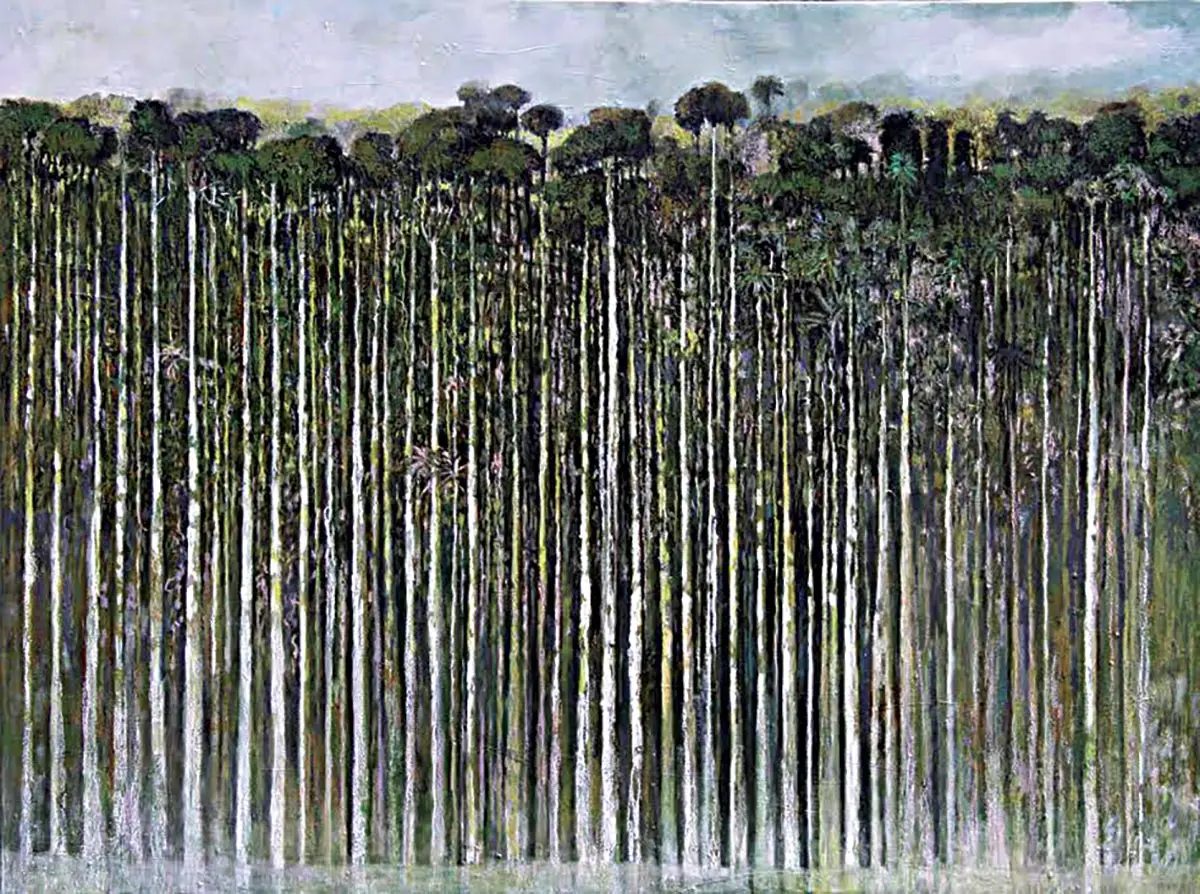
We perceive a similar but even more theatrical effect in David Solís’s jungles. He paints forests with towering trees, creating patterns of vertical lines covering the entire canvas or paper. At the top edge of the composition, in a narrow space, we see the tops of the trees and often a clear sky that offers a visual outlet, an escape from the darkness of the forest They are dense tropical jungles, drawn from both memory and the subconscious. They convey an impressive atmospheric quality, a sense of depth, even a feeling of humidity in the air.
We, the viewers, are the only human presence in these dense spaces that seem to summon us to meditation. This is the case especially in works like Nocturne (2014), where the range of jungle colors disappears, leaving a composition of dark backgrounds and almost white trees with tangled branches. The thickest and most pictorial jungles in the exhibition are to be found in the three paintings entitled Tropical Night I, II, and III (2015-2016), where short bright brushstrokes of red and orange highlight and contrast with the multiple shades of dark green.
In The Jungle’s Last Lights, (2014-2016), Solís seems to be celebrating the rain forest with more luminous colors and a luminous background where a light blue sky shines through. In general, his works awaken a feeling of a deep love for nature, a reaction against urbanization and materialism, like a flag reminding us about the importance of protecting ecological balance. It is particularly fitting that these paintings should be shown in Panama, where the indiscriminate felling of trees in areas like Darien is taking place.
Some of his newest paintings show another aspect of Solís’s exploration of nature. They are macro views of plant forms in which seemingly random patterns fill the composition. They vary from Entrelacs (2014-2016), where crisscrossing branches and lianas produce a dynamic design, enriched by a light blue background that contrasts with the green and yellow foliage. In Low Tide (2014-2016), there is an even more dramatic botanical “grid” with horizontal and vertical forms that seem to be in full and active growth. This new and more dynamic interpretation of nature is also featured in Gleaming Jungle, (2016) with its tangled, confused, and lively botanical forms and lines, but nowhere more than in Nocturnal Fishing (2010-2016) where a jumble of fish comes dramatically close to the all-over patterns typical of abstract expressionism.
Solís has impeccable control over his medium, a fact that is especially obvious in this collection of works in which he combined the use of oil paints, crayons, pastels, charcoal, and graphite. He has a powerful sense of composition, painting in layers and transparencies, as well as with rich surface qualities. He is an artist at his prime, whose exhibition offers up an esthetic exploration through the natural world, but also through the spaces of the mind, from the deepest entanglement to a distant clarity.
MÓNICA E. KUPFER