
The work by Mexican artist Edgar Orlaineta (Mexico City, 1972) has been characterized by monumental comments and temporal and spatial interventions based on the work of some paradigmatic figures from 20th-century design. He draws from the objects (and forms) that have defined the work of those artists in order to create connections and narratives that set the aesthetic of furniture and environments against the historical context in which they were created, provoking in viewers a paradoxical fascination.
The installation History Is Taking Flight and Passes Forever is titled after a desperate phrase written by Isamu Noguchi, a US artist of Japanese descent, during his stay in one of the Japanese internment camps—created in the US after the Pearl Harbor attacks for the internment of Japanese-Americans. The phrase was part of a letter that Noguchi wrote to Man Ray asking him for help.
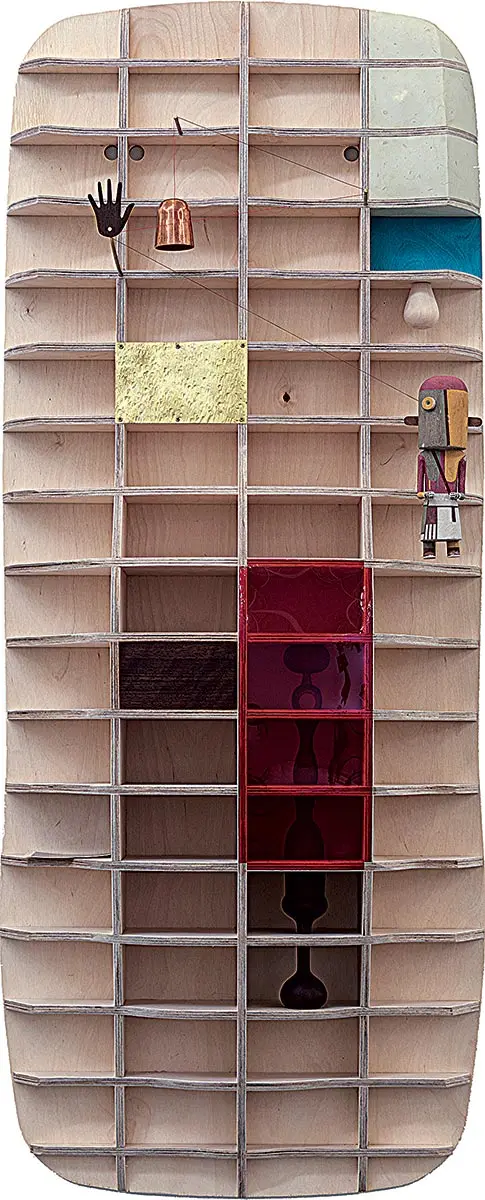
The formal support of the installation by Edgar Orlaineta is based on the assembled sculptures (that stands through the counterweight of its parts) created in wood by Noguchi during the 1940s (when he was ostracized along with the entire Japanese-American population) and used as furniture and for scenographies.
Various objects turned into memorabilia, from clocks patented by Noguchi (that are the nodal reference of a sculptural installation full of nodes) to the illustrated novel authored by Miné Okubo, in which she narrates her life in the internment camp; photos of cult actress Tura Satana; the lamp screens by Ruth Asawa; the miniature cars by Larry Shinoda, among other objects, artifacts, posters and publications of the time that stain and animate the purity of forms arrange like superimposed writing, evidencing the various layers that exist in the historic process (overlapped in order to hide or highlight its content depending on the perspective about the scene of the events).
In another distant and idyllic place, the furniture in the exhibition appear to live, grounded or pulled by the historical documents evidencing an obscure and obscene political agenda and cultural background.
The point of departure of the exhibition—which defines its formal contents and paradoxical meaning—is a photograph that portrays two clocks patented by Noguchi, one white, placed on top, and the other black, placed upside-down, between two painted boards. It is a conceptual play very similar to the fish chasing their tails in the yin-yang symbol. Here, for obvious reasons, they are transformed into a metaphor of time (which goes by in an inexorable manner), only survived by objects, those silent inhabitants that have served as accessories in the different scenarios of modernity.
In the second exhibition room, Orlaineta performs a scenographic revision (in the terms in which its installations are scenographies) of the patterns of the fabric created by Ray Komal (US artist of Japanese descent who also stayed in an internment camp) in 1948 for the New York design house Laverne Originals. Komal’s piece was based on designs of Polynesian masks (which would become an atmospheric leitmotiv in the Disneyland of the comfort of the 1950s and 1960s).
Orlaineta replaces the green color of the original fabric for the greens and earth colors used in the patterns of camouflage clothing (which, by the way, was produced by Laverne Originals during the war). Then Orlaineta transcribes (or transfers) the designs of this emblematic fabric to the white painted wire found in chairs and costume jewelry hidden or blended into with the white cube. It is a commentary about the invisibility in which Japanese-Americans had to live during the war and postwar. The masks reveal and hide the legacy from a cultural group to a visual imaginary of a nation that lives between the paradox of a libertarian dream and the Orwellian control of its masses and minorities. Orlaineta pays tribute to those artists and designers—as he emphasizes the adverse conditions of his experience of the American dream—turned into relics in a world that knows only of appearances that hide the transits, sufferings, and conquests of a country that only find redemption through consumerism.
Orlaineta is obsessed with establishing connections between objects and life. In his work, he has insisted on representing them in display windows where he recreates, redeems, and transforms their narratives. In the reading material displayed in the exhibition room, Willy Kautz emphasizes the way in which Orlaineta “has insisted on thoroughly studying the intersections between sculpture and design, or rather, the relationship between art, handcraft, and industrial production.”
RICARDO POHLENZ