
Enter Conjetura (Conjecture) at Ruth Benzacar Gallery and you will be surprised. Comprised of photographs, monoprints, gouaches, collages, and furniture, Ernesto Ballesteros’ (Buenos Aires, 1963) new body of work represents a shift relative to his earlier exhibited work. The show, as expressed in the title, is a continuous exploration of intuition, an invitation to unmoor perceptions, to experience, to guess, to stop, and to look into each other’s eyes.
The exhibition starts with a series of six brightly colored photographs that dazzle the viewer. On closer inspection, there is something ambiguous about them. They raise questions: how did Ballesteros arrive at such abstract compositions? What is the production process? The answers are not readily evident.
Covered with violet, black, and reddish rounded stains or dots, Untitled’s (2016) circular shape suggests an abstract skyscape. If familiar with Ballesteros’ older work 18448 covered stars (2001), the viewer might suspect a similarity to it. In fact, Ballesteros chose to zoom into the sky section of the original photograph 18448 covered stars (2001) to such an extent that everything is abstracted and one can no longer visualize the real skyscape.
Another photograph, Untitled (2016), depicts a blurred pattern where some large, dark irregular dots emerge from green, orange, violet, pink, blue and somewhat white blurred stains. The images’ fuzziness and the fact that they are grouped in one room might make visitors feel dizzy. The works present some elements of Op Art, as they imply movement, and produce an alluring effect, presenting irregular shapes, although not geometric, that brings to mind natural forms such as amoebas under a microscope.
In fact, Ballesteros has taken 18448 covered stars (2001) as the source for all of the exhibited photographs. He has then cropped, smoothed, and amplified each image until new shapes and colors emerged from the chemistry of the slide. Ballesteros’ treatment of his photographs differs from Thomas Ruff’s Stars series (1989-1992), which are enlarged, unchanged sections of telescopic images of the sky or from Ballesteros’ past series Mosaics (2007 - present) in which various images taken from different angles are grouped to produce more information. In the images presented in Conjetura, the original photograph is completely altered by the artist’s camera, producing a new image that is a mixture of predetermined real and unreal information that transforms the original photography.
Ballesteros’ photographs offer close-ups of distant images, “lo que esta lejos, no esta lejos en absoluto” (“What is far away, is not far at all”), bringing to the viewers’ eyes newly revealed spaces, colors, and shapes that would otherwise defy the naked eye.1
The second room shows a series of calmer monoprints done with watercolor, inspired by the Japanese print technique. They all present circular but irregular shapes. Their number (17) and diversity highlight the artist’s constant exploration as if something were about to emerge, but it is unclear what. The monoprints are contained by frames but they are very subtle, slightly blurred, irregularly cut and off-center - all of which underscores the idea of conjecture. These, and the gouaches, in contrast to the photographs, recall the subtleness, color, and action/movement of Ballesteros’ pencil drawings.
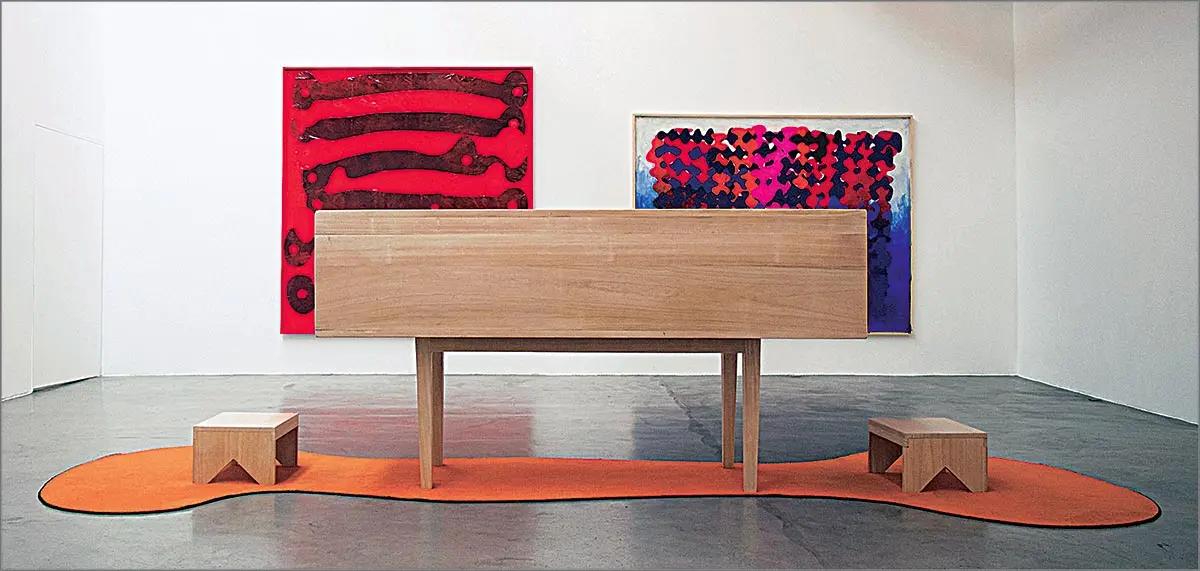
The gallery’s main room features a series of gouaches, collages, and a piece of furniture in the center of the room. The piece consists of a hollow, rectangular 2,5m (8.2 ft) wooden tube sustained by four legs with a small bench at each end that invites visitors to sit and look at each other. It is placed on an orange carpet that has the same amoebic shape present in the photographs and collages.
Here Ballesteros is interested in generating intimacy in the middle of public space, an idea that comes from his experience performing Indoor flights at the Venice Biennale (2015) where in the middle of the turmoil of the Arsenale, Ballesteros silently pursued flights of small handmade airplanes. Thus, the piece of furniture encourages visitors to step onto the carpeted space, sit and look through the tube. This action creates a space for the gaze to penetrate, concentrate, or meditate. The device also alters our perception of space. Visitors at either end will feel close to each other, although they are 2,5m away.
Unlike Ballesteros’ dysfunctional carts that lead nowhere, the device instead has a purpose, offering the opportunity for a respite or unexpected intimacy.
At Conjetura, the real gives rise to the unreal. The subtleness of the monoprints and gouaches hang in opposition to the bold colors of the photographs or the synthetic textures of the collages. In the midst of all this, a wooden device exacerbates the disconnection, or fosters a connection, with another person. In sum, the show unsettles, raises questions about artistic processes, and disrupts perceptions of distance. Just as for the viewer, for Ballesteros preparing for the show was a conjecture, a process, as one work leads to the other, and similar shapes emerged without being planned. As such, Conjetura represented a continuous search from the artist and the public alike.
NOTE
1. Extract from the text Conjetura by Ernesto Ballesteros that visitors could find as they entered the gallery.
AGUSTINA STRUENGMANN