
Emptiness has been a recurrent preoccupation in the history of art. In fact, the notion of representation has been clearly associated with the absence of the presented model and, therefore, it has been thought that art, without being reality itself, is an impression, a reflection of its void. Horror Vacui was the motto that directed the baroque saturation in its drive to do without the undesirable lack of content, which in turn is equivalent to the absence of the spirit in things. Le Font (Fountain, 1917) by Marcel Duchamp fills the void with meaning, objectivizing its existence in a piece that, at the same time, and paradoxically, granted a sort of King Midas license to artists, in an operation replicated in mass by other creators half a century later—something that has reached unimaginable limits, turning the Duchampian geniality into a contemporary rule of tinsel. Today, this elusive concept has become the protagonist of art. It is no longer a novelty, let alone an unapproachable challenge. However, as it happened with perspective in its time, emptiness calls for new interlocutors, well-versed artists who do not fear its overwhelming noise and get it to say things, not new, but perhaps necessary.
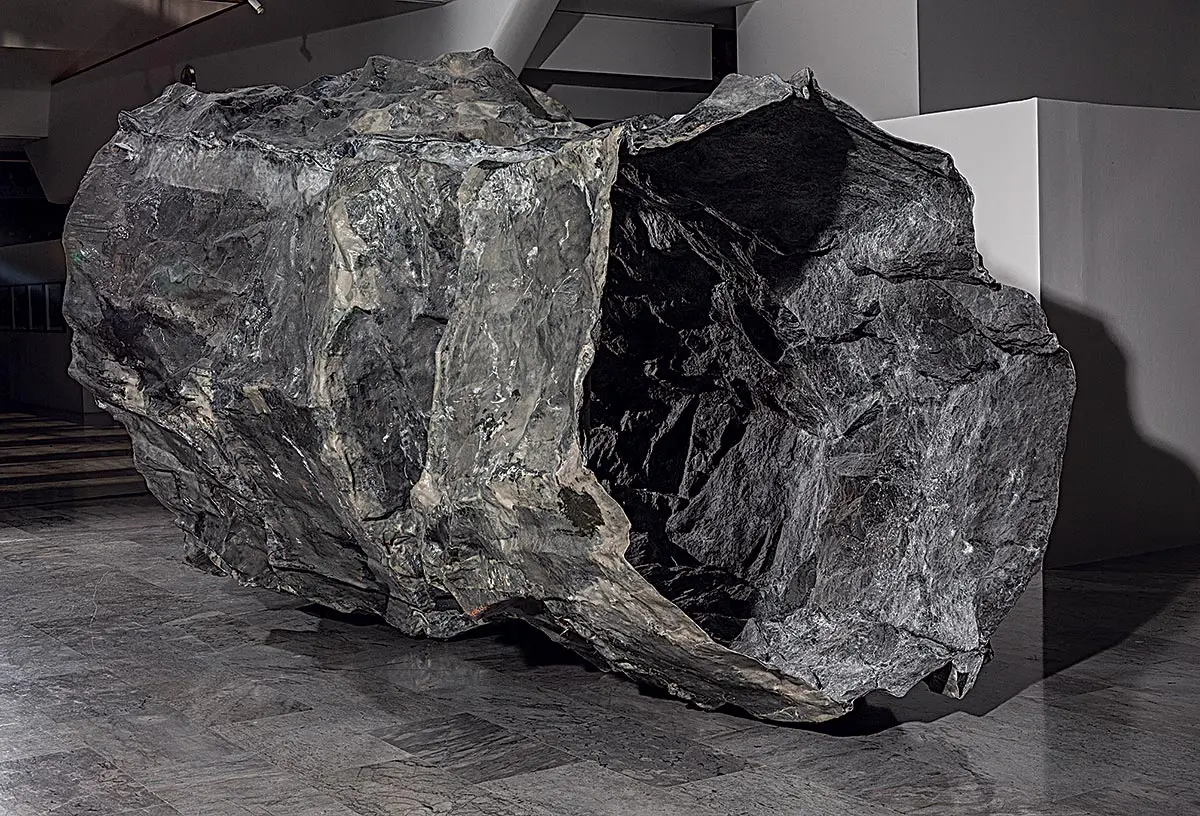
Fredy Alzate (Rionegro, Antioquia, Colombia, 1975), one of the Latin American artists who won the 2017 edition of the Cisneros Fontanals Art Foundation (CIFO) Grants and Commissions Programs, in the category of Mid-career, falls within this type of artist. He arrived at the void, cultivated it, first in detail, and then polished it by thinking about it, staging it. His most recent exhibition, presented at the Sala de Arte Sudamericana in 2016, Uncertain Territories, planted a colossal hole in the historic district of one of the most powerful economic conglomerates in Colombia, the Grupo Empresarial Antioqueño, formerly known as the Sindicato Antioqueño. The leitmotiv of this exhibition was literally a hole, a void in form and concept. With the care of an artisan, Alzate has been collecting, copying, the skin of the quarry mines from some places within the Colombian geography, where the eternal gold rush has returned. Hollow sections, which are voids at the same time, were transported from the quarry to the sterility of the gallery space. The overtly disrupted meaning confronts us with a dilemma, a volume that emerges from nothingness; a repellent question, like two magnets aligned with equal poles, and demands an answer. As the result, a void of content and content without form becomes the protagonist element of the scene. There is no room for a more diaphanous clarity: the tragedy of vanity once again emerges from within human anguish, its own misery.
Referring to the matter of illegal mining in Colombia, Alzate affirms that “although the issue is vast and has many subtleties, I am interested in transferring the references that I draw from the ethnographic work that I will continue to develop to an intersubjective space in which metaphors reflect the imbalance of nature.”
His interest is encoded in an undeniable reality: the value of the soil, not because it is soil, but rather because of what it is not: the gold that it contains. It is a paradox of the economy that contains its own structure and, at the same time, its unstable rigidity, making it an imprecise science with a certain amount of esotericism. Gold, the element that provoked medieval madness and gave rise to alchemical theories, a soft metal that until the most recent Industrial Revolution found a purpose in the production line as one of the most efficient conductors of the periodic table, remains the caliper in the financial exchanges from the dawn of the invention of money, perhaps based simply on its golden glow and its immediate association with the Sun.
To obtain a 4.6-gram Castilian coin (gold coin), a mine must expand its void around 27 cubic meters. What is interesting is that the territories that contain gold in Colombia, which are different from the contemporary city, also answer to a different era. There, one pound is equivalent to 460 grams, in other words, to one hundred Castilian coins; one Castilian coin is equivalent to 16 reales; a real equals six grains, and one tomín are two reales. Such is the ancient Castilian jargon of measurements for a colossal emptiness.
Through forms of emptiness and monumental pictorial representations that allude to the punishing processes of illegal mining, Uncertain Terrains presents a dialectic that confronts scarcity with abundance, in a display of sensitive materials that could clearly be part of another center of power, of another latitude of the planet. And even then, it would make the powerful think that it is a defense of their success, more than a sarcastic approach to human nature and the perfidies of its future. Perhaps that same precept is part of the urinal signed with the insidious R. Mutt in 1917: a form of warning for a race that, when digging the earth to find the resplendent sun, are unknowingly also digging their own tomb.
OSCAR ROLDÁN-ALZATE