
Gabriela Morawetz is exhibiting her work at Thessa Herold gallery under the title of Chambre d’(a)pesanteur (Weight(less) Room). Born in Poland, Morawetz studied at the Fine Arts Academy in Krakow, where she received a complete education in the various artistic disciplines. She lived for eight years in Caracas, Venezuela, starting in 1975, and in 1983 relocated to Paris. Her life has been marked by continued exchanges with Latin America, Venezuela is the country where her professional career began.
Morawetz’s early paintings already prefigured a personal universe comprised of subtle combinations of different techniques. In the early 1990s, she used silver emulsion and photography as her means of expression. Morawetz’s interest in photography began spontaneously in her youth, but it may have different roots: childhood memories of watching her grandfather working with negatives and planning and executing photoshoots; the poses that appeared, the interplay of lights, all like a private theater.
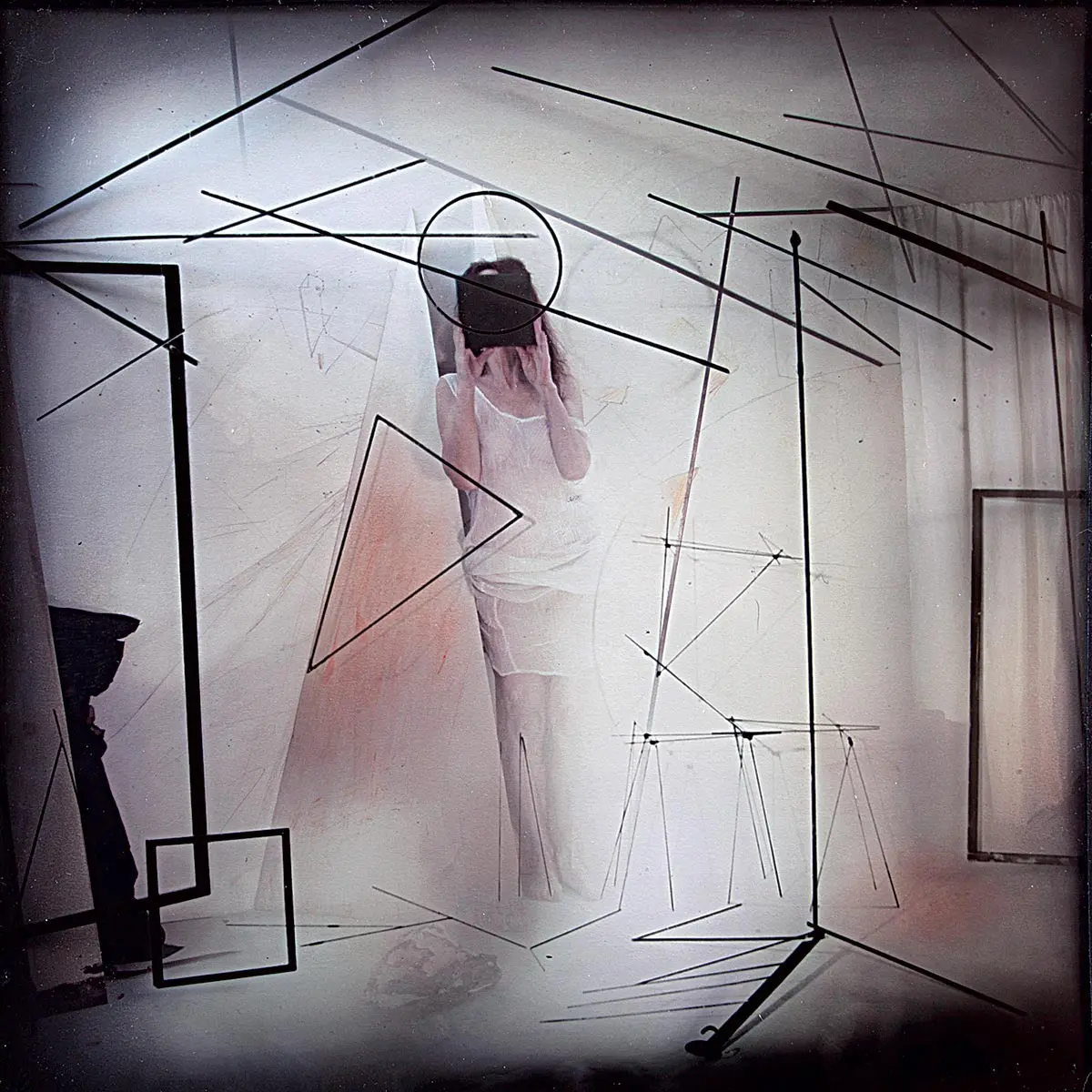
The exhibition unfolds in two sites of the gallery and at Paris Photo. Between stenotypes, emulsions on aged glass printed on a variety of papers, fabrics, flat or concave glass, the selection grow larger than one hundred images, articulated around Point du départ (Starting Point, 2015), an initial work inspired by Giotto’s The Annunciation To St Anne. The reference to the room is a kind of matrix, and its breaking is a leitmotiv. The annunciation—which is to say, the gravity—opens up according to this point of view: a synthesis of all the deconstructions to come. It is the projection of the private space of the workshop as a blank sheet. A metaphor of the surface (canvas, paper, or glass) waiting for a representation that is governed by antinomies: the cosmic, the psychic, and the corporeal.
The work is assembled and disassembled, and the artist invents solutions in the process: she adds pigments, traces lines, constructs, modifies, enters or leaves, invites characters in, and records the passage of time according to the map of the stars at that moment and in that specific location. Those are all viable ways of preserving the memory of scenes and scenarios that could be understood as autonomous residues: the dynamics of a projection.
An autographed artist’s book in seven copies, 25 x 34 cm, comprised of another sixty prints, is part of the theme. Its plaster covers transform it into an art object. An adjacent volume tells us the title, and another, the smaller book contains the star maps with the date and time when each photograph was shot; another kind of treatment of the image in allusion, again, to certain nomadism. Morawetz creates installations specifically for her shots, and her materials are varied: mirrors, fabric, wood, metal, wire.
Morawetz creates fictions and atmospheres using very simple objects, a few fixings, lights, and fabrics, in order to produce the illusion of a new space. This resembles the practice of a stage designer, where actors are recreated and de-structure their own pieces. As in the previous shots with the members of a Butoh dance troupe, the circularity, the stellar, and the questioning of the boundary between subjective and objective is highlighted. Passages of the soul recorded on a variety of surfaces. This is a feminine art that eliminates everything superfluous. Its only flickering reflections are the paths followed by the lines: thus the sensation of weightlessness.
This fiction helps viewers discover themselves: Euclidean space and, by extension, the gallery itself. The uncertainty of perception creates an out-of-time experience, and the result goes beyond the measure of the execution: from there come to its power and its mystery.
“The idea is that everything communicates and that each new action retains the traces of the preceding one (…) this is my observation about emptiness as a creative force,” says Gabriela Morawetz.
SUSANA SULIC