
In 2015, in Chile, Iván Navarro (Santiago, Chile, 1972) titled a retrospective exhibition of his work A Silent and Impossible War.1 And it was precisely the silence that emanated from the title amid his sculptures, energized by electricity and artificial lighting, what offered viewers a glimpse into the silent perversity of the reconciliatory ghost of globalization and its neoliberal economy. To observe his works back then—like the enormous sculpture that was actually a drum tirelessly repeating the word “Bomb”—also meant to fear their activation in the metaphors of the body. It was as if beauty only existed upon getting close to the reflective and electric pieces in order to appear or disappear, desire, or resist. Back then, it was a story about collective memory that, although silent, did not exclude the pervasive noise of that and other wars or the efforts to fight it and the pain that it brought with it. During that same year, Navarro organized in Santiago an exhibition titled Onomatopoeias at the Centro Cultural Matucana 100 (M100) in which sculpture and performance interacted with urban sounds, popular protests, and military marches. On that occasion, and in collaboration with musician Atom™, Navarro created Radetzky Loop, a work in which a tire that alluded to the mineral market emitted fragments of the famous Strauss’ march as it moved. In this manner, viewers acted both as bodies and listeners who, in the micro-politics of their movement could perhaps think about the military regime—and the effects still felt through its remnants—in connection with the military march playing; and its successful continuation in the form of neoliberalism and its “plurality” adjective.
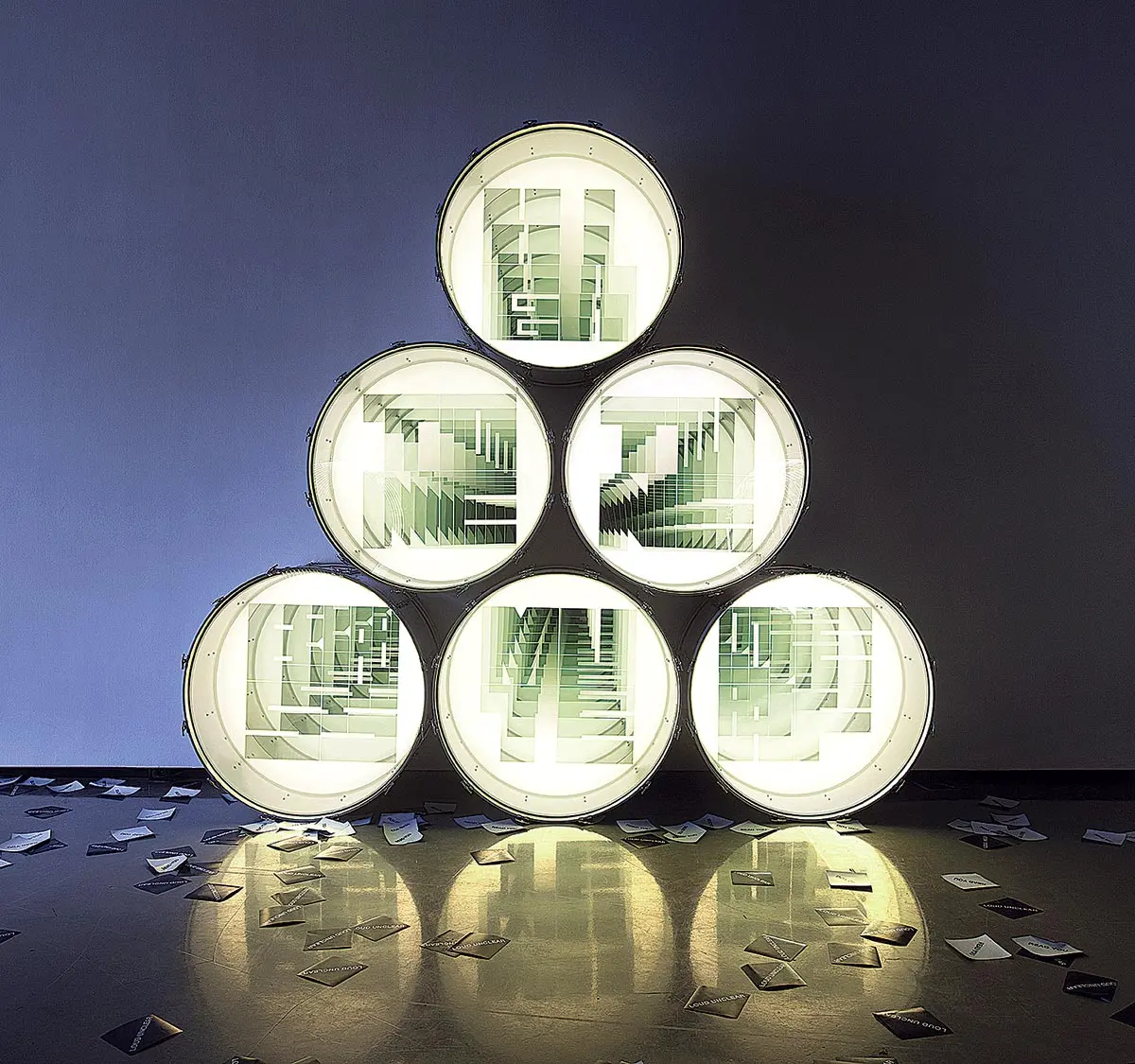
In his last exhibition at the Paul Kasmin Gallery, Iván Navarro showed us, in a ludic and profound manner, the transformation of silence into sound, image and language, and vice versa, just as he began to do in BOMB BOMB BOMB (2015) and Radetzky Loop. Pursuing even further the exploration of his idea of beauty as a place for the synesthesia and instability of the normalized discourse, in the exhibition titled Mute Parade, music once again returned to silence in order to sound and, in this manner, repeat itself, time after time, becoming confusing and contradicting to the viewer’s gaze, ears, and body. Alluding to the cultural and vigilant significations of military marches in an after-party or after-concert environment, in the exhibition Mute Parade, Navarro invited us to immerse in his imaginary, where music emerged from images and words that are images. Thus, music also emerged from its own absence.
In this manner, upon entering the first exhibition room, viewers found on the left side the work Tuning (2015), a pyramid built by six luminous batteries. Reinterpreting the functionality of an instrument insofar as the idea of a sound, was a notion that for Navarro also meant the need for deafness in order to listen, interpret, create music or noise, while mirrors on the batteries projected the words "High," "Tone," "Tune," "Bass," "Mute," and "Deaf." In this after-party environment, in other words, in the routine that will not shut up, hundreds of black and white papers spread across the gallery floor contained the words “Read You” and “Loud Unclear” on both sides. Altering the military expression “Read You Loud And Clear” for a confusing message on unstable support, paper, Navarro not only altered the conventions of dominance and power the stemmed from military marches, but also the order and cleanliness of its sculptures, creating as he tells us: “A friction… a tension between materialities like the lightness of paper versus the heaviness of sculpture [in order to] destabilize the order of the exhibition.”
Thus, in Mute Parade operated that same instability or binary negation that exists in his work, where lights are also shadows, the sound is also silence, and war (although masked) is also an invocation of memory, through the juxtaposition of celebratory and intimidating feelings that arise from military music. But it was a juxtaposition that, once again, occurred as ghostly silence, given that euphoria also intimidates others.
How to re-interpret the meanings of music, sound, noise or silence designed by the power structures? This is the question that also leads Navarro to resort to the onomatopoeic figure. The pieces titled KNOCKNOCKNOCK (2016) and KICKBACKICKBACKICKBACK (2016) are examples of this. Two batteries measuring six feet (1.83 cm) in diameter composed of neon, LED lights, mirrors, and electricity, and installed one behind the other in the gallery’s main exhibition room, projected circular texts that, like title, were repeated to infinitum. According to Navarro, “The sculptures do not sound, but it is said that they sound like a knock […] They are mute structures/instruments that try to communicate something beyond their assigned meaning.”
And, like metaphors that allow reformulating the meaning of things and of the senses, in the exhibition room further in the back, four 6 by 6 feet (1.83 by 1.83 meters) structures were nothing more than portable cases used for transporting and protecting instruments. But, instead of being static objects, their interiors filled with mirrors projected neon-green sound waves to infinitum. Titled Impenetrable Room (2016), in this, and in every other work, the silence of the marches expands across space without a purpose; an infinite that is imaginary and, therefore possible but impenetrable. Regardless, because of their scale, viewers wanted to get inside them with their bodies and senses. In Mute Parade, dystopia, as a form of beauty, became the possibility of interrupting unique and infinite sensations and meanings. In this manner, “ideal” silence as resting space or death was nothing but a multiple activation across space, images, language, and voice.
NOTE
1. For more information about this exhibition, see Florencia San Martín’s article “Iván Navarro, una guerra silenciosa e impossible: Centro de las Artes 660 [Iván Navarro, a Silent and Impossible War: Centro de las Artes 660],” ArtNexus No. 98, pp. 104-106.
FLORENCIA SAN MARTIN