We see a glass cube in an ample space. In it, we notice people, geometrically organized colors, a crossword puzzle. Back in 2009, when Aranda presented Intervals, with a clock1 on the stairs of the Guggenheim Museum in New York, her work went unnoticed for audiences accustomed to encountering in that space aesthetic displays rather than design proposals. Nevertheless, it created a certain mental buzz for many of the passers-by. Let that be our introduction to Aranda’s presence at Tank, the Art Institute’s exhibition space in Basel’s Dreispitz district. This unique, large transparent cube of a gallery brings together the eleven institutes of the FHNW Academy of Art and Design and is shared with other institutions, like HEK—House of Electronic Arts, an independent radio station, and the residency program of Atelier Mondial. As its name indicates, and as readers will notice, Tank is symbolic and metaphoric, and it is also linked to the Rhine River and the salmon that are so present in Basel culture.
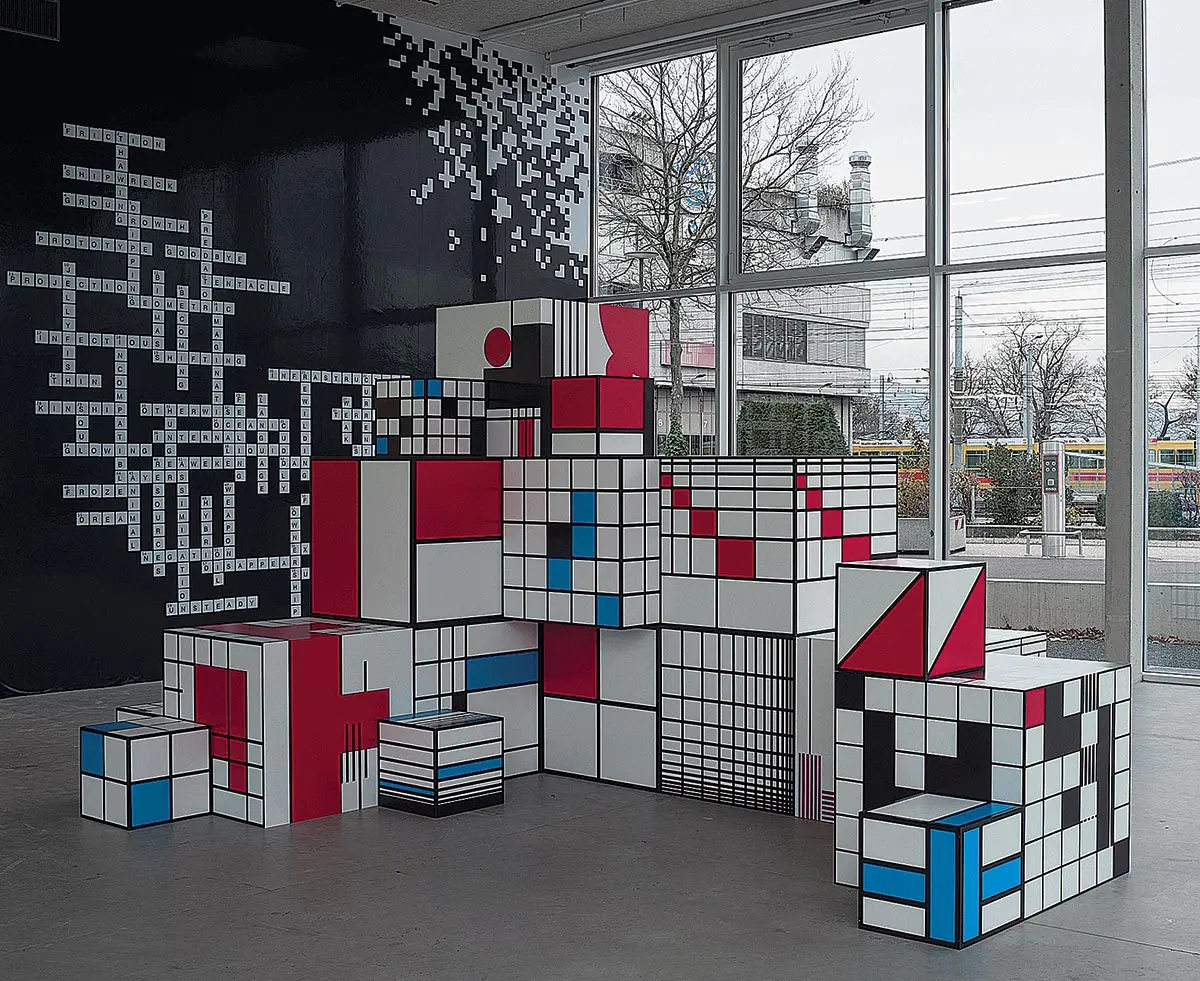
Tank is a place for reflecting and meditating outside traditional parameters; the actions posited/exhibited there are also destined for the Web or for cyberspace, or for any other vessel for which students may conceive them. And, indeed, Juliet Aranda has been developing her oeuvre outside the traditional context of the visual arts. She does not create objects; rather, she manipulates conventional knowledge in installations designed for specific sites. Using words, different methods of appropriation, printed media, eventually, video, pictorial blotches and/or color, Aranda articulates her motivations so that the viewer’s thought processes are pushed beyond the conventional cells of perception. There is a large black and white crossword wall, two stories tall, in the Tank building. Although this is taking place in Switzerland, a trilingual nation where Italian, French, and German are spoken, the language is chosen for the crossword is English. None of the words, be it across or down, are derivative or diffuse. Some—like "infectious," "shipwreck," and "friction"—refer to negative situations. Others—like "projection," "dripping," and "shifting"—belong to the order of the aforementioned thought processes that sustain the artist.
Aranda’s installations at Tank and at the Guggenheim—as well as her numerous residencies in Paris, Stockholm, and Rome and her participations in the Venice Biennale, Witte de With (Rotterdam), the Gwangju and Havana Biennials, and others—reveal her to be a complex artist who, ensconced in an educational-prospective Modus Vivendi, keeps her distance from publicity. Born in Mexico, she lives between New York and Berlin, and teaches at the Basel Art Institute. As an artist, Aranda, who is e-flux’s co-director, seeks to express herself in terrains where the traditional commercial circuits of the painting and the object are disarticulated.
The title of her proposal on this occasion is The Organ: As the Ground Becomes Exposed. It is an entirely new organ through which the artist presents us with temporal capsules towards the distant past. It is based on the Aranda’s investigation of the relationships that art establishes with life, time, and information at different levels. In order to develop knowledge of those relationships, artists and scientists need to be brought closer to each other. Aranda has established comparisons with scientific discoveries about the mysterious survival abilities possessed by certain bacteria. This new organ proposes a version of what sculpture could be in the future. In particular, it brings us closer to an understanding of how perception could function far into the future, taking into account the relationships that art establishes with the musings and questions that populate our everyday lives. This work commissioned by Tank reveals, as does Tank’s very exhibition program, that this “space” will help us think through certain subjects. At Tank it is understood that we have become “organs”, developed over the course of history through certain ways of perceiving the world. In a way, we could say that, as thinking beings, we are induced to change. Curator Chus Martínez and Filipa Ramos have been offering there a series of seminars that generate new starting points for scientists and artists. Julieta Aranda’s site-specific installation is an approach to a realm of rationalities freed from pre-established parameters.
NOTE
1 Graciela Kartofel: “Julieta Aranda…”, ArtNexus #74. Sept - nov, 2009.
GRACIELA KARTOFEL