
The MARSO Gallery, active in Colonia Juárez since 2013, represents twelve artists from different countries and generations. Its lively program of activities includes exhibitions and a sustained presence in the international fair and biennial circuit, as well as the publication of artist’s books and the promotion of residencies.
MARSO exhibited a selection of recent works by Luis Felipe Ortega (Mexico City, 1966), a multidisciplinary artist in its roster who has been part of a group of avant-garde artists since 1990.
From his beginnings in the alternative project Temístocles 44 through the present, Ortega’s artistic practice has always encompassed diverse media, such as drawing, video, photography, sculpture, and installation. The exhibition Noche larga en el presente (Long Night in the Present) brings together a number of different techniques, as well as the artist’s literary and academic interests, into the development of a personal language that at the same time transcends to the social and political spheres.
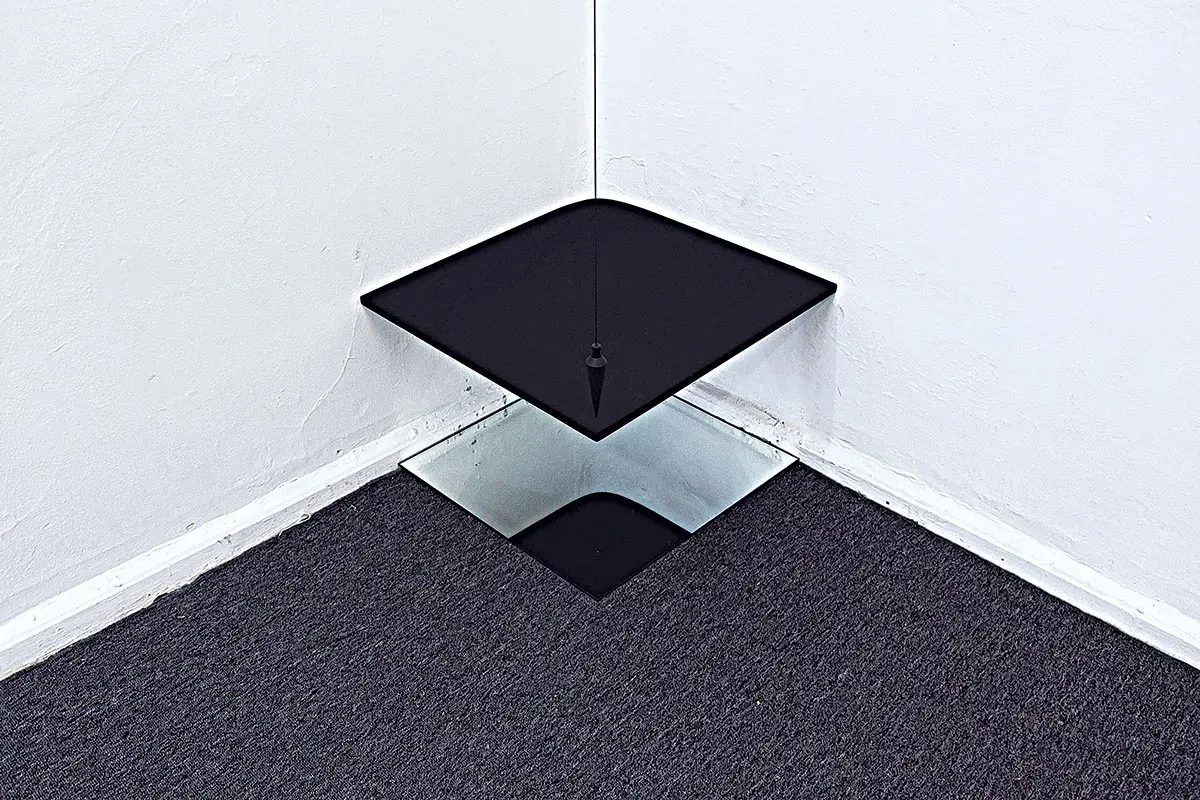
After his participation in the 56th Venice Biennale, Luis Felipe Ortega exhibits ten works that assemble a personal discourse on the basis of balance, geometry, and the texture of dissimilar materials like glass, wood, and mineral matter (graphite). Based on his research, Ortega poses questions intended to disentangle a process that combines poetry with the creative process and finds nourishment in a number of artists, engaging playfully in investigation and creation as he makes references to William S. Burroughs, Louis-Ferdinand Céline, Samuel Beckett, Jean Genet, and Truman Capote.
Also of special significance is Ortega’s reference to the writer and filmmaker Pier Paolo Pasolini in the two works titled Sobre la desaparición de las luciérnagas (On the Disappearance of Fireflies), a metaphor deployed here to allude, in the present, to the longing for the past and the loss of something that was deeply valued and treasured.
Another work on exhibit, a polyptych of four oil-on-wood panels, can be seen as an abstract homage to Marcel Broodthaers, the Belgian poet, filmmaker, and visual artist affiliated with conceptualism who put forth a new way of thinking about the relationship between artist, artwork, and art museum.
Ortega’s work has always included an approach to diverse media as well as literary and philosophical references, and he has talked about the need to explore different techniques and languages; in his view, limiting oneself to just one of them is to constrain the work’s discursive capacity. His production is in part anchored on the legacy of different movements and on a variety of media that coalesce into a new narrative.
The exhibition’s centerpiece engages the subject of absence and seeks, following a philosophical direction, to articulate a political discourse about a tragic event in Mexico’s recent history: the forced disappearance of forty-three students from the Rural Teacher’s College of Ayotzinapa, in the state of Guerrero.
On the basis of graphic abstractions, Ortega is able to build a metaphor of invisibilization and to produce forty-three 70 x 40 cm essays/drawings, one for each student: an undefined and uncertain portrait of an episode that prompts many questions and provides no clear answers. These blurred absences represent an ominous void for the State and for the families of the victims, who, lacking any physical remains and possessing no evidence about their loved one’s fate, have been unable to grieve.
In the history of Latin America, absences such as these have recurred and have been explored by many artists. For Ortega, the specific function of this work, which gives the exhibition its title and speaks in a poetic manner about that fateful night in the town of Iguala, is to foster a space for thinking about the subject, generating awareness about the need to clarify the present in order to position ourselves, as a society, towards the future.
Paradoxically, Ortega’s work produces a strong silent presence that invites the construction of a critical discourse on the basis of three simple elements: graphite and pastel on paper. The graphite gradually covers the paper, layer after layer, making it impossible for the observer to see what lies underneath its thick overlapping lines. In this way, silence and emptiness converge, and only from the standpoint of their convergence is it possible to understand vertigo and the darkness of the present.
ISAURA RUIZ