
Luis Molina-Pantin first appeared on the NYC art scene with his photographs of the extravagant-kitsch homes of rich drug lords in Cali, Colombia, and the rather sterile back offices of leading NYC art galleries in 2013-14. A year earlier he was one of the 14 young photographers selected by Martin Paar for inclusion in the 2012 C Photo book New Latin Look. Now he is back with his second one-person exhibition but this time with books…and books…and more books, which should be the name of the exhibition rather than the current generic Works on Paper. However, the exhibition title does inadvertently raise the more interesting question of whose works are on paper, and why? Unfortunately, the most interesting answers are only occasionally on display or accessible.
There are found books, created books, photographs of books, so-called Kinetic and Coloured books, and even a photobook made to resemble a Microsoft Surface Pro. Somewhere the phrase “obsessive-compulsive” should appear, ignoring the fact that what many consider to be a mental disorder is actually a major tool and attribute for artists. The philosopher Jacques Derrida referred to it as “archive fever.”
Not having read the books that Molina finds so fascinating this viewer is left to guess the content and speculate on the meaning of the works and the personal views of the artist based on what has been collected and an interesting if contradictory interview published on the gallery website.
Some seem obvious, as in the seven collected books by Marta Harnecker and Gabriela Uribe published in a numbered series by Cuaderno de Educación Popular (Booklets for Popular Education) with titles that need no translation; Socialismo y Comunismo, Monopolios y Miseria, Imperialismo y Dependencia, Explotación Capitalista.
Strangely the artist chose to title the grouping, now displayed together in a vitrine as are many of the collected and found books, Abstract Reading (Lectura abstracta) for what seems to be a very concrete and specific political orientation but one highly relevant in the USA at this moment in its political history, especially if you know what was behind these books but not made public.
The series was published in Chile during the Popular Unity government under Allende and it asks the same question we ask across the globe today. Why do so few have so much wealth? Of course the answer, then and now, goes back to Karl Marx’s nineteenth-century characterizations of capitalism. (For those interested, an English language translation of the second booklet, The Origins of Capitalist Exploitation can be downloaded free online at http://links.org.au/files/HarneckerCapitalist%20Exploitation.pdf. This seems appropriate for a book series that was reprinted across many countries, complete with study questions.)
Similar to Abstract Reading is the eight editions of the same 1976 book, Del Buen Salvaje al Buen Revolucionario (From the Noble Savage to the Good Revolutionary), by the Venezuelan author, diplomat, and television personality Carlos Rangel (1929-1988). But here the social and political relevance of Rangel’s text is purposefully negated by what seems to be Molina’s more overriding concern for formalism. Each edition has a differently colored title page, which is the subject of Molina’s title, Colour Bars.
How much more interesting it would be if the subtitle were included, Mitos y realidades de América Latina (Myths and Realities of Latin America), or a reference made to the later English title translation, The Latin Americans: Their Love-Hate Relationship with the United States.
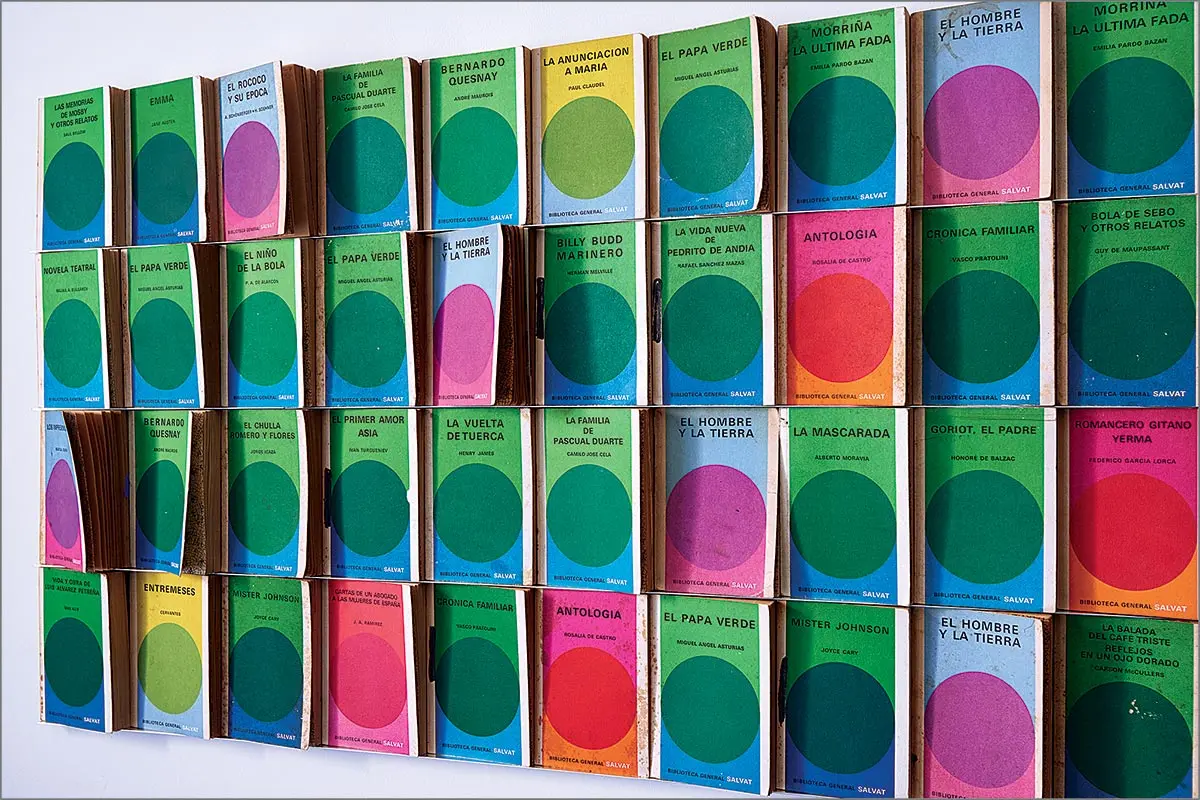
Similarly, the largest work in the gallery, 80 books mounted side-by-side on the wall under the title Contemporary Painting, was chosen for the color patterns of their cover page. All are products of the most famous Spanish publishing company of the 1970s, the family-run multinational, Salvat España (1869-1988 when purchased by the French group Hachette). The publishing house is important to Molina and also the current subject of his photobook Monochromo Naranja (Orange Monochrome) of 2016. In Molina’s interview, he refers to the impact of the publisher and its democratization of literacy while the title is taken from the 1971 Salvat imprint of Julián Gállego’s art history book.
Normally, these issues are merely accepted or ignored as the choice of the artist. But Molina’s interview statements show he cannot decide which direction seems best, often confusing his own “flaneurship” with his preferred term for himself as an “urban archeologist.” The New York Times critic Holland Carter observed of Molina’s earlier and better known photographic work, that the artist has the ability to present work which “simultaneously project and undercut illusions of confident power.” That is not much on display here but easily could be. I trust his vision will steady and clarify as he explores the potential of this new medium of books.
RICHARD LESLIE