
The Sala Trasnocho Arte Contacto (TAC) recently presented an important anthological exhibition by prominent Venezuelan artist, editor, and cultural promoter Luis Romero. Curated by Eliseo Sierra, the show consisted of several series that are representative of Romero’s almost three decades or artistic trajectory.
Several important central narratives came out of this exhibition, both in terms of the formal treatment of the pieces and their meanings. One such narrative was the profound and generous relationship between Romero and various iconic modern and contemporary artists like Marcel Duchamp, László Moholy-Nagy, Man Ray, and the Venezuelan Roberto Obregón, among others. They are part of a referential universe with which Romero constructs his personal work. In addition, another constant aspect of his creative process is the capture of surrounding elements that he takes from urban explorations, trips, thoughts, etc. Sierra accurately defines Romero as a collector artist and points out that the practice of collecting becomes a working method that he turns into a system. This is the manner in which Romero builds his images.
This process has been present since his early work from the late 1980s and early 1990s. In the introductory text of the 2015 exhibition by Luis Romero at the Alejandra Von Hartz Gallery in Miami, Ruth Auerbach pointed out that Romero’s visual discourse is based on the recycling of images, texts, typographies, and objects worked with a diversity of techniques and supports, such as drawing, painting, assemblages, and collage. She adds that much of this iconography comes from the domestic realm and the urban environment.
The domestic realm can be observed in a 1988 photograph showing a shadow cast on the wall by a birdcage. This image acquires formal signification in his later work: light becomes the element that forms the image, in the same manner, that the elements that exist in the real world shape reality. Thus the importance of everyday objects is as meaningful ephemeral situations. The collages created in 1995 by Romero in Amsterdam, from the series of the same name, are a reflection of this. They are papers glued with images of landscapes and architectures, notes, emblems, etc. that left their impressions; fragments of ideas and memories that are immediately developed into collages through different intervention approaches.
Light and shadow, on the other hand, turn into essential expressive elements in the photograms created in The Netherlands from 1995 and on. They are pieces reminiscent of the experiences created by Moholy-Nagy and Man Ray. In them, the “aura” of the objects is captured in the sensitive paper through the action of light. With this resource, Romero creates his Autorretrato (Self-Portrait, 1995), an homage to Roberto Obregón and his self-portrait Niagara (1994), one of that artist’s emblematic works.
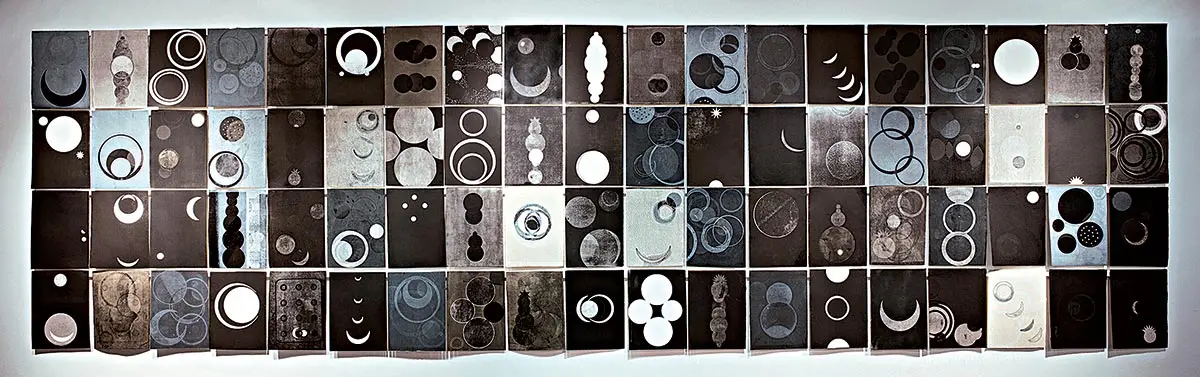
Nighttime is another central element present in the exhibition. Indeed, references to the night appear in several works by Romero: Estudio para nocturne (Sketch for Nocturnal, 1995), Nocturno–Zonnebloem– (Nocturnal–Zonnebloem–, 1995), and in the recently created Nocturnos (Nocturnals). In Libro negro de la noche (Black Book of the Night, 2013), a series of monotypes that form a large reticle present in the exhibition, not only denotes ambiguity between figuration and abstraction but also outlines another relevant aspect in the development of Romero’s work: the importance of the movement of the figure across space. At times, this makes his work appear to be turning into an abstraction of forms. But in this exhibition, there is not a conclusive definition towards one form of representation or the other. Both figuration and abstraction are manifested in several series, as they oscillate in the middle of this dichotomy. In 2010, for instance, allusions to gates in the city were represented through a diverse linear framework: geometric compositions created on carved woods that form a large panel in one of the central walls of the exhibition room. Despite its abstract appearance, the titles of each box or section reference the urban Venezuelan environment. The contrary occurs in the 2013 serigraphic series titled Sunsets, in which Romero combines concept, image, and space in pieces that, through color, become crepuscular landscapes as well as spaces for the mind. The 2010 collages and the 2014 photograms, on the other hand, describe vegetal figures, another important theme in Romero’s work. In the circles of D.R.O I, II, III (2015), pieces of cut rubber condensed by the artists are, on the one hand, also referential to Roberto Obregón and, on the other, represent and abstract synthesis of the predominant circularity present in many of Romero’s nocturnals.
In recent years, Luis Romero has been very active in Venezuela—where he has only shown partial aspects of his work—and abroad. This is the first exhibition by this artist that summarizes an artistic trajectory of nearly three decades of consistent production.
SUSANA BENKO