
Artist Mariano Sapia (Buenos Aires, 1964) said in an interview something that offers a glimpse into his work: “It is always possible to make a social reading, but the core runs through somewhere else.” The exhibition of his paintings at the Pabellón de las Artes de la Pontificia Universidad Católica Argentina, opened almost at the same time as the violent eviction suffered by the so-called manteros (street vendors) in the Once neighborhood, in Buenos Aires. At first glance, Margins is a succession of urban scenes full of small characters immersed in the chaos of recognizable spaces: the streets of Buenos Aires, train stations, and shantytowns. One of these works, an oil painting on canvas from 2015 titled Manteros (Street Vendors), could very well be referencing the recent conflict. But according to Sapia, that social account stops being the only manifesto once it becomes part of the vast landscape proposed through the numerous groups of works. It is this “overflowing of what is represented” that serves as the title for the introduction of the exhibition’s catalog.
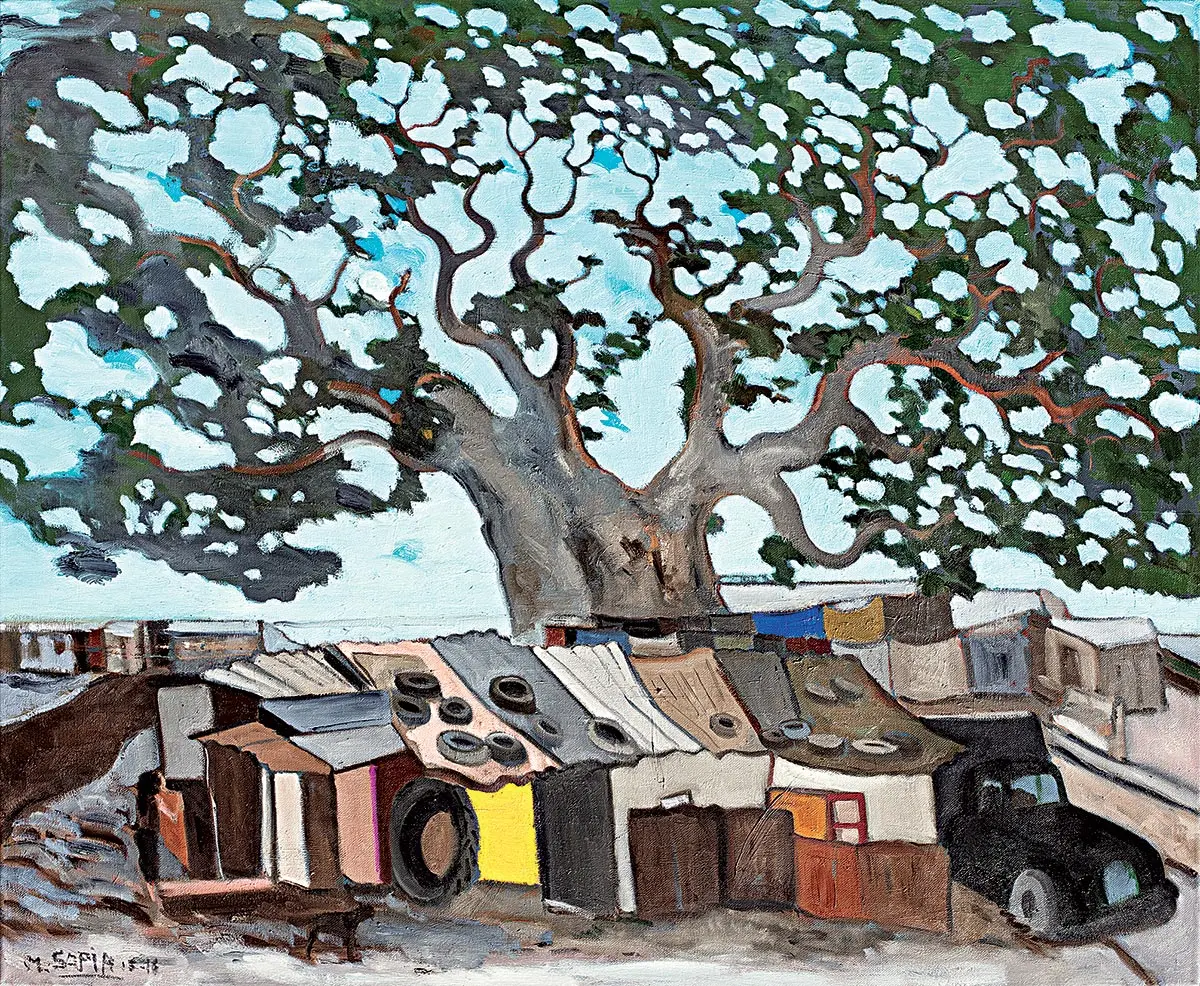
Once familiarized with the predominant theme in the works, the focus gradually shifts; painting begins to immerse viewers in a different manner: that which is evident gradually dissolves. In other represented events, which do not separate joy from drama, the multiplicity of events appears to vanish through the sheer dynamism of painting. From the close-up that allows for the recognition of details of some small and naïve character, in the threshold of the humoristic and caricaturesque, it becomes necessary to move a few steps back in order to observe in its entirety the enormous figure of a tree that appears to occupy the entire surface of the canvas. Moving even further back, the human anatomy and its recognizable surroundings become blurred, color imposes itself with all its energy, and so do the light and shadows that maintain the reflection of the passing hours of the day. It is as if viewers were echoing that which Sapia explained in connection to his creative process: “there is no such thing as the angst of painting… nor is there pleasure… it is just the act of painting.” Observing this group of works involves a moment of complete concentration that does not require any kind of state or condition.
In the enormous pavilion, viewers can follow the rhythm proposed by the play with distances and as they energize the gaze to freely capture the various perspectives. To abandon the static observation of the image in favor of constant movement appears to suit this exhibition better. Mariano Sapia does not believe in beginnings or ends; they are not applicable to painting, and this notion is communicated to viewers. To experience the different points of departure and arrival offered by the works expands the horizon of events to the maximum. From up close, we become part of the multitude of faceless characters blended into the movement within the mundane scene, as we participate in the dynamic of concrete surroundings: the moment of running to the train in order not to miss it, the whirlwind of buying and selling merchandise, the conditionings imposed by the urban architecture. And from there, without perceiving discontinuities, it is possible to reach the other side of things: the outline of the tree, this mythic symbol that branches ad infinitum and transports us to “the totality of the manifestations, the synthesis of the sky, earth, and water."1 The tree becomes the witness for the passing of time and the variations of light that mark the cycles. It is the only figure that appears to be agitated to achieve independence and peacefully oppose the chaos. Like the Tree of Life that is “regeneration… a return to the primordial state,”2 and, why not, to childhood.
Here painting is a representation, but the powerful images answer back to painting by dissolving reality. In the margins, all worlds are welcome: caricatures. Painting in its purest state, and even the very mystery of life.
NOTES
1. J. C. Cooper, Diccionario de símbolos [Dictionary of Symbols]. Gustavo Gili, Barcelona, 2000.
2. Ibid.
VIVIANA SAAVEDRA