Mayana Redin’s first solo exhibition was on display between November and December at Silvia Cintra Gallery, in Rio de Janeiro. Titled Arquivo Escuro (Dark Archive), the exhibition impressed viewers from the start with the atmosphere created by the artist: instead of the hospital-like lighting so commonly found in the “white cube”, Redin chose to transform the gallery space into a dark box whose tone, in general, was provided by the light coming from some of the artworks.
Redin’s choice connected with the use of the word escuro in the exhibition title and invited the viewer’s body to a unique physical experience. In this exhibition, the artist shared with the public an archive of her recent experiments. I think that the semantics of the archival act has permeated Redin’s production in different ways since her participation in the eighth edition of the Mercosur Biennial, in 2011. There, she presented Geografia de encontros (Geography of Encounters), a series of cartographic drawings where different territories overlapped in fictional encounters, as for instance in her superposition of the Strait of Gibraltar onto the Isthmus of Panama.
The act of appropriating maps and deploying them in a fictional construction reveals Redin’s interest in subverting the instruments used in the different processes through which the history of the human experience is built. It is not by chance that Redin went on to produce works where the notions of collecting, dislocating meanings and archiving became centrally important. I am thinking, for instance, about works that use postcards, like Acidentes de percurso (Accidents of the Trail, 2012), or her dialog with a historical figure in Caixa-móvel para Giordano Bruno (Box-Furniture for Giordano Bruno, 2014). More recently, in Edifício Cosmos (Cosmos Building, 2015), her collection of building names with cosmological referents was a way of creating new constellations of structures in the urban grid.
This entire apparatus—the maps, the archives, the albums, and the catalogs—is comprised of age-long human attempts to observe, analyze, organize, and give meaning to existence. The perpetual failure of such efforts, well documented in Albrecht Dürer classic engraving Melancholia 1, is due to humanity’s inability to control its environment in an absolute way. Something will always escape, and it seems to me that Mayana Redin is interested precisely in that quotient, especially with regards to a human effort that, by dint of the discipline it entails, comes close to being sheer nonsense.
Gazing upwards, like peoples in Egypt, India, and the Maya regions, among others, do to this day—this is to say, observing the sky, the stars, and the planets and finding meaning in them—may be one of the activities that more explicitly express, at once, our insignificance in the universe and our boundless intellectual ambition. Edifício Cosmos already gestured in that direction, but it seems that it is in Arquivo escuro that Redin’s obsession finds visual responses pointing towards more diversified pathways.
From the threshold to the exhibition, a slide projection titled Astronauta e cosmonauta (Astronaut and cosmonaut) established a tone that swayed between the comical and the tragic. Photographs of female astronauts were projected in pairs. On one side, we had the US’ Christa McAuliffe, the first civilian to participate in a space mission; on the other, Valentina Tereshkova, from the former USSR, the first woman ever to travel to outer space. More than twenty years separate those two historical events, and the fates of their two protagonists were very different: while Tereshkova orbited around the Earth three times and returned home a heroine, McAuliffe died in the Challenger Space Shuttle accident. Ironically, the images projected here show them in similar training scenes and, in a second moment, bring forth for viewers how they became part of historical memory. One came back to Earth and went on tour; the other turned into dust, and all we are left with are the tears of those who bid her farewell.
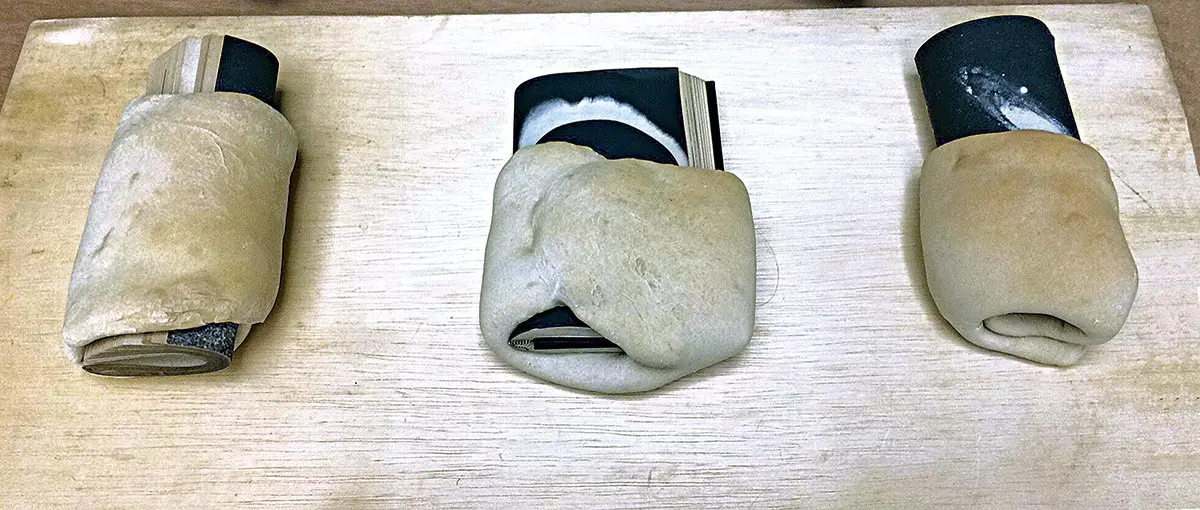
Life is permeated by chance events like those so clearly exemplified in these contrasting biographies, which put us in mind of the intangible. I think that the juxtaposition of materials operated by the artist—like bread dough with science or astronomy books—signals a similar line of exploration. On the one hand, we have bibliographic materials intended to explain, textually, the issue of celestial bodies. On the other hand, the coming together of organic elements capable of generating, by some alchemy, small three-dimensional objects that refer to interplanetary shapes. We can anticipate but never fully control the edges of an oven-baked piece of bread or the trajectories of asteroids in a collision course with the Earth.
When both domains are brought together in Pão (Bread), the banality of one attaches itself to the monumentality of the other, and a new unit emerges: one where wheat flour and cosmic dust are one and the same thing. There is no longer an up and a down, only the anxiety of incertitude.
A similar sensation invades our bodies when, in Costas (Coasts), we walk towards one side of the gallery and crouch to enter an empty space between a corner and a photographic reproduction of the Moon. The Earth’s satellite becomes an object that can be apprehended at the scale of our bodies. We are no longer required to gaze upwards in order to see the Moon; we see it frontally, all the while realizing that we are now too physically close to perceiving it in full.
The relationship between the Moon and the Sun is also present in Canhão (Cannon), where celestial bodies, moving as in an eclipse, become a light cannon in the exhibition space. Using a tube television inside a cardboard box as a projection device, Redin seems to be again signaling towards a trivial or anti-monumental understanding. The Moon-Sun is there, with pathetic utility for the terrestrial realm; there is a light cannon that could also be a stage spotlight. The process is similar to what we see in Sol (Sun), where an image of the star is captured in an astronomical observatory and replicated using a lighting device in the gallery.
An attentive listener will notice in Canhão an insistent rumor of people yelling and celebrating the eclipse that the camera captures. I had the impression that Mayana Redin’s artistic concerns turn on the observation of this fact: why does humanity insist on being so explicitly impressed by those celestial bodies, and, moreover, on generating expectations around them? What is the place of astronomical iconography in a world where images proliferate to such a degree, and where the boundaries between banality and erudition have disappeared? In the face of natural phenomena around us, are we to adopt a posture of skepticism or one of spirituality? Are we to be thankful for life and to celebrate the sunset, or should we simply await, cynically, the arrival of the rock that will clash with the Earth and put an end to it all?
In the absence of clear answers to these questions, it falls on the artist (and on those who follow her) to continue archiving small pieces of darkness.
RAPHAEL FONSECA