
For his third solo exhibition in France (Galerie Xippas, 1993, and Crestet Centre d’Art, 2000)1, Ricardo Brey (Havana, 1955) presents at the Galerie Nathalie Obadia eight collages and four large drawings (all from 2016), two installations—Birdland (2001-2016) and Árbol Cortado y Escombros (Cut Tree and Debris, 2013-2014)—as well as his earlier Venus (2004). Exile, time, displacement, and the issue of identity are recurrent themes in Brey’s work. His titles, written in several languages or created through the use of neologisms, indicate the most important concerns of an absolutely subtle, subjective and mysterious work that builds and deconstructs, creates and destroys; in which remains and debris, waste, and ashes are nothing more than memory ghosts, echoes of oblivion, allegories of the brevity of life and its inescapable end.
Powerful and fragile at the same time, subtle, earthy and material, open and closed, Brey’s work explores both the transience and the immutability of situations and things. While he vindicates chance and improvisation, his work comes across as extremely conceived and constructed. There is a kind of “affectation” in the choice of materials (stars, mirrors, chains with metallic bells, etc.) that clashes with the “mundane” (oxidized iron boxes, grease-stained cartons, a worn-out military blanket, broken plates, tires, etc.), objects that return with the passage of time as part of a formal and conceptual vocabulary that, through repetition, weaves a network of new discourses. Everything changes and yet everything remains identical.
The choice of dark polychromy for the collages—his colors are reduced to the soil to such extent that it could very well be a monochrome; the matted black of the burned wood, the green-gray of the aged metal, the rust, the matte blacks and whites of the photographic paper—is Brey’s way of challenging the luminous contrasts found in the magnificent drawings that he presents in this exhibition. Indeed, although we feel a form of accumulation in his works (stacked cartons that remind us of the lead “books” presented by Anselm Kiefer at the Bibliothèque Nationale de France in 2015), refinement authorizes the space to reclaim its place in the drawings, having as a dark counterpoint the various variations on the “circle”, “the enclosure” or “ellipse;” species of metaphorical cosmogonies in which a constellation of dispersed phrases and letters unfold across a graphic world full of subtleties.
There is also the threatened or devastated natural world, another obsession having to do with disappearances, in which Brey evokes the relationship between permanence and the instability of things and places. In several of the last collages, he emphasizes the figure of the tree, or, rather, that of a fragment of a trunk that underlines the organicity of the forms. The piece titled Exilio Temporal (Temporary Exile) associates the photograph of a trunk composed of multiple shoots that could announce the rebirth of the tree but that Brey condemns by introducing pieces of wood attacked by termites.
In the piece Keep Your Lamp Trimmed, a photograph shows a tree trunk already cut to exhaustion, divided in the center by an indefinable object (a stone, perhaps?), but also condemned by the horn that pierces it from side to side. Soyez Vigilants (Beware), Brey warns us as we are faced with the degradation of nature by man, chance, or fate—whatever the cards deal—as clearly shown in the installation titled Árbol Cortado y Escombros (Cut Tree and Debris). Brey’s oeuvre could be associated with the more militant and direct work of Frans Krajcberg, who uses burnt trees to denounce the destruction of the Amazon rainforest.
The four large drawings produced in 2016 address the origins, divided into the threat (Inferno), the birth/nest (Centro Terra), and the displacement (Departure), passing through the Enclosure. In Centro Terra, the center of the Earth is conceived through an arachnid design as a literary volcano that spits words and phrases ("road," "jungle," "anguish," "cave," "Lucifer," "giant" ...) on burnt paper. The game of contrasts between the upper part of the drawing, in which a black and compact mass weighs heavily on the lighter mass in the lower part—made of superimposed circles—confirms the work title Departure, a drawing in which opposites are connected through a vertical axis.
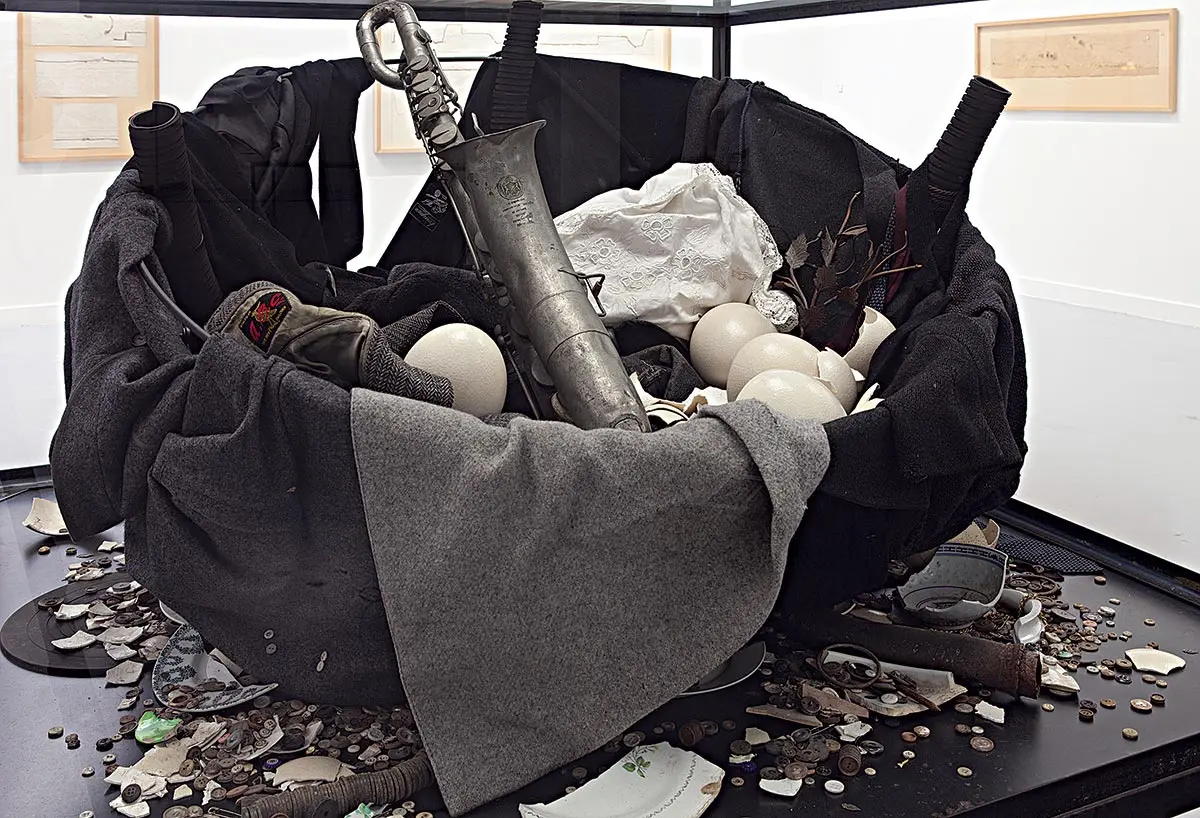
Birdland (the work that is reminiscent of another one presented in 2000 at the Crestet Centre d’art and titled Nest) collects in a container that also serves as corolla/nest, nature, jazz, mankind, religiosity, and the origin. The floor surrounding the “nest” is covered with fragments of dinnerware, eggshells, buttons, diaper pins, etc. A sentimental, referential, and sensitive hodgepodge used to inquire about life and its irrevocable contradictions.
NOTE
1. ArtNexus, Christine Frérot, April/June 2001.
CHRISTINE FRÉROT