
Ana Maria Tavares’ artistic project can be understood as part of a critical debate connected to the echoes of modern Brazilian architecture. Tavares’ work—sculptures, objects, and installations—interrogates and critiques the meaning of the everyday structures and accouterments of urban life.
The debates around our coexistence in cities, the projects of urban betterment around us, and the appropriate scale for life appear in Tavares’ work as a singular plane, especially when the artist activates her audiences as collaborators with the grand visual silence of the environment, referring them to Clarice Lispector’s thinking when she described Brasilia as “a place where space resembles time.”
Tavares’ creations are almost like tricks or ruses intended to confound the viewer. Or, better yet, to alert him or her to the innumerable pitfalls of contemporary life. The stainless steel, composite aluminum, acrylics, wood, and glass Tavares uses, along with her convex automobile mirrors, tubular structures, and metal mesh, give shape to dense experiments about the specific sites her works actuate.
Recently, local audiences and international visitors to São Paulo had an opportunity to discover the artist’s latest proposals in her large-scale exhibition No lugar mesmo: uma antologia de Ana Maria Tavares (On The Very Site: An Ana Maria Tavares Anthology), at the Pinacoteca do Estado de São Paulo. In this exhibition, a vivid selection of 160 artworks—created over the last thirty years—celebrated the vitality of the diverse means of conceptual detouring proposed by the artist in her critical interrogation of the uses of certain structures in our everyday behaviors, given the patterns of such a homogeneous society.
A Brazilian artist connected to a generation that in recent decades has been able to find rather auteurist pathways of investigation, Tavares encompasses in her work the expression of a mismatch of expectations, which is to say, a forking of paths in the concerted dialog between artist and viewer. A dialog that is shaped by the faces of a polyphony of gestures and actions in space.
For a “mismatch of expectations” one must understand, as a central component of Tavares’ proposals, the expectations generated by the work of art in its sustained critical formulation, with regards to the public sphere, urban space, the places of transit that reconfigure the meanings of each experience, of each barrier encountered in time and space.
A group of works stood out in the exhibition space Mesa Curva (Curved Table, 1989); Bico de Diamante (Diamond Beak, 1990); Pergaminho (Parchment, 1991); Coluna com retrovisor (Column with Rearview Mirror, 1997); Jardim para Burle Marx (Garden for Burle Marx, 2013); and Exit III com parede Niemeyer (Estação Luz) (Exit III with Niemeyer Wall (Luz Station), 2016).
As we can see, some of the titles make explicit reference to iconic figures in modern Brazilian architecture (Niemeyer, Burle Marx), problematizing the imagery of her projects and the repercussions of their use in collective space.
From the start in Tavares’ oeuvre, we encounter works conceived to discomfit, polished surfaces in stridently shiny light-reflecting metal that incorporate what is silenced in our habitual uses of objects—a ratchet, a column, a rearview mirror—and create a new relationship with such artifacts and devices.
Reformulated by a kind of formal vocation invented by the artist in order to activate the uses of an “experience of passage”—a context created in the confrontation of her work’s sites of articulation—our senses thus establish a relationship with the intimacy of the architecture of the building hosting her art.
As visual references established in the course of a three-decade career intervening in shared social spaces, Tavares’ zones of expanded reflection bring together inquisitiveness, constraints, and an agenda for ceaseless investigation.
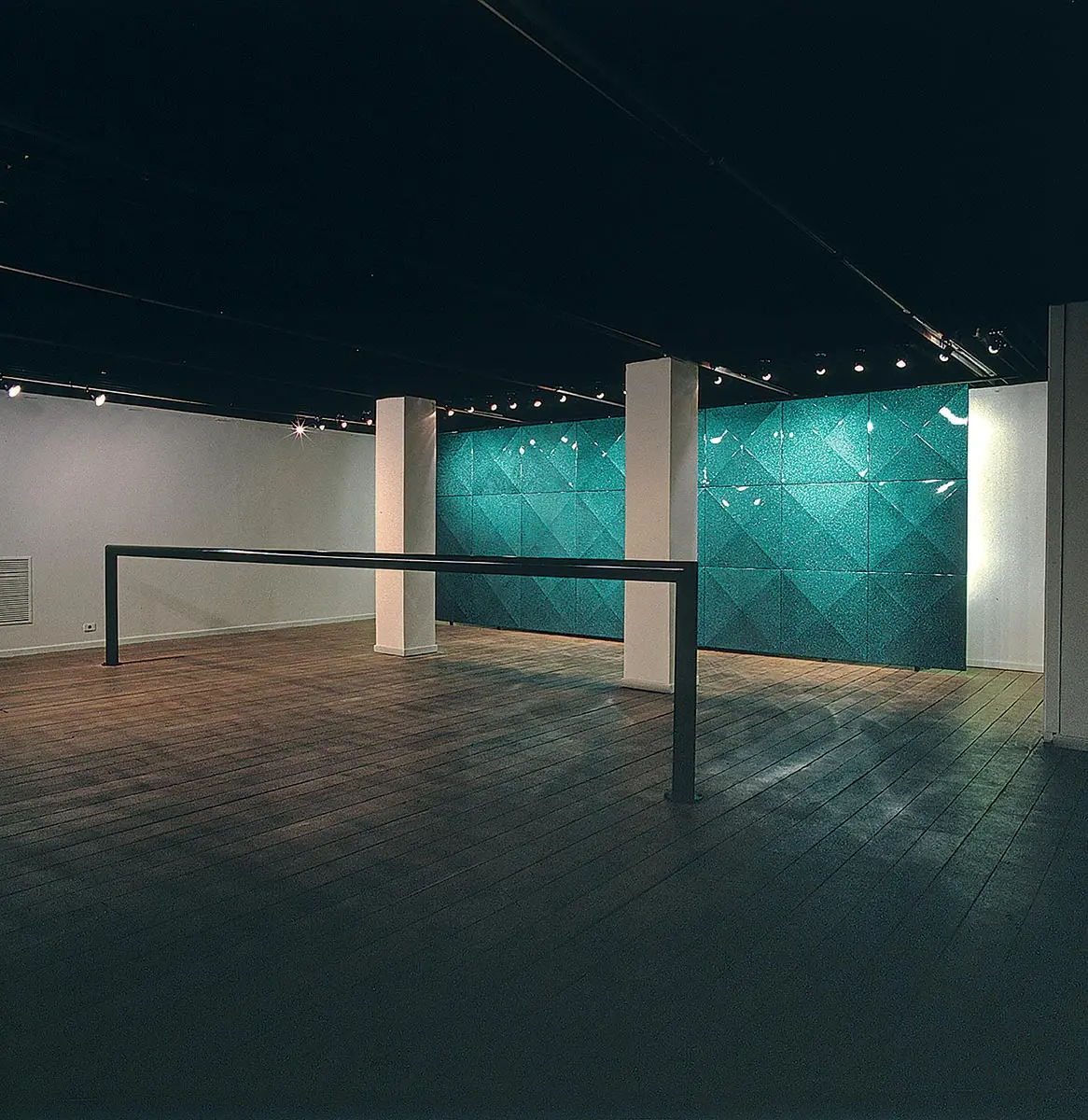
In Bico de Diamante, now in the Pinacoteca do Estado de São Paulo collection, Ana Maria Tavares explored the notion of the roadblock as the protagonist and established a pathway for the confrontation of polyurethane on the aluminum composite structure.
This work activates the notion of the roadblock—a hindrance or obstacle that creates a practically forbidden situation—and explores the viewer’s relationship with his or her own place as an observer, as a participant, or, as has been said, as a collaborator in the artist’s effort.
In a discreet room, viewers discovered a large vertical surface covered by trimmed metal plates coated in a metallic-green pigment. Luminous and striking, the color zone was closed to public transit. Access to it was blocked by a tubular barrier and two columns, which also partially closed the work down.
From the start of her career, Ana Maria Tavares has been interested in the inaugural condition of artistic creation, understood as a space for the activation of a persistent inquiry into processes of construction and deconstruction of the possibility of inverting the commonplace meanings, the circulation, and the flow of the architecture of her works.
Tavares is an artist committed to the lines of force of a restless thought, organized around a diversity of zones of passage between sculpture, objects, painting, and video; the issues her work engages rekindle many intentionalities in each proposal.
In fact, in proposing a retrospective look, this recent exhibition of her work established a broad framework of issues that are essential for the artist and remain current among her concerns. Curator Fernanda Pitta’s selection of works, ranging from the late 1980s to Tavares’ most recent installations, was intended to give greater density to a mode of coexistence established for the confrontation of particular readings on the part of observers who, unfamiliar with the artist’s explorations, often find themselves disoriented, especially by the obstacles set up by the works themselves.
For Tavares, warning her interlocutors about a detour in meaning does not suffice; it will always be necessary to establish a contract between the parts, artist, and audience, that challenges the commonplace modes of aesthetic reception, sallying forth into different uses and meanings of banal everyday actions and into previously ignored domains.
The work of Ana Maria Tavares is about a mode of critical consciousness that is alive in the contemporary scene, which activates the construction experience of the viewer—a collaborator in the work—via a cautious appeal that liberates him or her to become authors.
The starting point for the sculptures, objects, and installations selected for this exhibition was a universe decidedly ruled by doubt and hesitation with regards to the sites destined for occupation by the subject, given the uncertainties associated with the use and application of the fixed or mobile structures—hallways, handrails, columns, balustrades, revolving doors, mirrors—conceived by an artist intent on activating the visitor’s critical body and reestablishing other trajectories in the space of her interventions.
CLAUDIA FAZZOLARI