
Young conceptual artist Augusto Ballardo (Lima, 1986) presents his fourth solo exhibition entitled Plumage, the Splendor of Flight. Ballardo bases the title on an exhibition presented at the Museo Textil Precolombino AMANO titled Feather Mosaic Art Amano that showed pre-Columbian textile artworks. Ballardo tries to “delve into the analogy between the implementation of pre-Inca geometric patterns and those from a modernist period of art which today is constructed as a single image, the language of the arts.”1 This exhibition consists of eighteen works, nine of which are paintings on different supports (plexiglass, steel, and aircraft fuselages), three sculptures (plexiglass, steel, and aircraft fuselages), a nine-piece series of engravings, and five installations created with aircraft parts. The Ballardo’s oeuvre could be seen as minimalist because it uses basic geometric forms and colors with form.
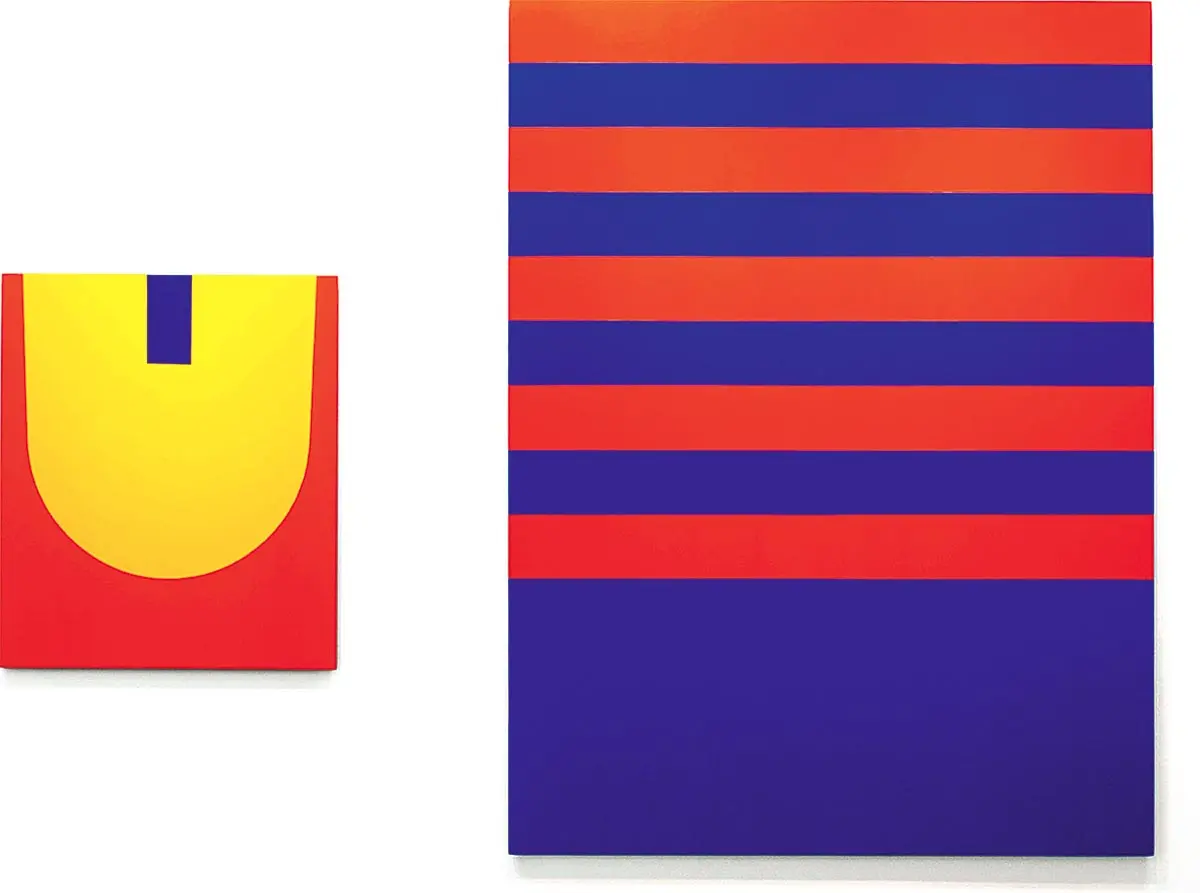
There are two paintings on plexiglass; one is a small work and the other a much larger piece. This contrast in size between the two works was conceived by Ballardo to emphasize the importance of the larger one. There, in addition to playing with form and color, the artist relies on the elements of size and supremacy, drawing an analogy between his works and pre-Columbian art, which gave great importance to size. The materials he uses in his paintings are surprising. Instead of canvas, Ballardo relies on various materials like plexiglass, steel, and airframe fuselage parts: wings, doors, tails, and wing flaps. Ballardo uses the parts of small airplanes to reference the bird feathers used to make textiles from which he also draws the geometric forms of his works. Likewise, Inca ceramics and ornaments with bird motifs and geometric designs also inspire him.
But Ballardo does not want this influence to be perceived. Otherwise, his proposals would resemble those by artists who base their work on pre-Columbian art, such as Fernando de Szyszlo, Pedro Caballero, or Enrique Galdós-Rivas. His analogy is: pre-Columbian art is ancient and there is much creativity in their geometry; in conceptual art, diversity is paramount, thus the generous use of geometry and color. The piece Portal, for example, is the door of a small rectangular airplane painted with geometric shapes, similar to a feathered ceremonial poncho. The door is of the same yellow color, and the linear details are in the same place and painted with the same colors as the poncho. The main detail is that while the sea waves that decorate the lower part of the poncho are wavy, in Ballardo’s piece they are actually linear, in zigzag. The artist does not repeat the form identically, he changes it.
All the works by Ballardo consist of many parts, with the exception of some sculptures made with parts from small airplanes. The piece titled Expedición (Expedition) consists of twenty-eight stainless steel paintings on plexiglass, becoming a sculpture rendered like a painting. In Ballardo’s work, the duality of form, color, and media is paramount. According to Ballardo, his work represents a “chromatic study of feather textiles that I have found in archeology museums during trips in Peru, Chile, Ecuador, Brazil, and Colombia.”2
In a piece consisting of two paintings, the small painting titled Plumario Naranja y Azul (Orange and Blue Feather Mosaic) was, as its name indicates, inspired by a ceremonial feather poncho. It has three colors: yellow, which is semicircular and gives the poncho its shape. Yellow represents the Sun god. Then there is orange, which represents dusk, and blue, a small stripe, which represents the hole on which the head is placed. The larger painting is titled Horizontes Paralelos Chancay (Parallel Horizons Chancay). Once again, as its name indicates, it depicts the horizon of a seascape sunset. Chancay is a city by the ocean that has a lot of Pre-Columbian art. This work only has two colors: a blue stripe and an orange one. In the bottom section, there is a thicker stripe in blue, which represents the ocean. The other orange stripes represent a sunset by the ocean.
With this exhibition, Ballardo opens new criteria for the analysis of Pre-Colombian art. His art surprises us with the use of geometry and colors.
NOTES
1. Interview with the artist. January 2017.
2. Interview with the artist. January 2017.
AUGUSTO CHIMPÉN