Multimedia artist Carmela Gross, whose career began in the 1970s, a turbulent time for the Brazilian art scene, has sustained the sharpness and critical capacity of her language into the present. This was in clear display in Arte à Mão Armada (Art With a Deadly Weapon), her recent exhibition at Chácara Lane, a group of preserved Nineteenth-Century houses now belonging to the Museu da Cidade de São Paulo. There, the artist presented as her main resources the visual appropriation of mass-culture elements, records of her urban interventions, and space-based works of art.
The exhibition offered a panoramic view of the Gross’ production over a fifty-year career, featuring fifteen series and nearly fifty works both historical and new, as well as extensive, never before exhibited documentation of her art and her creative process. Among the novelties were facsimiles of all of the artist’s project archives. Hundreds of documents, including drawings and studies, shone a light on Gross’ creative process in works like A Negra (Black Woman, 1997) and Carimbos e Carimbadas (Ink Stamps and Ink Stamping, 1977). Also included in the show was an installation inside the Morumbi chapel, property of the Museu da Cidade de São Paulo.
With a Doctorate in Fine Arts from Universidade de São Paulo’s School of Communications and Art (ECA-USP), Carmela Gross has worked with a diversity of languages (drawing, lithography, stamps, heliography, photocopying, and video art) and has experimented with the transposition of different media. For Douglas de Freiras, the show’s curator, in these fifty years the artist “has focused on works where the presence of the city and of the elements that build it and make it work is salient, works whose key characteristic is the radicalism with which art can challenge and critique the normal state of things, the logics of the city, and its own logic.”
Exhibited on the first floor, Escada (Ladder) was the result of the artist’s wanderings, accompanied by a number of colleagues, in the São Paulo periphery, spray can in hand, in 1968. “A mud wall seemed like a good spot to paint,” Gross reminisces in the exhibition catalog, adding that on that occasion she attempted to use color to compose the lines of an “impossible ladder” on the earthen material.
In those years (Brazil’s dictatorial regime passed the AI-5 Decree as a censorship instrument in 1968), Latin American art had developed an urban scale and a political accent; Carmela Gross has maintained those postures to this day, as her exhibition showed. One example was the posters on display in the second floor of the museum, including those that give the exhibition its title, Arte à Mão Armada (2009). What the artist calls her lambe-lambes were distributed for free to visitors all through the exhibition period.
The urban language that characterizes the work of Carmela Gross was also present in her legendary A Negra (1997), which references a 1923 painting of the same title by Modernist artist Tarsila do Amaral (1886-1973). The large volume created using tulle on a metal structure on wheels ended up as a great disfigured mass, and the sensation it produced was of a giant ghost-like woman parading through the streets, an “object-image that mixes with the sound of the street, the cars, the noise, the lights coming from the buildings, the shops, the billboards,” Gross explained.
In her dialog with Brazil’s neo-constructivist tradition, Carmela Gross has created works like Feche a Porta (Close the Door, 1997), a series of iron tubes fastened to the walls with hinges and intended to be manipulated by the public. Their texture to the touch and their sound bring to mind the bichos created by Lygia Clark (1920-1988). The influence of Athos Bulcão (1918-2008), creator of modernist tile mosaics, is also noticeable in Gross’ work. Bulcão gave construction workers the freedom to mount the panels as they wished, and Gross used a similar method in Pensas, Achas, Pode, Gosto (You Think, It s
Seems to You, Maybe, I Like It), from 1996: a large series of twenty monotypes with words that were repositioned every Monday. Following the artist’s indications, the configuration of the space was to be defined by the person responsible for mounting the work, not by a pre-established rule.
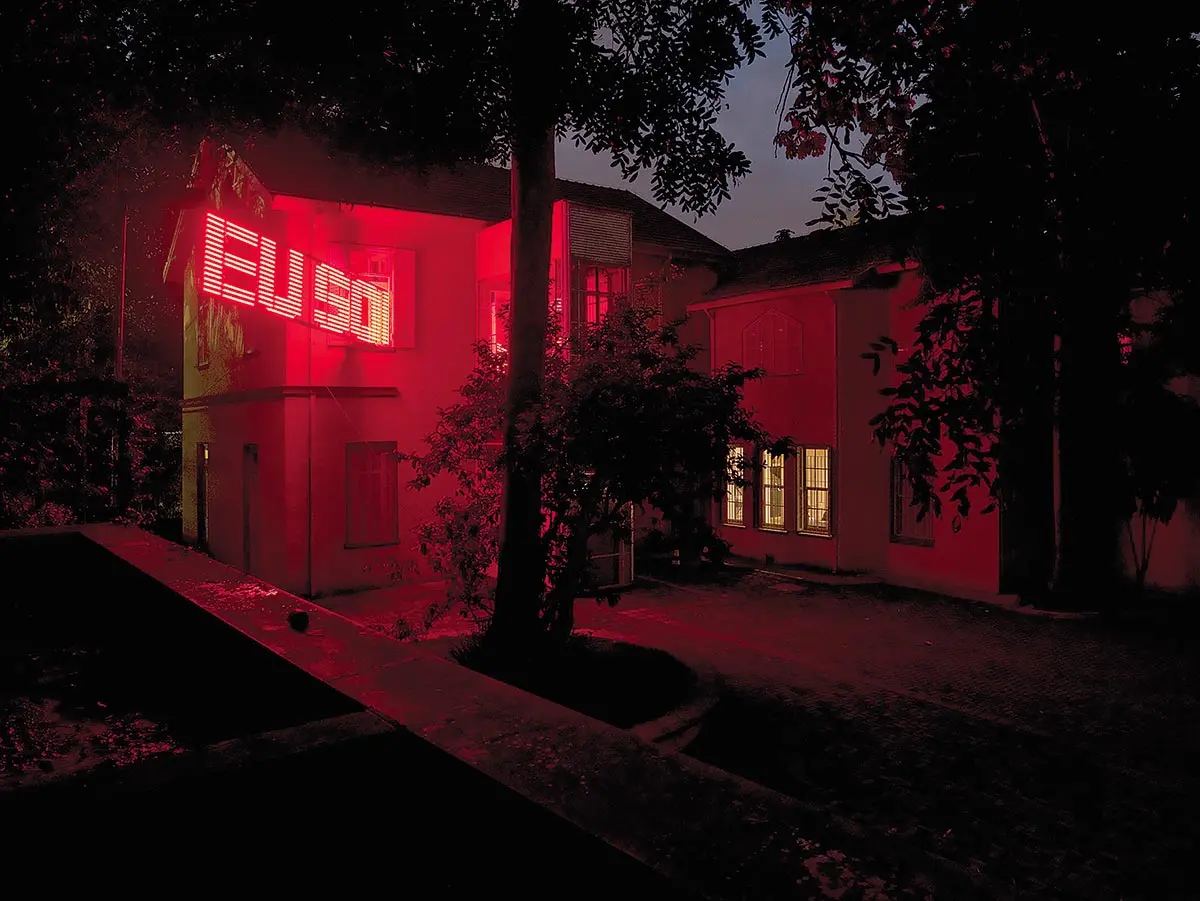
In a number of works, Carmela Gross has used large-scale interventions in order to connect art and space. The house’s balustrade was occupied by Hino a Bandeira (Hymn to the Flag, 2002), comprised of approximately 30 square meters of bed sheets in different shades of the color pink, dampened daily with water. Gross extrapolated the boundaries of space in her installation Eu sou Dolores (I Am Dolores, 2002), where nearly four hundred red tubular light bulbs attached to a twenty-meter long metal structure traverse the house’s inner space and project themselves outside.
Escada Chácara Lane (Chácara Lane Stairs, 2016), a new site-specific work, became a “sculpture-staircase” and provided a connection between the museum and a neighboring school. Gross’ intention was to reformulate artistic action in order to conceive of education as a free, creative activity as she generated, in her words, “a symbolic device that was capable of signifying the desired leap, a dual staircase that could cross over the fence and made possible a passage from the museum to the school and from the school to the museum.” In that way, and as she reasserted her political and libertarian avocation, Carmela Gross reinforced her current commitment to the erasure of the boundaries that separate art from life.
ALESSANDRA SIMÕES