São Paulo’s Casa Triângulo presents a solo exhibition of works by Rio de Janeiro artist Eduardo Berliner, curated by Priscyla Gomes and Felipe Kaiser. Berliner worked for a year in the creative and production process of the works included in the show, titled Corpo em muda (Mutating Body).
As the starting point for the production of the 120 works featured here, Berliner studied the scale of the gallery and its gigantic proportions, which immediately posed a great challenge: it would be necessary to harmonize large formats with works in smaller dimensions to present a broad spectrum of the artist’s thought. The large scale would allow him to explore large formats and harmonize them with smaller ones.
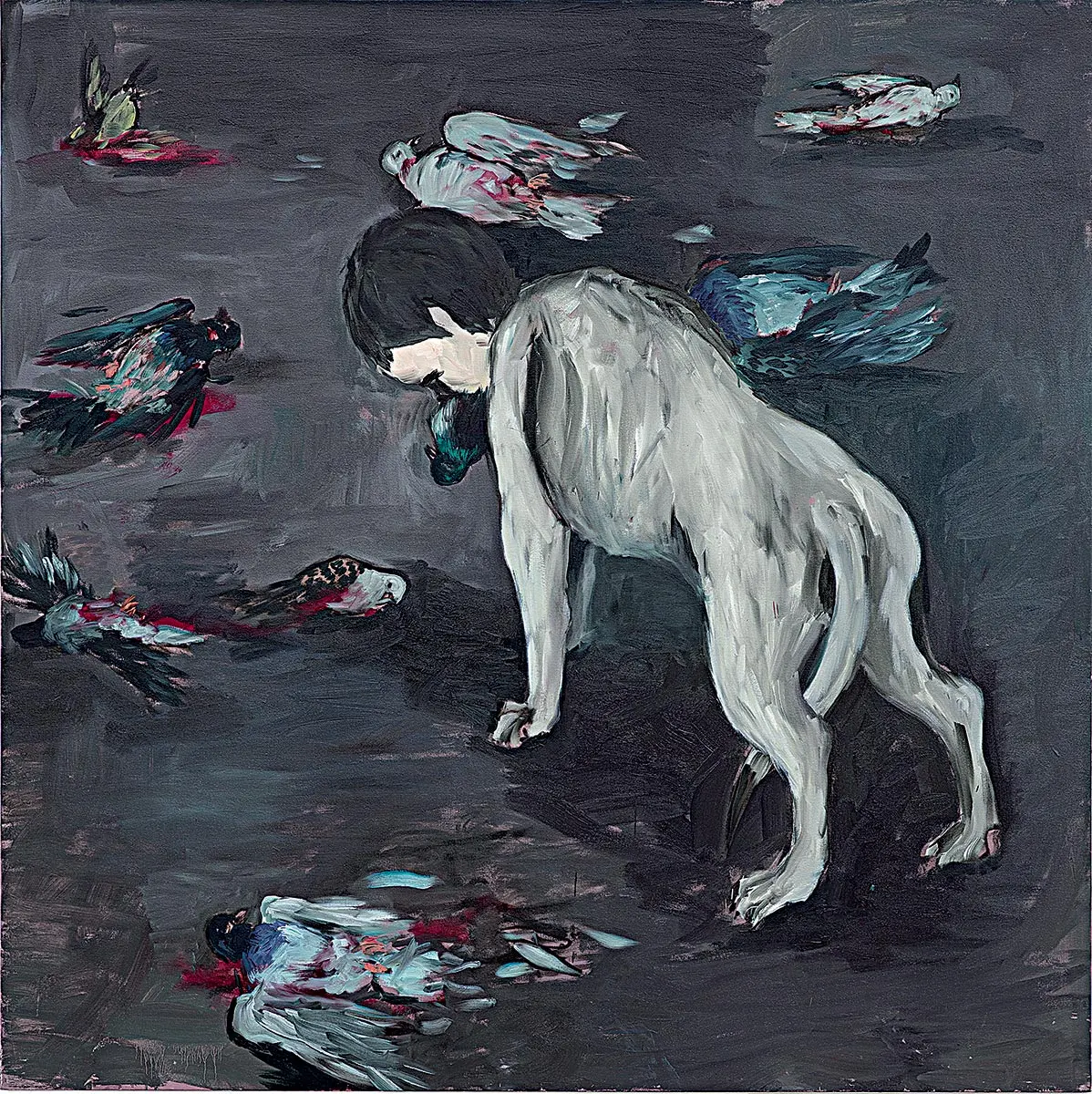
The imaginary universe that populates the artist’s thinking is on display in a variety of paintings, drawings, prints, and watercolors. Berliner’s unique grammar eschews rules in order to make room for images generated in his own mind. According to the curators, Corpo em muda was built in the exhibition space on the basis of the artist’s relationship with Portugal-based Angolan writer Valter Hugo Mãe. Berliner and Mãe has already collaborated in previous projects. The curators of this exhibition wagered in favor of this relationship, in particular on the basis of Mãe’s work A Desumanização (The Dehumanization).
In A Desumanização, Valter Hugo Mãe tells the story of a young girl who, after her twin sister died, wonders about what will be done to her body. What is buried is tantamount to the image of the body unmade by the bugs of the earth, and the bulk of something fecund. What is thus established is the uncertain condition of the sown girl, of a body that is at the same time carcass and seed. And, in the naiveté of the child’s imagination, prompts the sown girl to sprout branches and fruits, as well as nails and teeth, in a process of disorganized growth. A mutating body that produces disparate or ambiguous elements, where unconnected parts coexist.
For the curators, to sprout, to modify, and to renew are some of the concepts associated with mutation. The term also refers to a muda, Portuguese for a young plant awaiting the action of time. These meanings imply, among other things, the expectation of development, of change, of fructification. This is precisely the anchoring connection between the works of Eduardo Berliner and Valter Hugo Mãe.
Eduardo Berliner’s artistic process runs in the direction of his emotions, his drives, and his subconscious. The artist lets his mind’s images bubble up unconcerned with following a specific line or a preconceived project. Along the way, the works that emerge from this exercise reveal to him relationships that didn’t seem to be there before.
Eduardo Berliner does not follow a linear process. The artist notes that in these experiences he has even allowed his interests to emerge gradually over the course of days, as he paints and draws without a definite goal. The daily work process helps the relationship between his eyes, his mind, and his body to become increasingly more intense. His interrogations and explorations accumulate, unmoored from time and space. They are all there, in Berliner’s memory. A collection of images and figurations that populate the artist’s subconscious. This accumulation of mental inventions intermixed in Berliner’s memory occasionally, and unexpectedly, materializes in mental images, a Deleuzian becoming.
In the attempt to give shape to these thoughts, Berliner draws, paints, and builds objects in an obsessive way. He works via memory, via observation, or on the basis of photographs either from his own archive or newly gleaned, but as the mental images come closer to his world. Berliner’s scores begin to gain form. The mental images are only a starting point. Berliner’s decisions start with his intuition, but they are not random; a guideway runs between the moment, his emotional state, and his works in process. As Berliner begins to draw and paint on the basis of some of those entry points, a visualization evolves of that which already, nebulously, populated his mind. In this way, there is feedback between the things of the world and the artist’s mental images.
Many of Berliner’s paintings deal with a non-linear understanding of time. On occasion, a single canvas can contain subjects mapped more than a decade before, juxtaposed to or amalgamated with a more recent event of a different nature. Berliner’s remembrances and distortions find a reflection in various things around him; perhaps because of this, the artist creates not only an objective record, but also something of a different nature that is often outside reason.
In exploring these sensations, Berliner builds fusions of images that interconnect and traverse his mind. An imaginary universe with its own constructions, which gain complexity with the accumulation of gestures and fortuitous events in the manipulation of the medium. Despite it all, however, Berliner’s images are material. Each work is established as a body in the presence of its observers. In the end, Eduardo Berliner gambles for the ambiguity of seeing: what is recognized and what isn’t in the canvas, paper, or wood support. A permanent interplay between abstraction and figuration underlies his debates about his own imagination: it is also a question of pigment, light, size, and distance.
Between the imaginary and the physically real, these mutating bodies overflow Eduardo Berliner’s senses, revealing the connotations that are present in his figurations. Valter Hugo Mãe’s seed girl is not echoed in Berliner’s work by means of a direct reference, yet in both authors, we find the point when a potential for change brings together the most diverse pathways on which to germinate the stunted and the humorous, the prosaic and the brutal.
HÉLCIO MAGALHÃES