
Enrique Tábara-Zerna (Guayaquil, 1930) is one of the most recognizable Ecuadorian artists of all time. So much so that upon attending one of his exhibitions artists Oswaldo Guayasamín said the following: […] there are two painters in Ecuador: Tábara-Zerna and I.” Beyond what an exhibition like Latin American Collection by Enrique Tábara-Zerna—on display at the Sala Multifuncional del Museo Antropológico y de Arte Contemporáneo (MAAC) during the month of November of 2016—may be able to show, when one happens to personally know the human being behind the production, it is possible to be certain of the existence of an interior world that politely rejects any protocols in order to focus on the rigor of creation.
Consisting of thirty-five pieces created between 1954 and 2004, the exhibition includes works made with oils, inks, pencils, tempera, serigraphies, and mixed media that offer a survey of some of his portraits from the pata-pata (Leg-Leg) series1 as well as his more informalist production. These are works that, while being apparently simple, reveal a person truly focused on projecting essences. Besides recurring to a figurative painting mostly centered on portraits and landscapes, Tábara-Zerna has also been part of tendencies like informalism, neo-figuration, fluctuations influenced by Uruguayan artist Joaquín Torres-García, as he eventually evolved into a singular artist immersed in a continuous process of reflective exploration about the matteric possibilities of art.
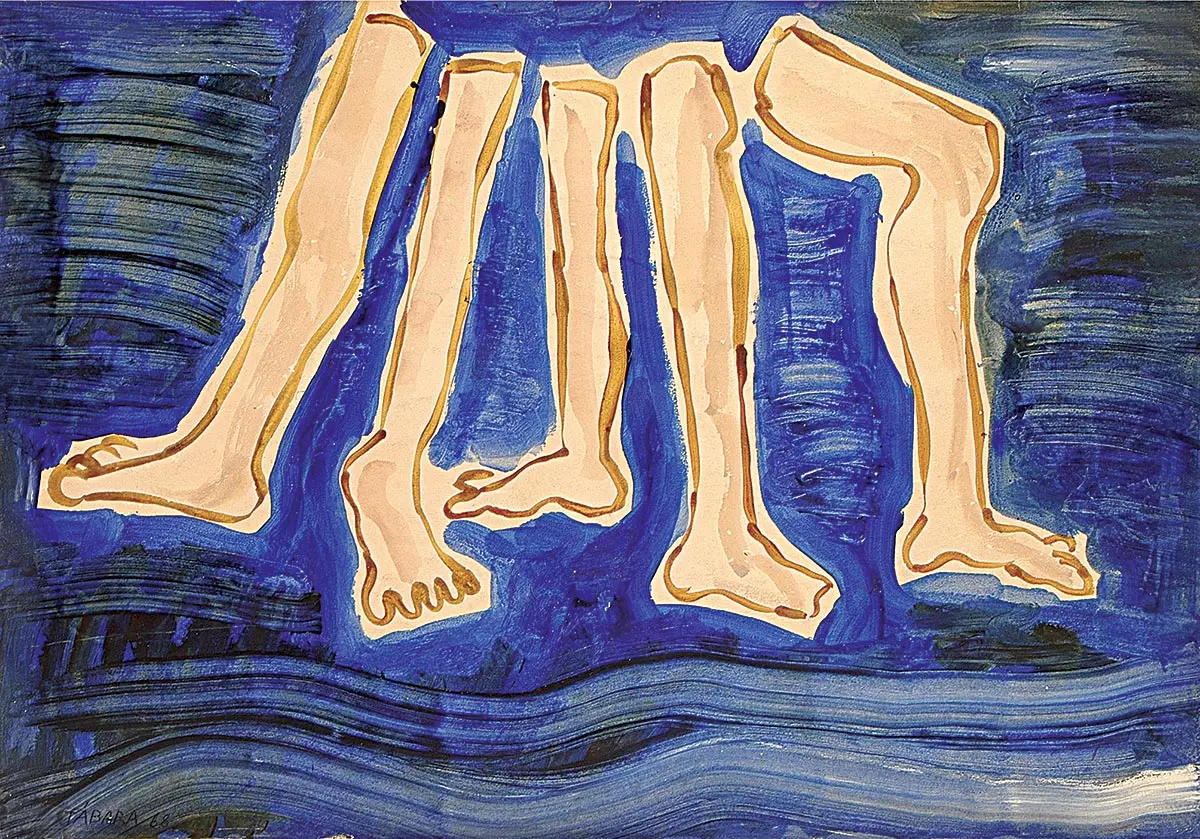
During his childhood, Enrique Tábara-Zerna greatly enjoyed observing nature for long periods of time. He found in the natural world valuable motifs for his compositions of butterflies, trees, landscapes, and human figures. He has said that he has always been fascinated by the colors of these elements and the challenge of capturing them in their most ethereal dimension. A reflection of this can be found in pieces like Mariposas (Butterflies), Celeste Limón (Light Blue Lemon), Enredo del Bosque (Forest Entanglement). They follow Tábara-Zerna’s desire to emulate and stir that which is primitive. Some of the works from his series pata-pata (Leg-Leg) emerge with similar expressive force, among these: Sobre Fondo Azul (Over Blue Background), Las Patas (Legs), Atigrado (Striped). Influenced by pop, they became some of the most controversial works exhibited in Ecuador. Echoes from that aforementioned tendency influenced him during his youth. Conceptually these pieces are also reminiscent of those wak-wak trees from Indian and Islamic cultures during the Middle Ages, in which the vegetal kingdom was associated with the origin of our species. The man-plant worldview that obsessed the conquistadors and that was expressed in traveling diaries occupied a central place in this exhibition. Perhaps it was on his return to Ecuador, after having been in contact with Spanish informalism and Parisian surrealism, when Enrique Tábara’s decided to associate feet with his roots, very much in the manner that eastern regions have done so in their harmonious vision of the world. And he achieves this without affectations, all-the-while remaining true to the visceral sense of experimentation that can be appreciated in his artistic production.
There is one work that conveys Tábara-Zerna’s passion for resorting to the abstract geometry drawn from Mondrian’s legacy and enriched by Torres-García, but without ever renouncing its regional roots: Precolombino (Pre-Columbian, 1968). Created with mixed media on posterboard, it is one of the most convincing pieces in the exhibition. An artist fortunate to be recognized with the International Swiss Abstract Painting Prize in 1960, Tábara-Zerna was personally invited by André Breton to participate in the International Surrealist Exhibition held in Paris, a member of the Spanish informalist group. He was also invited to participate in the São Paulo International Biennial (Brazil) in 1961. Four years later, Marta Traba said about him: “There is no other painting in Latin America that, like Tábara-Zerna’s, so precisely expresses not-being indigenous.” On his return, it must have been very difficult to have to deal with the conventionalisms of Ecuadorian society.
To defend creative freedom and to adopt a radical position against the institutionalist prerogative to evade local languages, he became a member of the VAN group. To face the situation, the group organized the anti-biennial and showed controversial works. When in his work he decided to alter the abstract language with the aplomb and insolence offered by pop art, he was saddled with not responding to what the critics of the time in that context considered Latin American art. It is then when he began to include in his work legs of a referential nature; the same ones that during the 1980s would also hang from his atypical trees. It is during this period when he produced the work titled Rojo Vertical (Vertical Red, 1980), a piece that marks the return of Ecuadorian democracy initiated a year earlier. A sequence of feet—which by that decade already wore shoes—rendered with a warm red, attest to the hunger for change and massive tendency towards the ideological context in the making.
There are a group of works displayed at the beginning of the exhibition that belongs to Tábara-Zerna’s figurative period: Muchacho (Boy)—interestingly, it is actually an adolescent girl with very masculine features—Sin Título (Untitled), and Las Chismosas (Gossipy Women). They originated during the 1950s when, motivated by the language of social realism, the artist portrayed coalmen, prostitutes, spinsters, and the world of dance rooms. This approach cost Tábara-Zerna to be underappreciated in the national artistic scene, given that by then the indigenous discourse was already in vogue—in Ecuador’s case, save rare exceptions, such discourse was often of a calamitous nature to the point of becoming demagogic.
Tábara-Zerna has been an artist who has chosen to remain distant from the “noisy world” of the media and the dilettante nature that often characterizes the local artistic scene. Nonetheless, and with an attitude to be expected from the noblest spirits when facing adverse situations, he has never rejected collaborating with institutions and persons who have asked to exhibit his work and showcase one the most solid artistic trajectories of Ecuadorian contemporary art.
NOTE
1. The “Leg-Leg” series, which began in 1954 basically uses a neo-figurative language, with some pop influences, and consists of a group of pieces in which Tábara-Zerna incorporated feet that he would eventually connect to legs, socks, and shoes. He created them with highly chromatic cut-outs from drawings. The geometrization and movement of the images alluded to a fragmented universe closely associated with Tábara-Zerna’s aesthetic explorations.
AMALINA BOMNIN