
“The unburied is a deformed figure that appears in multiple ways in past and present Latin American scenes. Sometimes, art goes after it, driven by a sinister fascination for the deformed, the improbable, the ungraspable, but as a desperate act to imagine possible forms for such a heartbreaking pathos.” Ileana Diéguez
For a while now, art has been demanded that art demonstrates a commitment to social reality in order to impact it and, perhaps, transform it. Although this titanic task has been called into question many times, there are artists who have managed to combine their aesthetics pursuits with social issues in an overt manner. In a context like ours, in which violence has been an inherent part of our recent history, art, we could say, still has a semantic field to affirm, question, and interpret the very conditions of life in the context of our reality. Inscribed in this perspective is the exhibition by artist Erika Diettes titled Shrines at the Museo de Antioquia inaugurated on November 9 of last year.
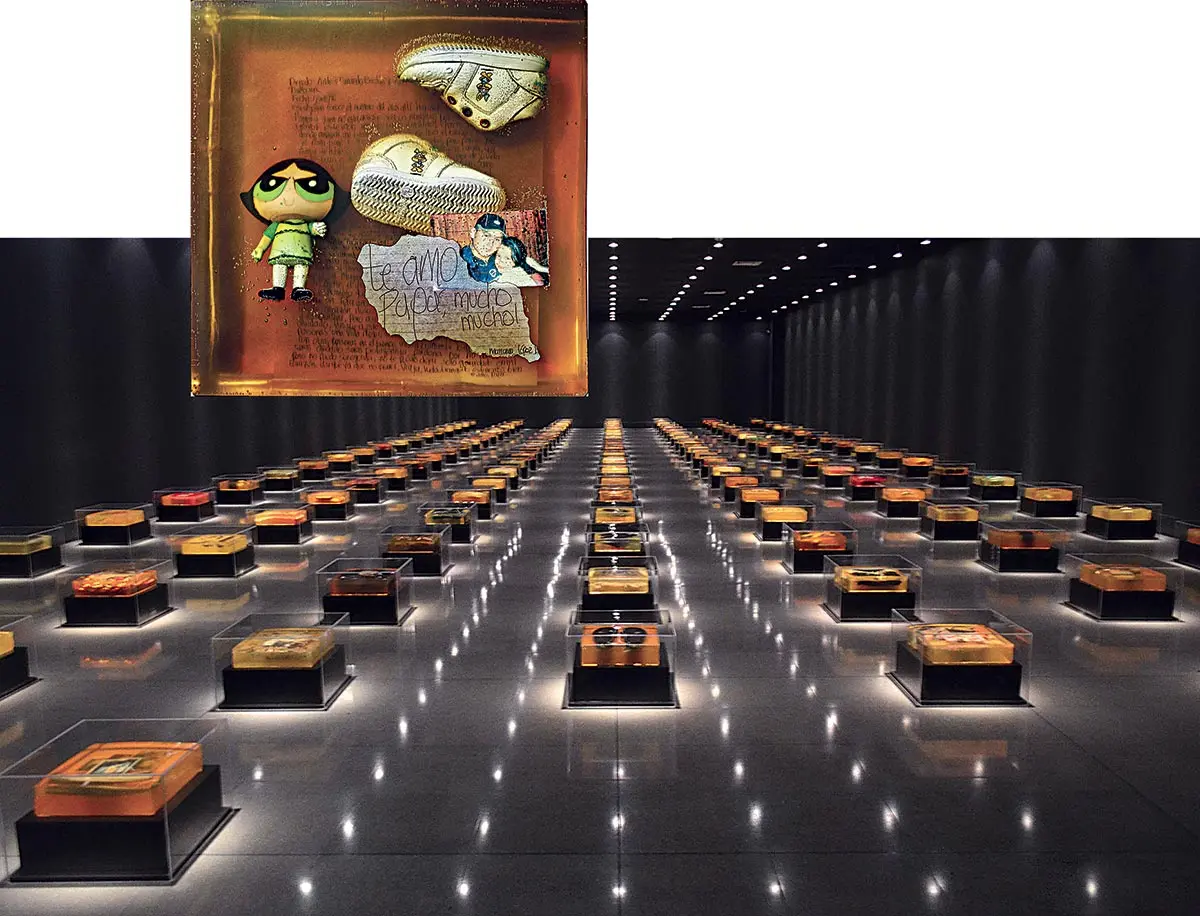
Shrines is an exhibition that, through an impeccable montage, presents objects that belonged to those who departed, as depicted in the myth of Charon, on a vessel that goes to the world of the dead. Individually, or sometimes in groups, the objects given to Diettes by the victims that she visited during several trips throughout the Colombian territory, are placed in small, amber-colored, tripolymer rubber cubes, each measuring 12 × 30 × 30 centimeters.
In this manner, through the millimetric arrangement displayed in the temporal exhibition room, in the northern section of the Museo de Antioquia, those who enter the space are confronted by a sort of sacred, solemn, place; perhaps because other persons’ deaths remind us of our own finitude, or more likely because the absence of others is a product of the violence and the armed conflict that Colombia has been experiencing for so many decades. The arrangement of the pieces (across the floor) in which the memories of the 165 families that participated in Diettes’ process rest resembles a sanctuary. They did not only participate by giving objects to Diettes, but also by taking part in the elaboration of the small amber-colored boxes.
In Diettes’ proposal, disappearance, death, and mourning find a way of being represented. The objects become a testimony to the unrest of those who face the unavoidable pain brought by the absence of their loved ones. The objects also attest to a reality taken to a small compartment in the realm of the intangible, of memory. For Ileana Diéguez, curator of the exhibition and professor at the Universidad Autónoma Metropolitana–Cuajimalpa campus, each cube represents an allegorical dwelling inhabited by the vestiges of life.
Before Diettes’ proposal, one could think that violence demands new paradigms of communication in which art must clearly play a central role. And not necessarily because it is the only approach that artists can take, since that would negate the plurality of art—since the opening to new forms of representation that emerged through the 20th century—but because art cannot escape the context in which it is produced; a context sometimes associated with the sociohistorical realities of territories outlined by an amalgam of sinister situations.
Pain, that ineffable feeling, has a place in the pieces that form Shrines, reminding us that it is a collective process. The objects and articles of clothing placed in the small amber boxes bring to the forefront the affections that those who were left behind in this world feel for those who have already departed. Perhaps, affections and memory are the only invisible bonds that try to maintain us attached to that absence present. The poetic gesture of bringing those presences to the realm of art offers, among other things, a significance that transcends the mere contemplation of aesthetic objects; it is an endeavor that repairs and offers peace to those touched by violence. In this manner, although the work by Diettes exists in a museum setting, the origins of the pieces come from life itself, and in many instances, from life in the periphery, in rural areas in which other lives are also invisible.
Shrines is undoubtedly a reconfiguration of the present. The manner in which the objects are installed, arranged across the floor, across the dark space, turns the aesthetic experience of the works into an immersion into an atmosphere of mourning in which the memories of the absent ask us to be in that back and forth that memory sometimes exerts, going through the immediate instant, and all the way to a peaceful future.
JORGE LOPERA