
The sculptures by Gustavo Toro (Pereira, 1982) are objects that increasingly move away from the image, photography, and the experiences that inspired them. The distance between the initial reference and the final piece increases under a consistent process of abstraction, which also succeeds in maximizing the meaning of the original circumstance when reformulated. During his participation in the section of Arte Cámara of ArtBo 2013, for instance, he presented a series of works (Essays of Evasion) that specifically alluded to situations in which the population of a place is confronted with water flooding issues. Based on this reference, Toro developed various objects that possessed micronarratives that rejected a documentary approach. The works consisted of deformations and assemblages that suspended the information about their origins and sparked new hypotheses.
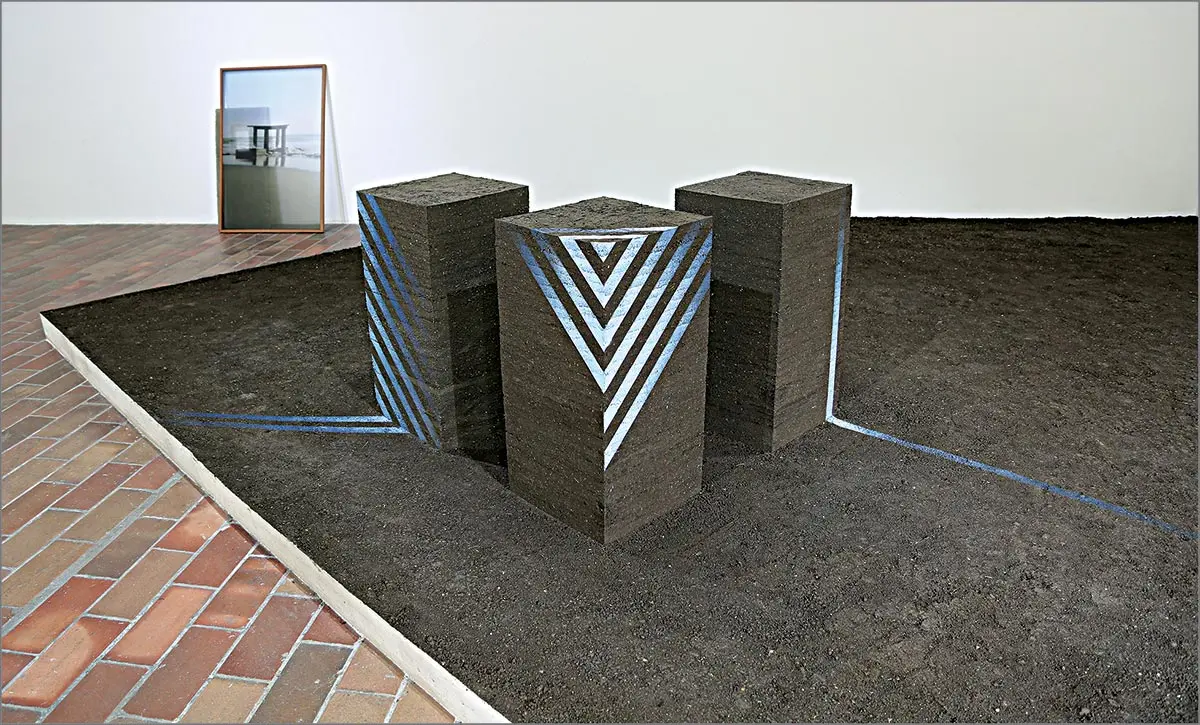
With Regard to the Place, the exhibition by Gustavo Toro at the Museo La Tertulia, was produced as part of the Program C. conceived by the Museo de Arte Moderno in Medellin and curated by Juan Sebastián Ramírez. As its title indicates, the exhibition’s point of departure is a non-specific place that addresses the notion of territory as a category and concept, without clarifying a locality or town. The architectural and natural conditions shape sculptures that do not directly respond to a particular reality. The photographs exhibited do not belong to an existing place because any reference is omitted to neutralize any documentary attempt. The images are provisional landscapes that serve as the basis or the foundational myth of the works.
This exhibition presents Superficie Interrumpida (Interrupted Surface, 2014), Inflexión (Inflection, 2015), and Son las Aguas Las Que Hacen La Ciudad (The Waters Are What Make the City, 2016), along with two landscape photographs that connect all the elements as if they were part of a single installation. Despite being created in different years, they include recurrent interests as well as new ones to develop. And this is true even for the works exhibited at ArtBo 2013 mentioned at the beginning of this review. Gustavo Toro expands the idea of observing and working the natural and artificial dynamics of the territory, its transformations, and accidents. Superficie Interrumpida consists of an iron table on which several small pieces—made with concrete sheets—serve as miniature notes about construction processes observed by Toro. A thin and straight sheet surrounding a stone, for instance, alludes to architecture adapting to the landscape and vice versa. The installation is complemented by an arrangement of fine floor tiles, also made out of concrete, which in certain points are raised as if the roots of a tree were pushing them up from underneath as they subtly distort the reticle.
Inflexión is a printed image on thin and translucent silk leaning on a wall. A thick concrete sheet behind it gives texture to the image and becomes a dynamic background for the landscape. The photograph depicts a beach and concrete construction that could very well be the section of a dock still standing or an illogical temple in the middle of the sand. With these pieces, the Toro confers sculptural attributes to the image: a problematic position in the space (on the ground and resting on the wall), translucency, and weight, in addition to underscoring the reference of the landscape as image and as an object.
At the 44th National Salon of Artists in Pereira we saw a version of his work titled Son las Aguas Las Que Hacen La Ciudad, now shown in Cali. The piece is installed on a base of soil that expands it and makes it appear as if it were merging with space even more than it actually is.
The blue overtones on the soil are reminiscent of light openings or crystalline water that does not flow or move, as if the fountain had become static as if it were artificial. The fertile soil in the sculpture produces plant shoots, collapses, falls apart, and moves. As objects, the very flat and straight soil rectangles contain several contradictions that turn the piece into an anti-paradigm or an occasion for destroying the structures that we take for granted.
In connection with Gustavo Toro’s proposal “With Regard to the Place,” it is worth concluding with a note about the site on which the Museo de la Tertulia was built. For a long time, the land on which the museum was erected was a popular spa by the Cali River known as El Charco del Burro (The Puddle of the Donkey). At some point in the 1960s, the Cali River was diverted in order to extend a stretch of Colombia Avenue that, back then, only reached the Obelisk. In the process, "El Charco del Burro" disappeared and had to be filled with remnants. The exhibition acquires a particular relevance considering the architectural circumstances of a museum-inspired on the Palazzo Della Civiltà Italiana in Rome, erected over the ghost of a river. Abstraction and the rational projection of forms perhaps require a distancing with respect to its original conditions, which at some point could strengthen the sense of what is a stake with them.
BREYNER HUERTAS