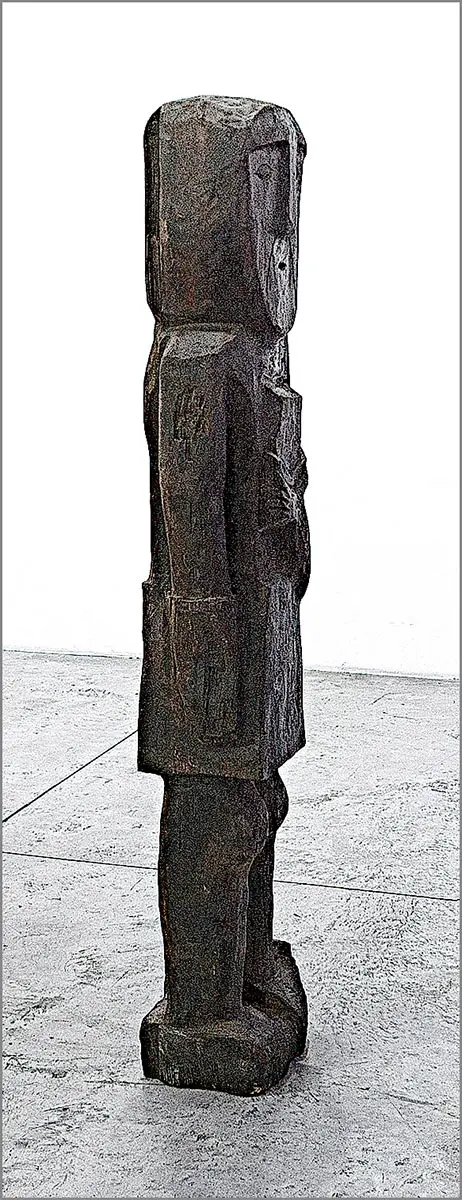
In the background, a large blue monochrome whose tone is close to the International Klein Blue, patented by artist Yves Klein in the late 1950s. It emotionally and sensorially contrasts with the old human figure carved in dark wood. The reverberation that this generates in the space cancels the possibility of turning the gaze to another place or to suddenly leave the room of projects that contain the solo exhibition by José Vera-Matos (Lima, Peru, 1981). Once there, in that peculiar atmosphere, the encounter begins to expand in a series of exchanges between the contemporary and the old, the rustic and the stylized. As Vera-Matos and the curator of the exhibition, Josefa Ortega, point out in an interview, available to the visitors, these works engage in a dialogue with Jean Baudrillard’s book The System of Objects (1968), in which the philosopher describes a series of relationships and interdependencies between contemporary functional objects and the ancient, mythical and symbolic artefact. In this regard, Baudrillard points out that: “The antique is always, in the strongest sense of the term, a ‘family portrait’.” It is in the concrete form of an object that the memorialization of a past taking place, a process that in the order of the imaginary is equivalent to an elision of time. That is to say, the temporal distance vanishes, and the proximity is potentialized in an affective body and in a specific matter. Like it or not, we arrive at an eternal kinship.
The exhibition Gold Tooth Shines Once Again approaches that and many other aspects of the aforementioned relationship. But the relevant aspect of the exhibition is not the connection established between philosophical theory and artistic practice, but rather the manner in which José Vera-Matos succeeds in eluding a mere illustration of concepts in favor of a visual and critical or reflexive contribution.
But let us go back to the exhibition and, particularly, to the monochrome surface. More than a pictorial plane, the chromatic structure serves as an undefined object, a panel on the floor resting on the wall; a rectangular minimalist element that subtly references certain works by Californian artist John McCracken or the ideas printed in the mythical text by Donald Judd titled Specific Objects (1965), in which the artist proposes the lack of definition or hybridization that, during the 1960s, occurred between painting and sculpture. Nonetheless, the pointed reminiscences lose gravitas when infected by the aforementioned figure. This primal representation consisting of four blocks or segments (head, torso and arms, waist and the lower extremities) transforms the indigo panel into a sort of monumental diorama, into an element between the mere museographic institutionalization and symbolic, sensorial, and emotive transcendence that a specific color can embody.
Then, a wide spectrum of ambiguity arises and drives the viewer’s gaze to continue exploring. It is not a walk through an exhibition in the formal sense, but rather an enjoyable being there, exactly there. It is visual contact with the features and traits of a type of sculpture that belongs to Chincha culture developed, between 800 AD and 1473 AD, in the southern coast of what is today Peru, and that corresponds, in archeological and historic terms, to the Late Intermediate Period.
However, the precise origin of this piece and its degree of authenticity is also secondary. What matters and transcends is its arcane nature. What is this object doing here, placed in such a manner and in front of a blue sheet? Are there other pieces in the exhibition that offer any clues? Indeed, there are three drawings placed on cubic supports—made of lightly finished wood that shows its grain— that, at first glance, give the impression of being geometric abstract forms, cartographies or divided territories, graphic essays, shallow tectonic planes; diagrams of some technological device, graphic essays centered on the pictorial work of Gunther Gerzso, etc. But it is actually the meticulous and almost improbable transcription of an entire book—The Jealous Potter written in 1986 by anthropologist and writer Claude Levi-Strauss. The tiny size of each letter makes it impossible to read. The text in which various myths of pottery in America are narrated becomes an image, and the relationship between the civilized and primitive worlds is accentuated in a complex and yet simple way. Confronted by these illegible drawings, the tired gaze returns then to the field, to the environment created between the two now inseparable bodies.
In this manner, the work of this Peruvian artist points to the heart of the matter, to that traumatic longing of contemporary man for his origin, for that anonymous “family portrait” of which Baudrillard speaks, as he simultaneously wields a precise and unspoken critical remark to the excessive contemporary artistic productions based on dense interdisciplinary research processes that are usually stuck in a swampy terrain of hypersensitive intelligence and knowledge.
VÍCTOR PALACIOS