Strangely silent landscapes, oils about everyday situations inside Juan Cárdenas’ studio, collages that challenge not only the laws of gravity but also space, created by the work’s frame and, finally, caricatures. This is an exhibition that covers all of the facets of this great artist from Popayan who has not shown his work in Bogota for fifteen years. Yes, there are caricatures of public personalities associated with political, economic, and social issues, as well as of entire families or simply of people known to Cárdenas. These caricatures showcase his mastery as a drawer and, most importantly, reflect a keen eye for exaggerating the neck of someone that deserves it, or emphasizing a facet that turns his characters into sort of monsters charged with irony. As it occurs with caricaturists, Cárdenas appears to be silently laughing at his subjects behind the pencil, wondering about their weaknesses, their ghosts, and even their darkest desires. One thing is what we want to show to others and another very different one is who we are in private. Cárdenas gradually reveals, unveils, and uncovers that side we all want to keep hidden. When he shows us a perversely disingenuous society, he is portraying everybody, even those observing his canvases and drawings. When spaces are disarticulated, multiplied, and colonized, they become the outcome of a possessive, usurping, need that moves us.
But this exhibition goes beyond a retrospective, beyond a show of the various artistic nuances contained in Cárdenas’s oeuvre. Beyond the artistic language, technique or format employed, the show offers us a glimpse at the way in which this artist is always having “fun” with his surroundings, transforming it, ripping it apart, or turning it into an intimate and desolated body. Cárdenas delves into the details; he explores and exalts them, and then returns them to us in their crudest and most overwhelming nakedness.
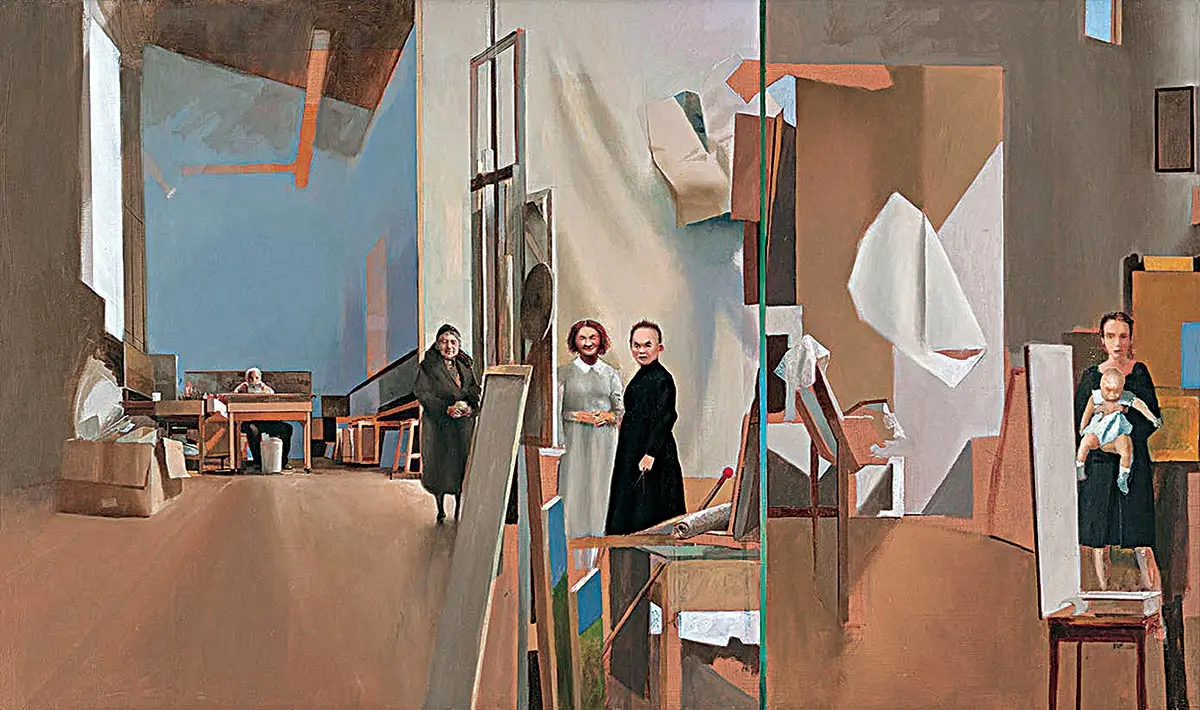
Even then, it is interesting to find in his images the silences that we mentioned earlier. Despite the irony and crudeness, the fragmentation of the spaces, and the psychological transformation of the characters, the walkthrough this exhibition is accompanied only by the sound made by our own steps. Everything else is silent, there is no wind circulation; the landscapes wait for the viewers to yell at them so the perpetual echo of that gesture is repeated in the space. When it comes to a self-portrait in the artist’s studio, Cárdenas observes viewers from behind the easel or the drawing desk—like Velázquez used to do—waiting for us to make a gesture so he can materialize it in that other “work” that he is painting. The curl is once again a curl, and Cárdenas waits for viewers to look so they can feel observed, like when one looks at the mirror and the mirror gazes back to inquire about one’s misfortunes. But the painter is painting, and the work being painted has already become the space that we are occupying. Viewers are attacked by their own fears while the artist smiles in silence. It is the same type of silence maintained in an elevator: everybody there shares the same intimate space, the same air, atmosphere; everyone hears the other person’s breath or smells the neighbor’s coffee or the perfume worn by the civil servant who just entered the elevator. We all look at our watches, our cellphones, as we anxiously wait to get to our floor so we can leave behind that box about to explode with information despite the apparent calm brought in by the deathly silence. There, during those moments, is when we see the artist finding in those tensions the magic hidden in the relationships between people and space, or the relationships between society and any given politician. Cárdenas contemplates that panorama infuses it with irony, and redirects it to the world that has recreated it a thousand times, day after day. He subjects those experiences, those details with spaces or portraits of society, to the mirrors of a world teeming with ambiguity.
Here is where the cartoonist that has been accompanying Juan Cárdenas since the beginning of his career—back when he made a living as a drawer in the periodicals La República, El Tiempo, and El Espacio—shines. Cárdenas addresses that period in an interview about the exhibition. Present throughout his work, without him it would be impossible to offer the same level of irony and sarcasm in works that are so supremely subtle. In general, his work is reminiscent of Goya’s, another artist that made fun of the world in which he lived, masterfully portraying and showcasing the extremes and limitations that accompanied him back then. Many years have gone by, but in Goya’s case and in this exhibition by Cárdenas we realize that irony is as universal and immortal as desire.
ANDRÉS GAITÁN