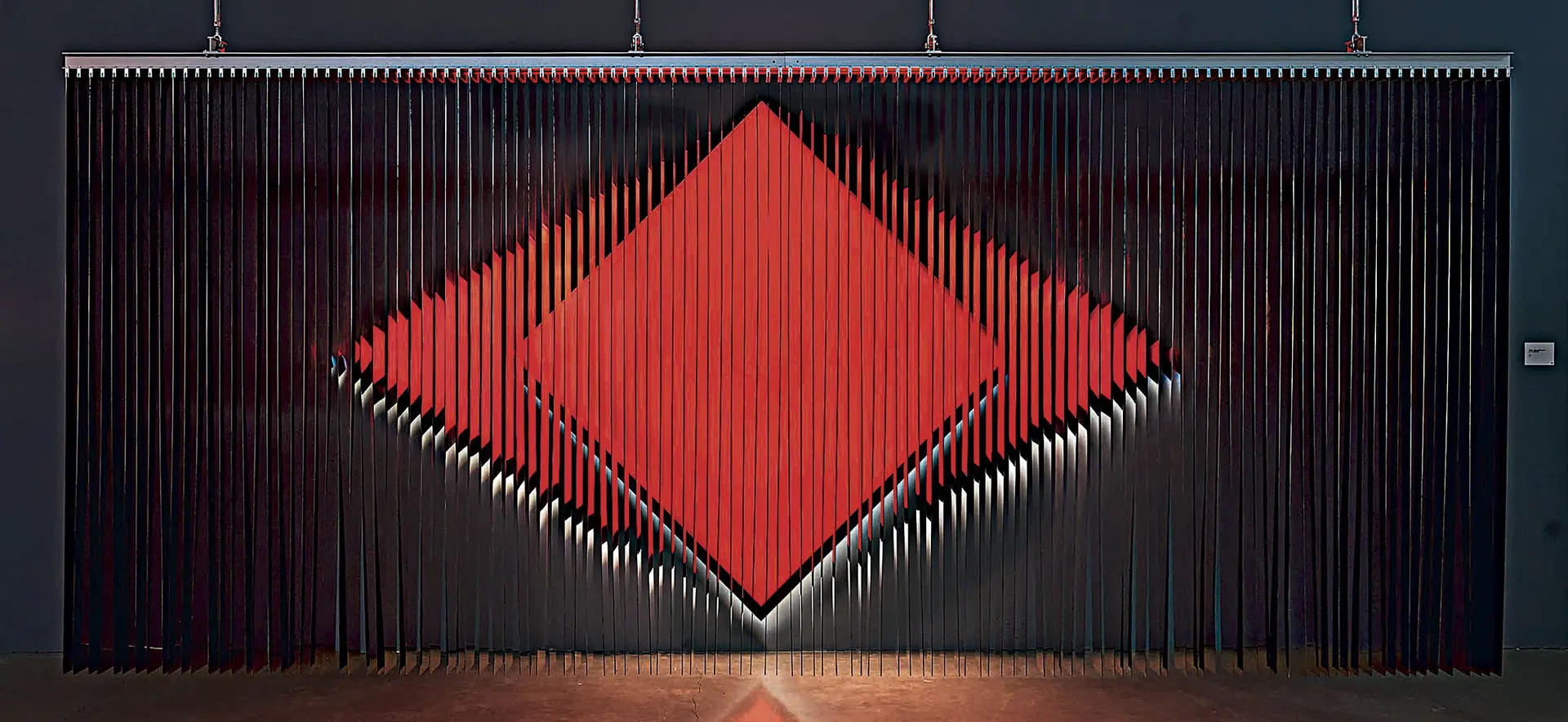
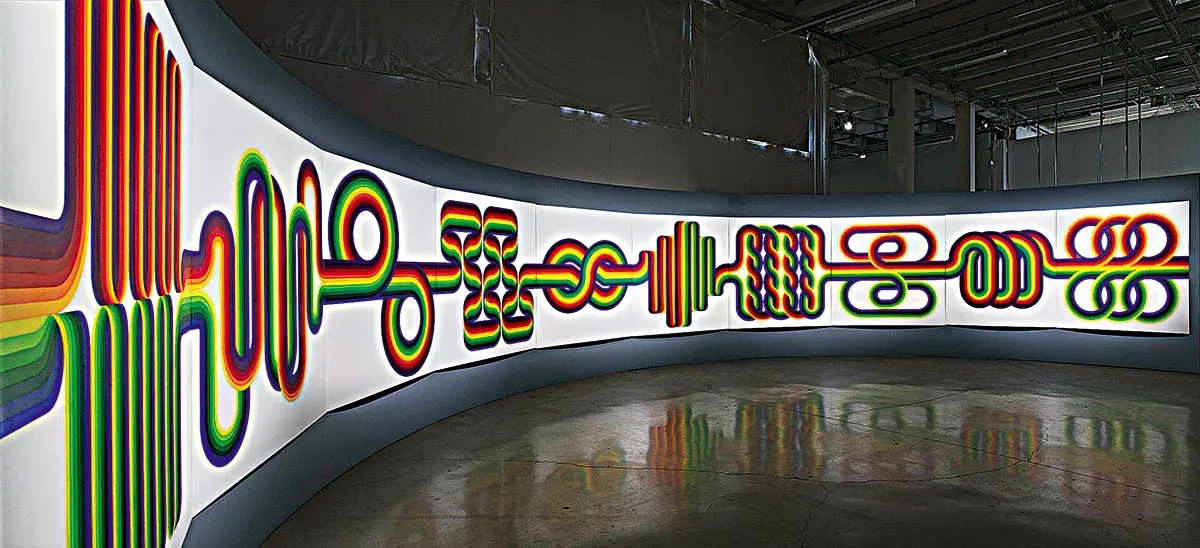
Following the theme of social empowerment, Form into Action, is divided into three thematic sections, beginning with early works on paper and paintings that show Le Parc’s commitment to color both as a theoretical construct and as a means of destabilization of the surface. Particularly notable in this first area is The Long March, a suite of 10 paintings flowing around a specially designed curving space that invites the viewer to enter and follow its sense of movement through color. The next section features Le Parc’s labyrinthine and complex installations in a sequence of three light-infused rooms that are the most disorienting of the exhibition. Called Displacement, Contortions, Reliefs, the section recreates installations first shown as part of GRAV’s participation at the 1963 Paris Biennale. For their first exhibition in the United States, the works provide the most visually disorienting experience for the viewer and accurately validate the artist’s intent to create new spatial and physical awareness through a variety of optical interventions. The viewer’s Play & Politics of Participation, where the assumed museum-constructed physical and ideological walls no longer separate the viewer from the work of art. From an almost carnival fun show encounter to the most advanced technology existing in contemporary virtual reality tools, this approach to viewer participation and collective projects began in Le Parc’s student days of political activism in Argentina, and he never lost his commitment to creating change in the way art is viewed and how it could be used for political and social commentary that focused on the participation of everyone, not just the elite. Even when GRAV dissolved as a collective in 1968, Le Parc continued to be open to working in groups and forging new directions that could play a role in current social constructs. Over the last 50 years, he revisited, recreated, and repaired works to assure their effectiveness and sense of immediacy for the viewer. Cloison à lames réfléchissantes (Partition with Reflective Strips, 1966-2005), is composed of simple red steel panels arranged as diamonds within a diamond that constantly shift optically to dominate one of the darkened galleries, in contrast to the mirrored silvered installations that surround it. One after another, the viewer’s perceptions and sense of balance, optical and physical, are challenged.
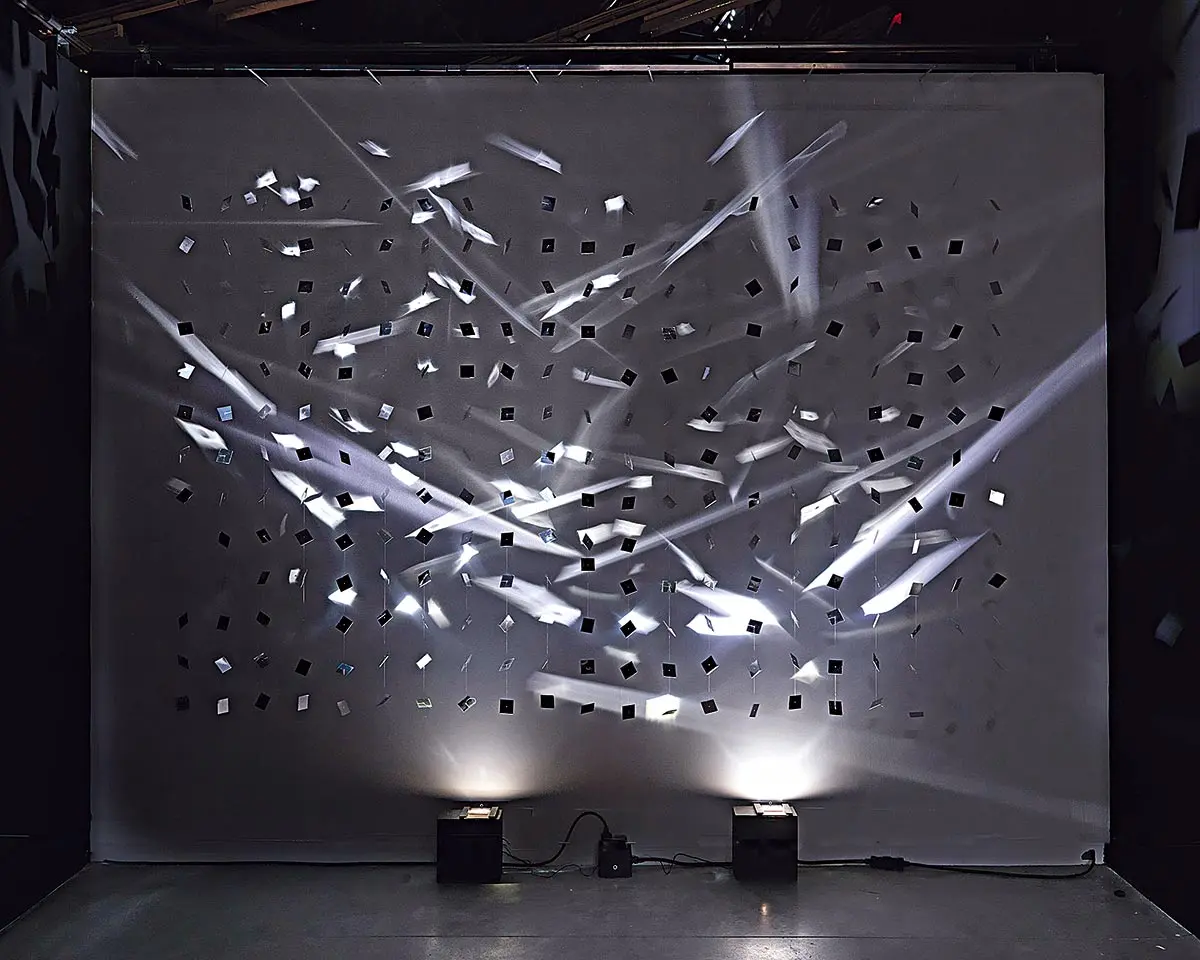
Despite the apparent complexity of the installations, Le Parc constructs his work with the basic and formal elements of painting: color, line, and form. Constantly reorganizing these elements into repetitive and serialized sequences that result in progressive systems and arrangements whose structures are as suited to two-dimensional works as they are to kinetic reliefs and large-scaled installations where light plays a definitive role and add another immersive component to the experience for the viewer. Continuel-mobile (Continuous-Mobile, 1963/2016), at the entrance to the exhibition, serves as visual preparation, with its reflective, constantly moving steel panel elements immediately introducing the viewer to what promises to be a unique art experience, that does not disappoint.
If the intention of Le Parc, within the context of his own creative spirit and the GRAV Manifesto of 1961, was to challenge the accepted views of art as something to be viewed from a safe distance by an educated audience, this exhibition succeeds. The viewer is constantly bombarded with the sensual and innovative as interaction replaces the normalcy of an individual artist’s unique control of traditional media. The final work, Sphere Rouge (Red Sphere, 2001-2012), is a dramatic closing with its constantly modulating arrangements of brilliantly lit and reflective plexiglass squares (the same basic elements) creating the intricate sensory environment. With all of Le Parc’s works, institutional walls are non-existent in the traditional sense and by the end of a walk-through of the exhibit, the young and the old, the sophisticated and the novice, have shared a provocative, yet playful, foray into the world of art created by one of its most inventive and ground-breaking masters.
* Courtesy of the artist Julio Le Parc © 2016 Artists Rights Society (ARS), New York / ADAGP, Paris. Photography: André Morin.
CAROL DAMIAN
Art critic and curator. Ph.D. in Latin American History.