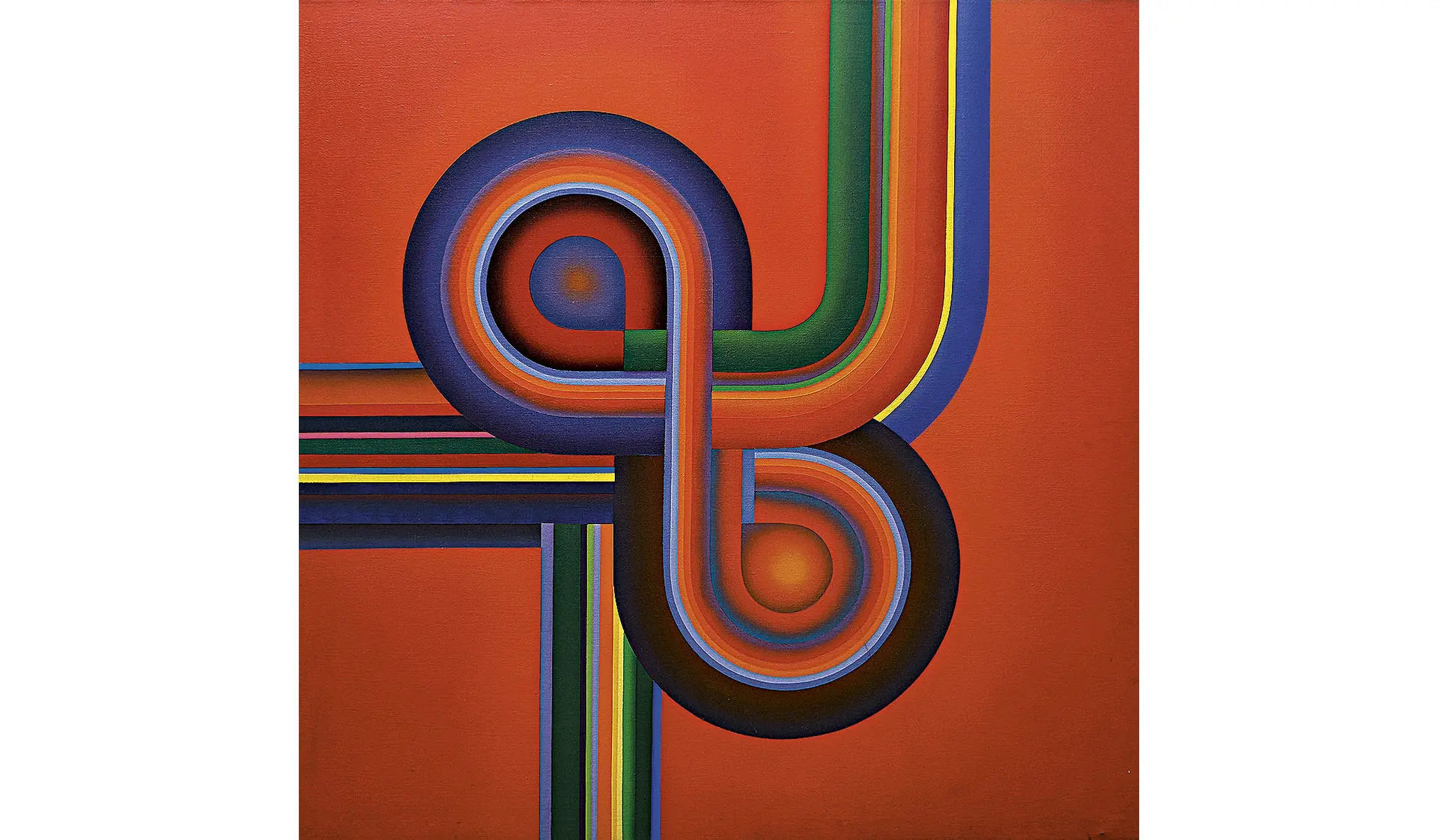
Garza Usabiaga’s curatorial proposal focuses on the years between 1965 and 1977, the period that Kazuya Sakai spent in Mexico. Those twelve years of Sakai’s Mexican sojourn were of crucial importance in his development as an artist: it was in that period that he evolved the personal style that Garza Usabiaga defines as “a geometric pattern with no equivalents in Twentieth Century art: smooth structures that distill the flat colors and the contrasted volutes of traditional Japanese landscape representations into sinuous musical scores of vibrant chromatic variability, crowding around one another to the beat of his favorite composers or sax, trumpet, and piano players.
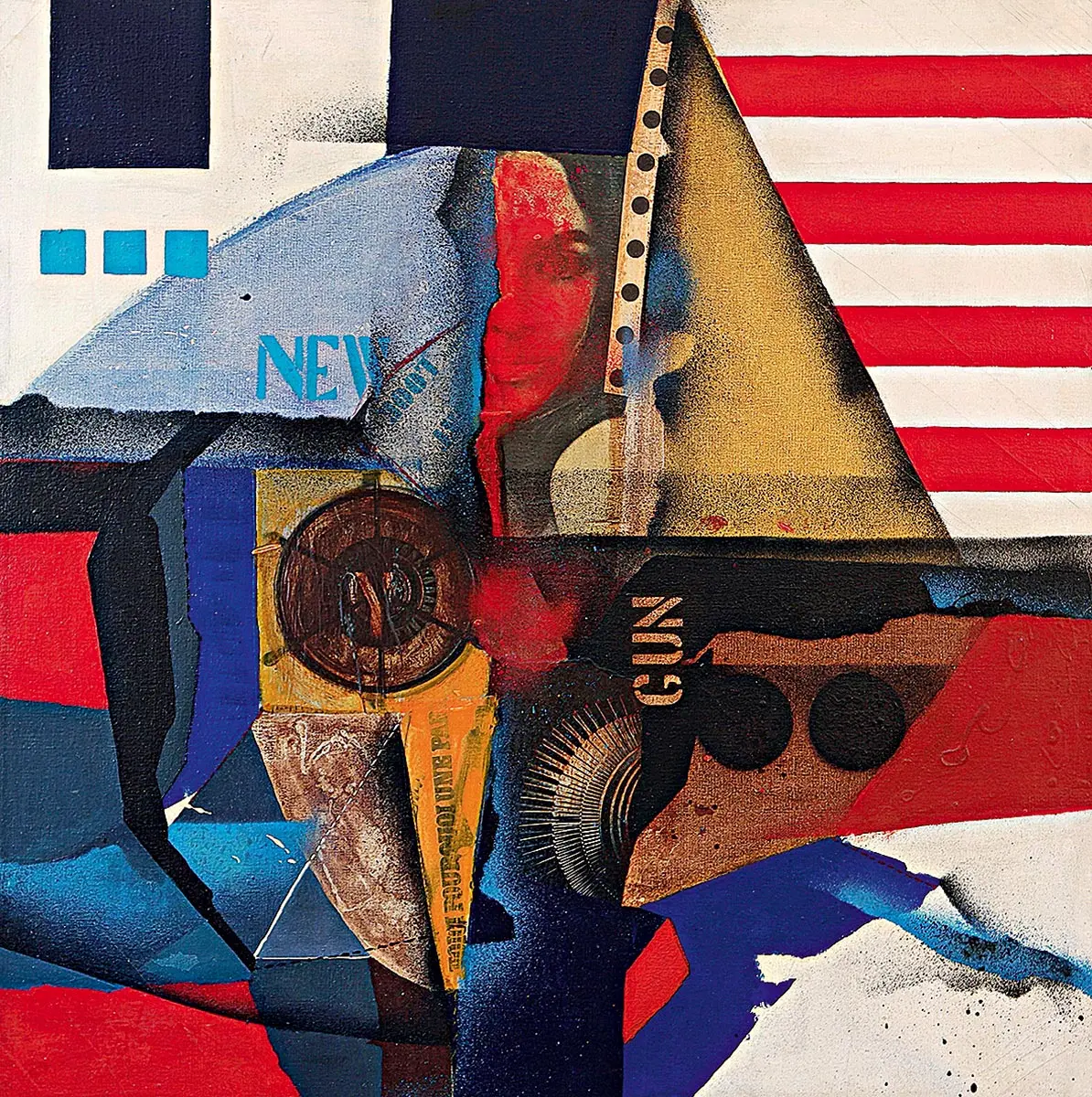
The curatorial take on the exhibition underscores the interdisciplinary character of the artist’s work and the many references that fed into it. Music, Japanese printmaking, and his own work as an art critic influenced Sakai’s pictorial production. Although it is a retrospective, the exhibition includes works by other artists, Sakai’s contemporaries who explored a similar style and whose work provided feedback for his. These works by Vicente Rojo, Manuel Felguérez, Helen Escobedo, Gunther Gerzso, Sebastián, Francisco Moyao, and Eduardo Vázquez help us understand the stylistic and formal features of what was seen at the time as Mexican geometric art. Also included in this section of the exhibition are works by Latin American artists like Julio Le Parc, whose prior investigations guided and gave direction to that late-blooming Mexican movement, as seen in the 1976 MAM show El geometrismo mexicano. Una tendencia actual (Mexican Geometric Art. A Contemporary Movement).
These projects synthesize several characteristics of the art of the period, such as its visual experimentalism, its relationship with technology, and its interest in optical effects. Sakai’s work is no exception; this retrospective at the MAM features works that incorporate three-dimensionality into the canvas in interesting ways, articulating picto-sculptural proposals that impact both the viewer’s perception and the traditional boundaries between genres.
The exhibition encompasses Kazuya Sakai’s works in a variety of genres. In terms of painting, the selection focuses on his Ondulaciones (Undulations) series, also from 1976, which is presented in its entirety in a single room for the first time. According to Garza Usabiaga’s research, these paintings find their inspiration in—and pay direct homage to—the work of Japanese artist Ogata Kôrin, who developed, on the basis of traditional Japanese aesthetics, organic proposals using serpentine shapes. In the Ondulaciones series, Sakai reinterpreted those shapes in a personal, modern style laden with optical effects. It is in these works that his most characteristic style—paintings in vibrant colors and curved geometric shapes with defined outlines—became established. All of these paintings allude to music composers and seek to provide a visual representation of musical abstraction.
In his texts for the exhibition, Garza Usabiaga points out the links between Sakai’s work and similar proposals, for example, Vicente Rojo’s series Negaciones (Negations). Sakai’s Ondulaciones are a series of repetitions understood as an “anti-assembly line where, on the basis of color and the different configurations of the solution, a difference is introduced in each repetition.” This reading provides a political perspective for our approach to the work, situating it as an alternative to the expanding world of corporate and commercial repetitions that were becoming entrenched at the time.
In the catalog for the exhibition, Garza Usabiaga informs us that the artist spoke of the works on this series as loops, which emphasizes their relationship with sound and music. The catalog, designed by Luis Miguel León, comes in a novel format, comprised of two sections: one with texts and images, another focusing exclusively on reproductions of the paintings. It is an object for aesthetic enjoyment, wholly coherent and consistent with Kazuya Sakai’s artistic proposal.
JOSEFA ORTEGA
Master in History of Art and curator.