Liuba Wolf’s exhibition at the Lasar Segall Museum, in São Paulo, presented the public with a series of sculptures and reliefs created by the artist in the 1960s, 1970s, and 1980s. The works on exhibit unveiled for visitors Wolf’s aesthetic inquiries of that period, when she fostered a dialog between abstraction and figuration, and investigated geometric representation. The basic material of her sculptures is bronze, although in the 1970s she also worked with polyester.
Among the works featured in the exhibition was one that resulted from an homage to Lasar Segall (Vilnius, Lithuania 1891–São Paulo, 1957). It was a work in plaster—a Cabeça (Head)—created to commemorate the 50th anniversary of Segall’s 1913 exhibition in Brazil. This 1964 bronze was intended for installation in Rio de Janeiro, in the neighborhood of Glória (Largo do Russel).
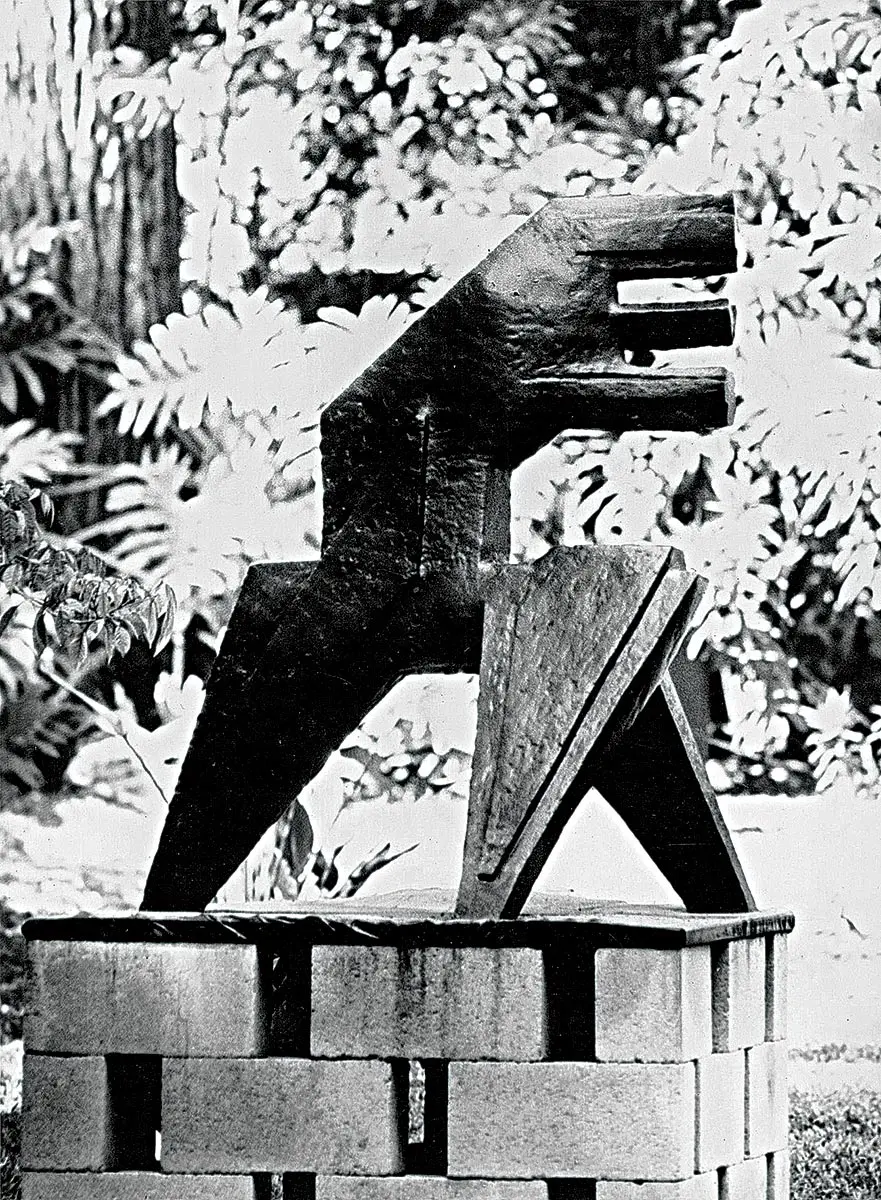
A long time had passed since the last time the public had a chance to encounter works by this artist, except for those that can be found in museum collections. The first time that Liuba Wolf’s works were exhibited after her death in 2005 was at the most recent Mercosur Biennial (2015), and it is only now, in São Paulo, that audiences can have direct contact with her production.
At the Segall Museum, Wolf’s large-format sculptures, made for exterior spaces, were on display in the garden, and her medium-format works were arranged inside the institution’s exhibition space.
Liuba Boyadjieva was born in Sofia (Bulgaria) in 1923. She was raised in a privileged, cultivated milieu by a writer mother and industrialist father who (he also played the violin) instilled in her a taste for music. The artist received a humanistic education, studying Greek and Latin and mastering the piano. When her family moved to Geneva, she attended art school and developed a special interest in sculpture. Later, she studied in Zurich under Germaine Richier (1904-1958), a renowned artist of the Paris School.
This contact with Germaine Richier had a strong impact on Liuba Boyadjieva’s education as a modern sculpture and left a deep imprint on her understanding of sculpture. In those years, in Zurich, she was also in contact with a group of important artists, like, among others, Marino Marini and Arthur Honnegger. At the end of the war, when Richier reopened her atelier in Paris, Liuba moved to the French capital and continued her studies with her teacher until 1949.
Her social circle in France included Zadkine, Viera da Silva, Alberto Magnelli, among others. She traveled often throughout Europe and visited the most important museums.
Liuba Boyadjieva came to Brazil, married the industrialist and collector Ernesto Wolf in 1958, and lived between São Paulo and Paris, keeping studios in both cities. She became a naturalized Brazilian citizen. She developed a personal way of working her sculptures and achieved full artistic maturity. In the 1960s and 1970s, Liuba Wolf exhibited her work in several cities around the world and achieved international recognition. In 2001, on the occasion of her exhibition at Achim Moeller Fine Art. Rizzoli (New York) published a book celebrating Wolf’s art and featuring Sam Hunter’s essay “Liuba: At the Edge of Abstraction.”
Among the central features of Liuba Wolf’s work are her expressive power, the surface’s play between the smooth and the textured, and rusticity. Verticality is another key characteristic, as well as the gesturality of the forms. Figurative early on in her career, Wolf’s works became abstracted starting in the 1950s, but there always remained an archaic memory that referred back to primitive archetypes. Some critics, like Sam Hunter, see in those shapes a reference to pre-Columbian realities. Another highlight is a degree of surrealism in Wolf’s abstraction, yet critics mostly underscore the fact that she situated her sculptures at the border between abstraction and figuration, as well as the force of imagination in the conception of the works.
On more than one occasion Liuba Wolf said that her forms are born from the subconscious. For her, they are “bugs”, animals, but they can also be plants or roots. They could be totems, in a symbiosis between the animal and the plant worlds, according to another observer, artist Emmanoel Araújo. Liuba Wolf stated once in an interview that her work “finds inspiration in natural shapes.”1
The exhibition at the Lasar Segall Museum made it possible for visitors to reengage with Liuba Wolf’s sculpture, revitalizing the aesthetic dynamics it prompts in its viewers. Curators Jorge Schwartz and Marcelo Monzani selected twenty-seven works for exhibition, and situated Liuba Wolf as one of Brazil’s most important female sculptures, alongside María Martins, Felícia Leirner, Sonia Ebling, and Pola Resende.
NOTE
1. Interview with Liuba Wolf. Chefs d´oevre de l´art, nº 105, 1965. Cited by María Alice Millet in Liuba en Río de Janeiro –Marcelo Guarnieri Gallery. May, 2016 (catalog).
LISBETH REBOLLO GONÇALVES