
According to some hunters, foxes would rather lose a limb caught in a trap than letting deception get the best of them. Others affirm that when foxes fall into those much larger bear traps they are driven to escape despite any fractured limbs. Some carnivores are born to be free, and they much rather enjoy their freedom than become prey to other beasts and their killing methods.
In his Notebooks, the exemplary sufferer of “Our America,” José Martí, wrote poetry about the course of being captive: “And I will tear out your love that hurts me, as a fox caught in a trap amputates with its own teeth the imprisoned limb. And I will walk the earth bleeding, but free.”
It was perhaps the flow of this legend that inspired the intervention Soliloquio del Zorro (Soliloquy of the Fox, 2013), a proposal by Lorena Guitiérrez included in the group exhibition titled To Break the Walls and presented at the Museo Nacional de Bellas Artes (2013-2014). The piece consisted of fifty rusted traps laid out on the floor in one of the exhibition rooms dedicated to contemporary Cuban art. A “mined space” that insinuated the problem of being an ordinary person trying to survive as an artist during difficult times.
Such allegory, interpreted through the physical absence of the “clever immortals,” expanded to the canvases created by Antonia Eiriz and Raúl Martínez. They also had to behave like foxes to save the skin of that "Great Dictator": The neglect caused by hegemonic intransigence. To confer symbolic meaning to the lapse of rescuing grey matter or to receive a dignified burial in foreign land constituted the visual wink of pairing instinct with longevity, animal reason with human intuition.
Soliloquio del Zorro was perhaps the trigger that led to Rust, an exhibition by Lorena Gutiérrez-Camejo (Havana, 1987) presented at the Galería La Acacia during the months of November and December of 2016). Here, the curatorial principle was centered around the local extremes of abstraction and concrete reality, glamour, and decadence, practical aesthetic and theoretical propaganda, signification, and wear.
Solemnity as means to an ironic conclusion allowed for interacting with the rigidity of a happy and temporary world. Gutiérrez-Camejo chose to play with the illusion of turning that virtual altarpiece of real failure into something eternal.
What place in the collective memory of obscure smiling peoples is occupied by a washed medal or a general executed by a firing squad in the name of a patriotic embarrassment? That which stays as the malleable residue is a nothingness governed by routine and simulation. When neither winning nor losing are options, then the old fox’s tail is the one thing that remains to erase the footprints of the inglorious bastards.
“Power gives and power takes away,” acknowledged a former official of the cultural structure turned freelance promoter with broken wings. It is no accident that Rust represents the most ambitious and minimalistic proposal by Lorena Gutiérrez-Camejo. It is also no accident that, rather than the expected outburst of resentment, the discursive leitmotiv was channeled by a lack of purpose. So much so that is the predominant characteristic becomes the fusion of essence and appearance.
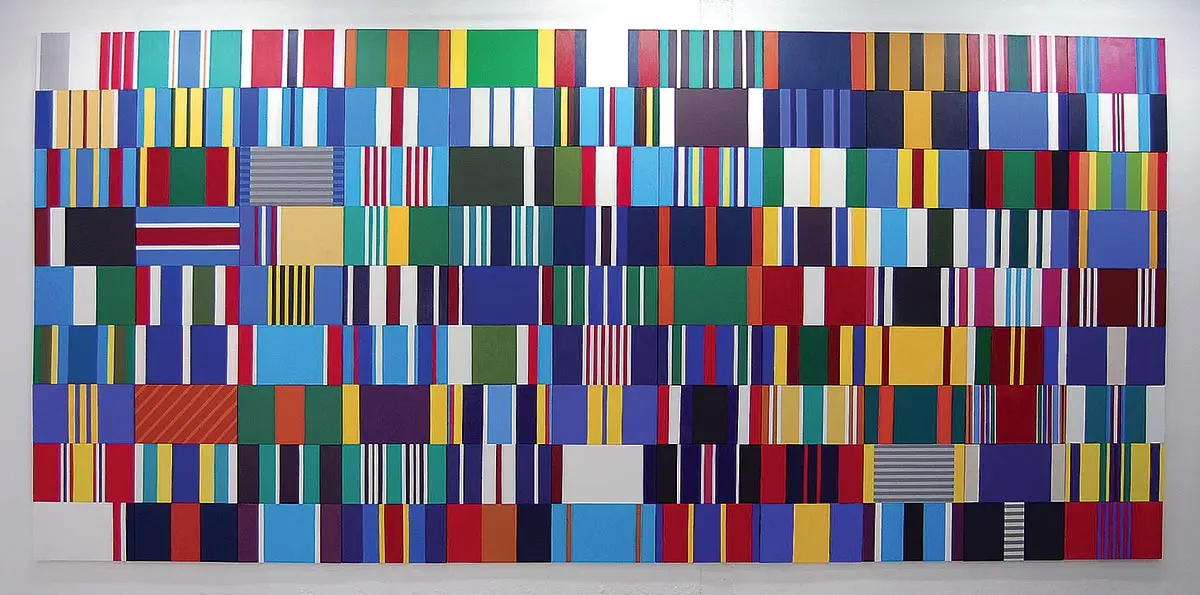
¿Dónde están los Héroes? (Where Are the Heroes?) is a pictorial surface fashioned with ninety-nine original military distinctions from the famous Cold War triad: Cuba, the US, and the former Soviet Union. Once again, the end of a story facilitated the beginning of another aestheticization of chaos, to satirically restore what Hannah Arendt called “the banality of evil.”
“Life is always someone’s death,” said Antonin Artaud during an instance of mental calm. This is a sufficient enough reason for the value of a medal to find its purpose in the price of a painting, light as a form and heavy as an idea.
The century of names announced by the nomad Arthur Rimbaud lacked meaning in an abstract composition, where it is impossible to distinguish imposed leaders from chosen ones. To reproduce and gather the colors for the epic implied making it legible for those who proudly vegetate while ignoring matters of principle. It is purely visual demagoguery: superficial politicization as visceral apoliticism.
A sketch of the infinite plan to link an organic ideology between a controlled hell and a disordered paradise was attempted in El Vacío de Mi Reflexión: Réplica de Una Hoja del Periódico Granma (The Emptiness of My Reflection: Replica of a Page From the Granma Periodical). The piece was constructed with lead movable types used in printing. Disorderly arranged the golden letters looked like a hieroglyph that should be read like a puzzle.
Some observers thought that the framed ingot on a pedestal represented a sort of tribute plaque without identity; an allegory for those who could deserve a personally subtle collective recognition.
Rust was at its most vague in the work Patrón 0 (Rosa) [Pattern 0 (Pink)], a multicolor embroidery where pink prevails as a representation of a redesigned military medal collection. In the end, recognition was replaced by an aleatory structure capable of exonerating it from any suspicions of making up content. The emptiness traps synthesized by Lorena Gutiérrez-Camejo reaffirmed that, once the histrionic repertoire of a purple fantasy has been exhausted, evoking a chromatic delight weaved with merciful hands is comforting.
HÉCTOR ANTÓN