
There is no doubt that since he began exhibiting professionally, Luis Cruz Azaceta (Marianao, Cuba, 1942) has been one of the most vital of contemporary artists. One of a handful of Latino artists who entered the mainstream by the mid-1970s, his fluid and multi-layered style (defined by critics and curators over the years as Apocalyptic Pop, Social Expressionism, Post-Geometric Narrative, etc.) has allowed the public to perceive him and his art in a complex manner: he is a contemporary artist formed in New York who lives and works in New Orleans; a Cuban exile and Cuban-American, a Latino, and a social and political painter. The philosophical and formal solidity of his work survived and transcended the shallow neo-expressionism of the 1980s. Within Latino artists, he is among the “elders of the tribe,” such as Amalia Mesa-Bains, Rupert García, and Pepón Osorio. In recent years Cruz Azaceta’s trajectory has been acknowledged by an A Ver series monograph (2014, written by this reviewer), the inaugural exhibition at the American Museum of the Cuban Diaspora (on view in Miami through March 23, 2017), and a book of interviews by Prague-based author Carlos Aguilera (Madrid: Taurus, 2016).
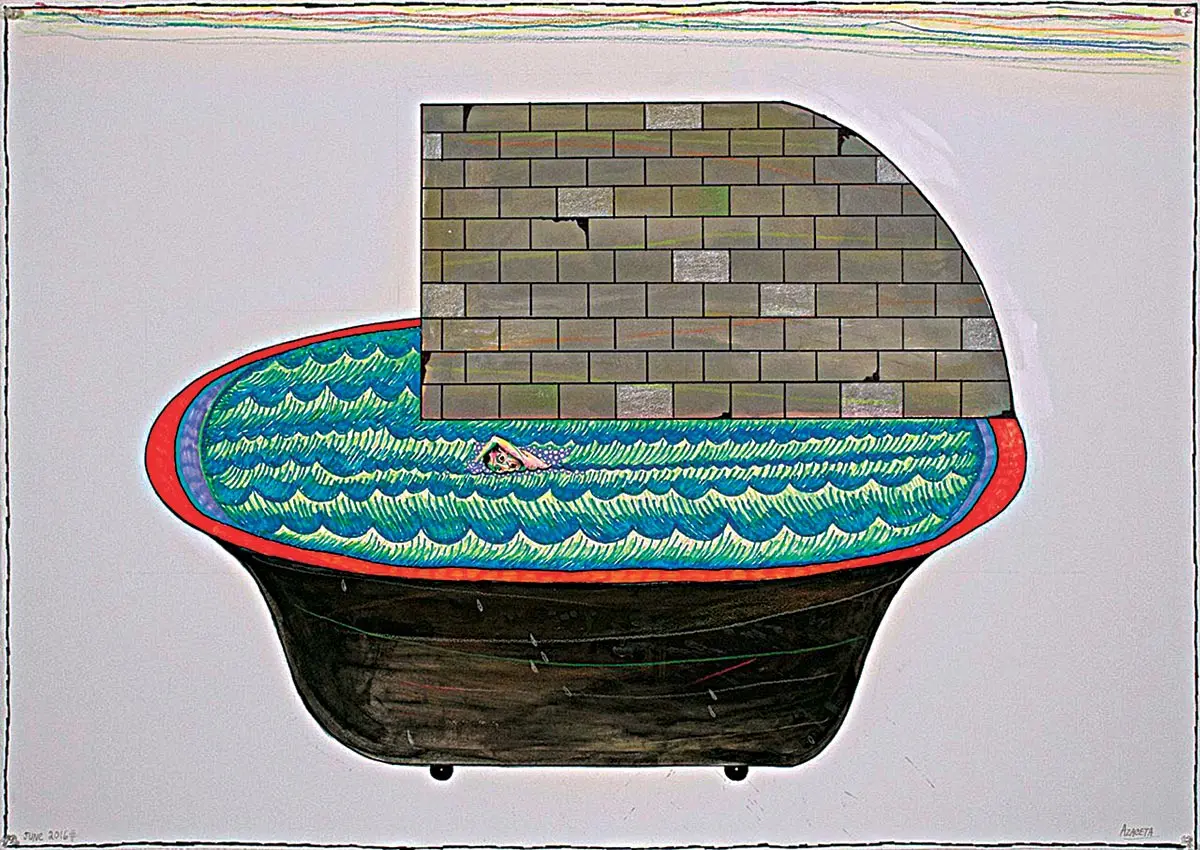
A recent body of work was presented at the New York space of the Lyle O. Reitzel Gallery under the title Swimming to Havana. Starting in 1980 and the Mariel boatlift, Cruz Azaceta began depicting balseros – rafters (the men and women who flee the island in make-shift boats and inner tubes), and by 2009, in the words of the artist, he had “reversed the flow,” “lived the journey through a mental trip.” His drawings, paintings, and mixed-media objects started representing rafters or solitary swimmers trying to get back to their place of origin, but getting lost in labyrinths or hitting concrete walls that keep them from reaching the homeland. The exhibition at Reitzel is filled with this kind of imagery, explored via acrylic paintings on canvas, marker drawings on paper, and an altered manufactured object.
The paintings are large, and the intimate space of the gallery is a bit tight around their bold forms and loud colors. Of the three canvases, the one dated 2010 and titled Swimming to Havana at Night, is the strongest, with its cock-eyed geometric shapes constructing a hermetic world in a palette of blues. The single self-portrait-like figure (a constant in Cruz Azaceta’s iconography) in the composition swims in a dark and threatening sea, which is enclosed. The exhilarating pieces in the exhibition are the drawings that are executed in markers and the washbasin transformed by the artist’s brush. An elaborate orchestration of colors and a linear pattern, charged with what can only be defined as quirky whimsy, endow these drawings with a freshness and lyricism that bring to mind masters such as Klee and early Dubuffet. Cruz Azaceta’s abilities as a colorist of the great range are visible in these drawings made with simple markers. Pinks, purples, and blues bounce off sections of gray, thereby creating a push and pull field, which engages as an active pictorial surface. The formal language pulls the viewer in, and then we encounter the content, which is deeply disturbing. The exile is trying to return to the land he was forced to flee, but forces beyond his control prohibit his action. The object Basin-Swimming to Havana, 2009, demonstrates Cruz Azaceta’s inventiveness in taking a mass-produced utilitarian object and transforming it into a piece charged with subtle pathos. The viewer is grabbed by the calm blue color of the basin, looks inside, and finds a swimmer’s body cutting through the water, anxiously trying to get back to an unreachable shore.
In a text written to accompany the exhibition, Cruz Azaceta states that these pictures are about “an absurd journey enclosed in a labyrinth with no exits. Swimming to nowhere.” The artist’s words underline the absurdist vision on which a substantial component of his production is grounded. In this pictorial universe, Sisyphus instead of pushing a boulder up a hill swims in an endless sea and never reaches dry land. Yet the overall tenor of the exhibition is not one of despair, but rather of a life-embracing resistance. No matter how bleak the historical moment, Cruz Azaceta’s “little man” continues to go forth. Like a character in a Samuel Beckett play, he says “I can’t go on. I must go on.”
ALEJANDRO ANREUS