
The Alejandra Von Hartz Gallery presented a selection of two vast photographic series produced in recent years by Argentina-based Guatemalan artists Luis González-Palma (1957): Hesequía and Koan.
A drastic departure from the mostly figurative production that González-Palma is known for, these two recent bodies of work by the artist delve into the introspective space of abstraction. González-Palma uses several tools to manipulate/create his images: he resorts to old photographs, objects, scanning, and digital photography to explore the sensitive and emotional space of geometric plans from the perspective of several formal and conceptual strategies. His exploration appears to reflect on a particular moment in the history of photography. As Joan Fontcuberta points out in his most recent essay titled La Furia de las Imágenes (The Fury of Images): “It is obvious that we are immersed in a different visual order and this new order appears to basically be marked by three factors: the immateriality and transmitability of the images, their profusion, and disponibility; as well as their decisive contribution to the encyclopedization of knowledge and its dissemination.”1 González-Palma discredits the camera’s realist representation and relies on different methods to achieve his purpose: wonder about the life (history and memory) of the photographic surface at a time of immateriality, speed, and immediacy.
The first exhibition room presented two large pieces created in 2016, La Luna (The Moon) and Cometa Halley (Halley’s Comet), digitally printed on rice paper, with folds and clippings in the form of a collage. They were accompanied by a selection from the series Koan and Hesequía. Voluntary iconoclasm. To make the moon, saints, priests, and nuns disappear through retouching, by folding or Photoshop is the same as erasing the scientific and/or religious history that has accompanied us through our Western history.
These removals turn the image into an act of faith, magic, and transformation. In this manner, González-Palma’s once figurative work gives way to an imaginary that is no longer there, showing the mark that attests to its existence like a sacred mantle.
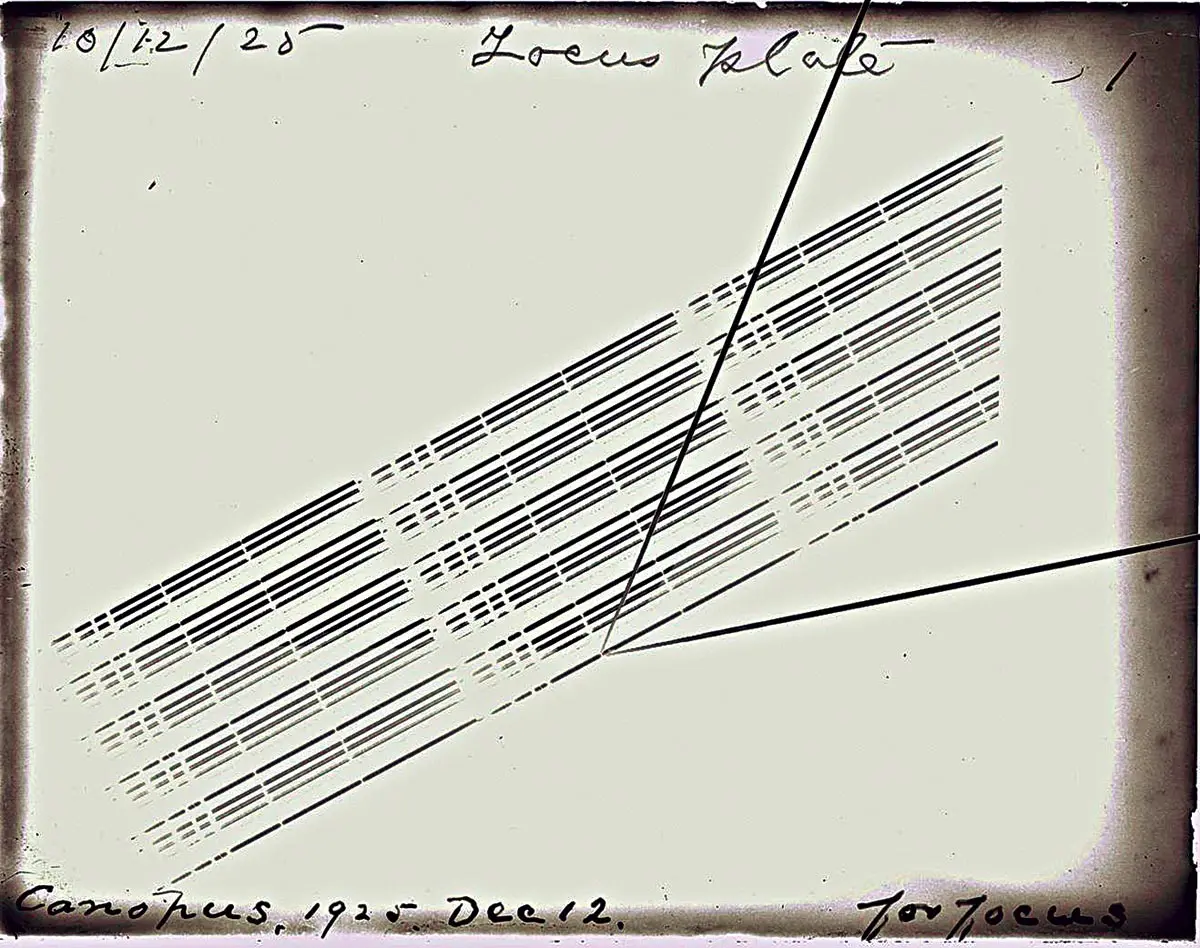
Two large digital prints and some collages on tracing paper from the series Koan are representations captured from the archives of the Astronomical Observatory in Córdoba: La Luna and Cometa Halley (2016), Eclipse de sol. Polvo Cósmico (Sun Eclipse. Cosmic Dust), and Espectros (Specters) show González-Palma’s interest in, on the one hand, answering what does observing once again the constellations, the sky, and the stars mean and, on the other, questioning the idea of the specter and the radiations that are imperceptible to the naked eye. We know that these strategies for photographing, appropriating, suturing, erasing, folding, and observing stars speak of a fragmented and inquisitive way of perceiving the natural reality, of an attempt to return to the roots, to that virginal gaze of past civilizations attempting to build cosmogonies in order to understand the world. How did we photograph and look at the world before digital photography? How do those images from the past survive in the immediacy of the present? These are questions that González-Palma appears to be formulating. Although he does not reject the uses for digital technology, he continues to maintain a close connection with analog photography, especially in the formal sense.
The work by González-Palma is incorporated into a temporal space that compiles photographic memories, gathers knowledge on emulsions, wet plates, and digital scanning to, on the one hand, reflect on a more complex conscience that reveals emptiness, the geography of the photographic surface; and, on the other, to reflect on the archive of time, on the memories produced by mankind and stored in series like Hesequía (which, according to monastic orders, means a state of stillness and silence). In that series, González-Palma begins with recovered photographic plates made by XIX century Guatemalan photographer Juan de Jesús Yas and scans selected images from which he erases the portraits of priests, religious images of virgins and saints, leaving only the backgrounds exposed. The background becomes the subject of the work. A background that has served as support for those religious images and that now, devoid of them, speaks only about the silence, about that void and the inaudible passing of time; namely, memory, a reconstructed memory. Marks, traces, time, and absence become protagonists, emulating the sacred mantel in which a trace replaces the subject. Like an archeologist looking for new interpretations and perspectives González-Palma searches for meaning both in those traces from the past as well as in those from the present.
The second exhibition room continues with images from the Koan series, the folds from The Moon series, and the Specters series—printed digital photographs also on rice paper. Constructing pictorial planes, pentagrams, and lines from the recovered plates, in the manner of shoji, as Junichirô Tanizaki referred to in his book titled In Praise of Shadows, in the following manner “… basking in the faint glow reflected from the shoji, lost in meditation…”
González-Palma has said that photography and technique are not the things that are most appealing to him. He is most interested in the mysteries contained in the images. Therefore, each body of work demands specific supports and treatments that allow the artist to contain the tensions that he wants to underscore.
Far from those faces of the past, a new identity and memory are being forged: intimacy, silence, the gaze, and the representation of the invisible represent the new point of departure. Manipulated images gradually disappeared from the support to give way to space for introspection and reflection on the vertiginous nature of the medium and, to comment on the existential void, which is materialized by González-Palma in a sensitive and emotional manner in order to talk to about that which is not representable.
NOTE
1. Joan Fontcuberta, La Furia de las Imágenes. Notas Sobre la Postfotografía [The Fury of Images. Notes on Postphotography], Ed. Galaxia Gutenberg, S.L. Barcelona, 2016
AMALIA CAPUTO