
Luis Roldán was born in Cali, Colombia, in 1955. He studied architecture and later taught himself art. Then he did some traveling, stayed for a long while in Wisconsin, and finally settled in New York City, in Harlem to be more specific, a place that he favored for its multicultural neighborhood. He has been living there for the last nineteen years.
Curated by Nicolás Gómez and Ximena Gama, Periplo is a retrospective exhibition of the work produced by Roldán between 1986 and 2016. It expands across two large exhibition rooms, allowing for the display of a body of work that combines structure and randomness. In other words, work that oscillates between the concrete and abstract realms or between the local sphere—understood as his explorations of the city, history, literature, print advertisements, mundane rituals, etc.—and a type of visual thinking able to contain all of that complexity and turn it into a sort of art energizing talisman.
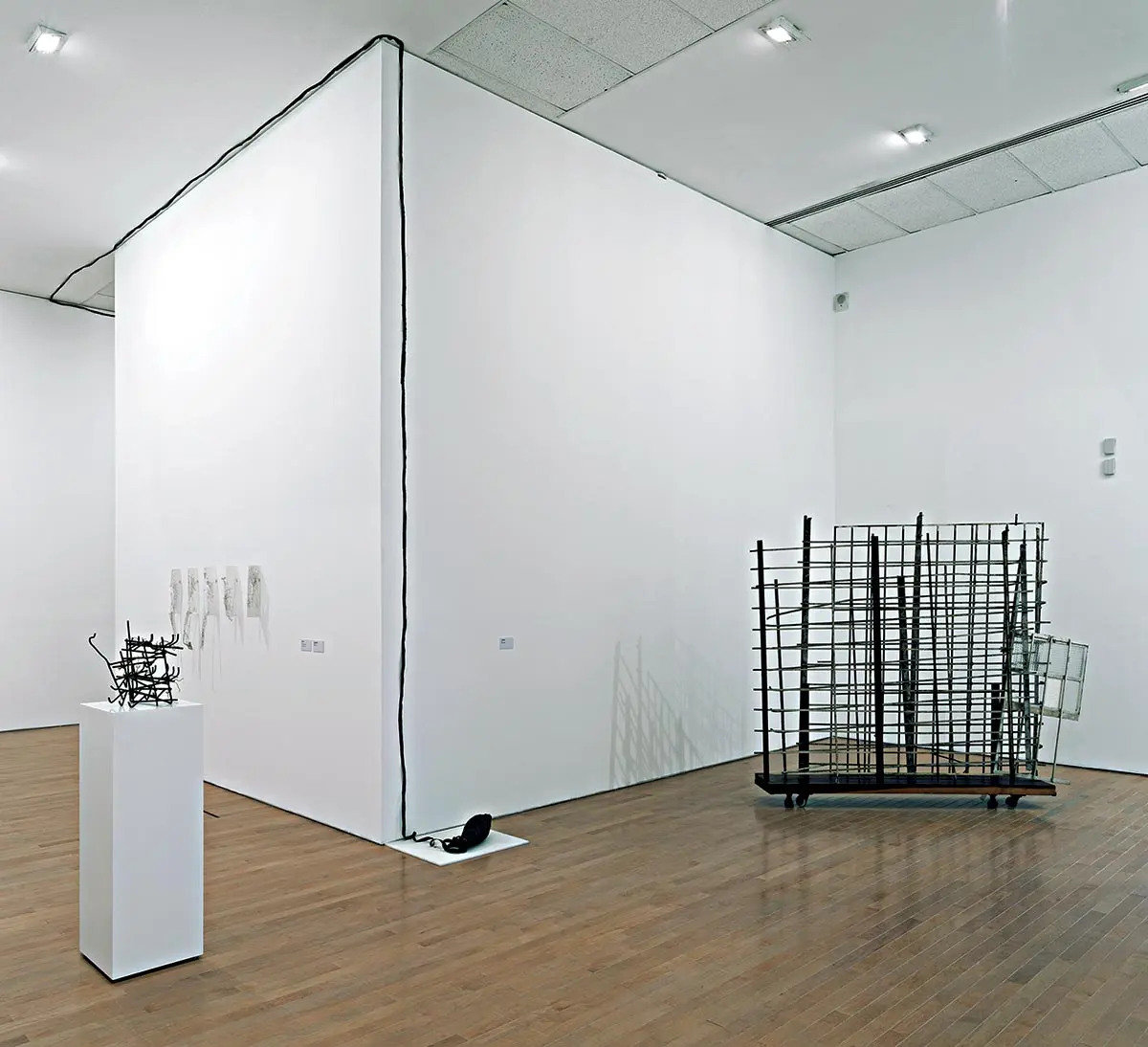
As I walked through the exhibition rooms of the Museo de Arte del Banco de la República in Bogota, I was reminded that the art that interests me is the one that looks for several interlocutors. That is to say: I believe that art becomes weaker when it only works with a self-referential logic and, conversely, is more powerful when it draws from the complexity of experience. It becomes richer because art is a convention that every so often has to be doubted to remind the “institution of art” that something is happening elsewhere that has not been considered; it must be included because it offers other logic and multiple possible combinations in the art of living.
Roldán would appear to be interested in observing that which the Colombian artist Carlos Rojas called “the concrete:” a stone, a stain, an old rug (why not), and the invention of a visual structure to make them visible. But Roldán can also be associated with other artists from Cali active during the 1990s, like Juan Mejía and Wilson Díaz, who created places for art that precisely favored those spaces affected by exclusion. “Cali is the base of my structure,” an affirmation by Roldán that compels me to dare say that Cali could be thought of as a city wrapped in a tempo, in a certain rhythm in which singular narrative devices have been built—in filmmaking, the visual arts, music, and literature—to convey the most complex and never before told stories of affection and an inventive dramatization that relies on all possible temporalities.
It must be noted that Roldán has been in permanent contact with art from all places and times and has tried to permeate it with local references. One of the paintings by Roldán that led me to understand his work is titled Fusilamientos (Execution by Firing Squad), a piece that measures almost 10 meters high. The first layer of the work depicts the image of Goya’s emblematic painting El Tres de mayo de 1808 en Madrid (The Third of May, 1808). It is covered by countless brushstrokes that were actually copied from all the brushstrokes of the history of art, particularly those made by the abstract expressionists in the US.
I also remember the work that he presented at the Fifth Bogota Biennial organized by the Museo de Arte Moderno in 1996: it consisted of dots of color that blended with the wall and that were actually lids from paint jars. This work showed Roldán’s early break with the specific discipline that could box him as a painter or sculptor. Instead, he preferred to search for logics yet to be considered and explored; logics that are different from those of modernization and that must once again become operational before the viewer’s experience. In recent work, for instance, Roldán looks for ways to operate the so-called “housing bubble” in the US based on for sale advertisements for all types of real estate properties. He turns those appropriated and redesigned images into a sort of map reminiscent of those created by Hans Haacke: maps of power in capitalist society.
These works reveal that Roldán’s inventions are not free from angst. And this is perhaps the reason why he constructs strange rituals, both for his work and for himself. A case in point: he decided to make one drawing every day for a period of one year—depicting roaches and people—in the subway, to accompany a 30-meter long painting created with the body; or, a Calendario (Calendar), in which 365 small stretchers used backward are turned into containers employed in his studio to collect garbage and clippings from Colombian periodicals that offer ominous news from the 1990s.
This retrospective exhibition allowed me to once again see, for instance, early paintings by Roldán in which five to seven small white forms appear to participate in a secret game in which the borders of the stretcher are touched or the works are taken down and placed in black spaces with almost no background. I was also able to observe stains that looked like gardens, trash turned into gentle abstract subversions, frayed sheets invading the space, bars tied to moving little cars reminiscent of those fashioned by destitute enthusiasts in large cities; paintings with lashes of ink that accompanied the reading of Colombian writer José Eustasio Rivera’s La Vorágine (The Vortex), and a sort of lamentation about the disappearance of the Tequendama Falls from a landscape where the splendor of the fall of the Bogota River—or of any river—is used like a theatre prop that can only exist as fiction.
This is a retrospective exhibition that offers the type of visual thinking necessary for a world whose transformation and configuration we are still trying to understand and that, as result, requires the invention of other ways of showing it and narrating it.
NATALIA GUTIÉRREZ