Whoever hasn’t seen this exhibition—exhibition? action-transdisciplinary intervention-collaborative solo show—will have to sharpen all of his or her senses in order to receive this critical note. Let’s begin with the sense of orientation, necessary not only to search for answers on the gallery walls, but also to skirt around a disassembled and in some way empty upright piano as one enters the space, and to visualize the need to avoid the elements, guitars and former guitars, strewn about on the floor. Our sense of sight indicates that perhaps we should perceive some sound from those elements, or from their surgery/destruction. Has the gallery morphed into a different kind of business establishment? Is it now a musical instrument store or repair shop?
Manuel Rocha Iturbide is the artist programmed for these weeks at Le Laboratoire gallery. It is in that laboratory that the author—and us with him—experiments with the interactions between being and ceasing-to-be in order to become another. When John Cage said that the sound of the automobiles he heard from his home was the music of the Twentieth Century, he confirmed that music is composed and played through different media, outside the scope of traditional orchestras or soloists. This gesture is as valid in the visual arts as it is in music, and it animates a large portion of ]entre[ (]between[). The gesture resides in the carrying of the piano and the guitars, in stripping them of their lustrous coverings and wooden boxes, and leaving their inner bodies exposed in plain sight. A piano can be undressed in that way, but a pictorial canvas can not—unless the threads of the fabric are considered structure and material at the same time. As far as the guitars go, the wordplay is introduced with the two meanings of the word execution. Someone whose head is chopped off in the guillotine is executed; the guitar that has its body torn to pieces has also been executed, as it can no longer perform music—prior to that, it was perfectly able to execute a score!
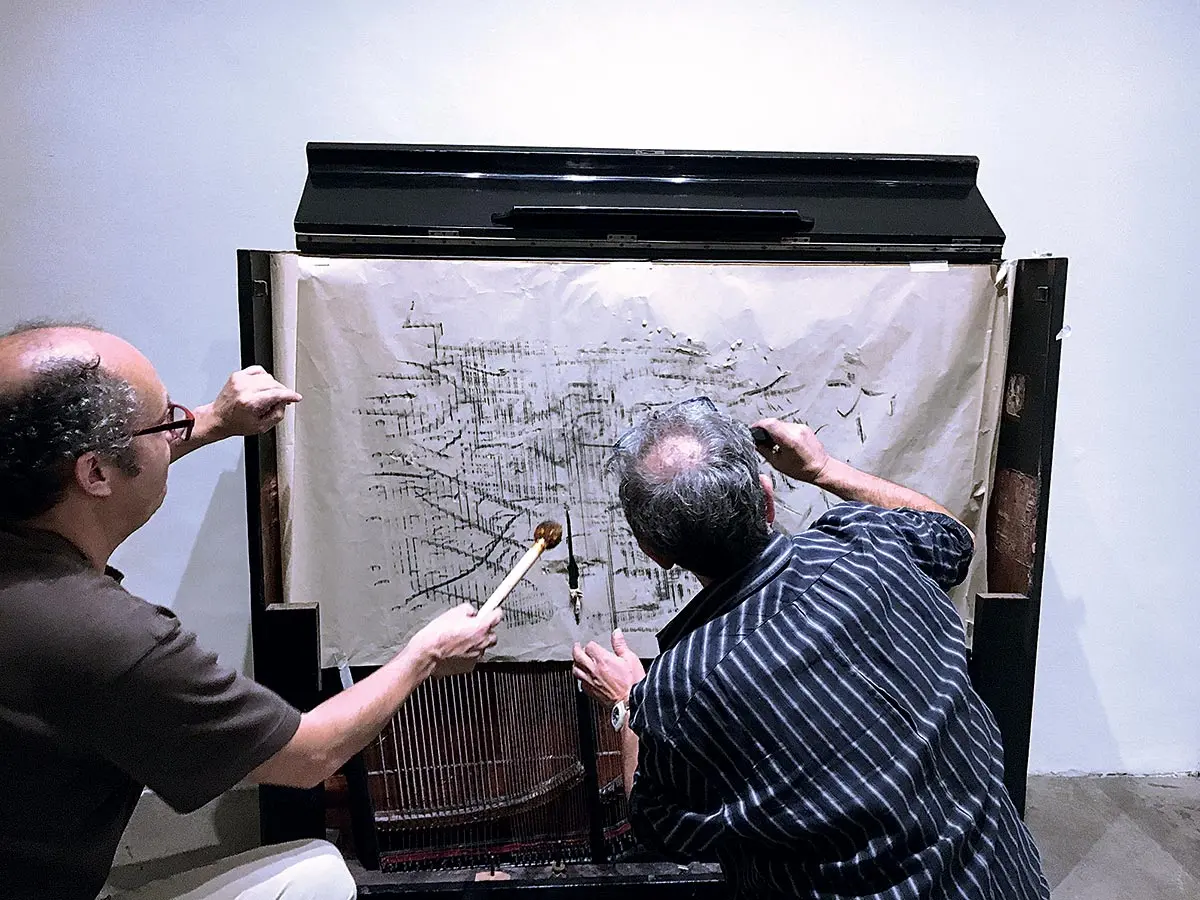
Manuel Rocha Iturbide graduated from UNAM and did graduate work abroad. Besides interacting with the music and visual action, in ]entre[ he brought sculpture and musical instruments close together by rendering both executable. In sculpture, he presents an upright piano that has been disassembled and partially emptied (its harp remains). The artist planned to make a set of radiographies of that body. To that end, he spontaneously invited Roberto Turnbull to collaborate. A number of pieces of paper extended over the harp act as supports for analogies of radiographic plaques of the kind used in medicine, intended to find out whether that body was still capable of vibrating. And the vibrations emerge from the gestures of frottage and similar actions, like the action that we could call golpage1. After visiting the exhibition, a brief dialog with Roberto Turnbull—a visual artist always guided by a will to experiment, devoted to printmaking, drawing, painting, and occasionally sculpture—provides some guidelines to understand his interactions with Rocha Iturbide: “Manuel’s invitation was fun and liberating, entirely improvised. I have no ear for music and can’t play any instruments.”
The sounds, traced by both artists in graphite and charcoal, revealed the interplay of their gestures. Some of the drawings generated in this process reinforced the concept of a Manuel Rocha Iturbide exhibition in an art gallery. In the exhibition spaces, those gestures of frottage and golpage, with varying intensities and thicknesses, are very unlike the visualization of a music score; nevertheless, they come from an instrumental “execution.” This was not a question of dissonances or electronic music, but of antimodal sound-visual structures. In the de-sacralization of instruments, along with John Cage, we must mention Raphael Montañez Ortiz, the educator and artist founder of the Museo del Barrio in New York City, who developed that line in his personal work. For the actions, Joseph Beuys is a point of reference, albeit with some differences in terms of his use of the piano. Many artists today are developing interactions between images and music, although within more mainstream or traditional channels. ]entre[ is a fresh experience both in the visual arts and in music.
NOTE
1. In Poe, Creator of Words, Burton R. Pollin explores the legacy of Edgar Allan Poe, coiner of more than nine hundred words. The author of these lines is keen on coining words as required by critical discourse; such is the case of golpage, a term also used in the gallery’s communications.
GRACIELA KARTOFEL