
City and forest, opulence and misery, tradition and novelty, peacefulness and violence: in its contrast-ridden vastness, the Amazon region is all of that at the same time. Its monumental scale holds unimagined diminutiveness, a simultaneous past, and present. Marcone Moreira was born somewhat to the east of the Amazon region as such, in the state of Maranhão, but grew up in its heart, in Marabá, a large and chaotic city in the state of Pará. In the Tupi-Guarani language, the name of this land means “the offspring of a white person and an indigenous person,” an appropriate descriptor for the mixture of races and immigrant groups that have come to populate it: individuals from all over the country attracted to the area first by the abundance of Brazil nuts and later by the gold and iron of the neighboring Serra Pelada and El dorado dos Carajás. This region is infamous for episodes where the worst rapacity and social inequities are exacerbated, including land conflicts, slavery, and abuses of power. It is a way station for workers and goods, ships and trucks (be it autonomous or at the service of large corporations). It is also the starting point for this artist’s poetics: Marcone Moreira has devised for his career a path that is all of his own, guided despite his youth by a sensitivity molded in the course of nearly fifteen years of activity.
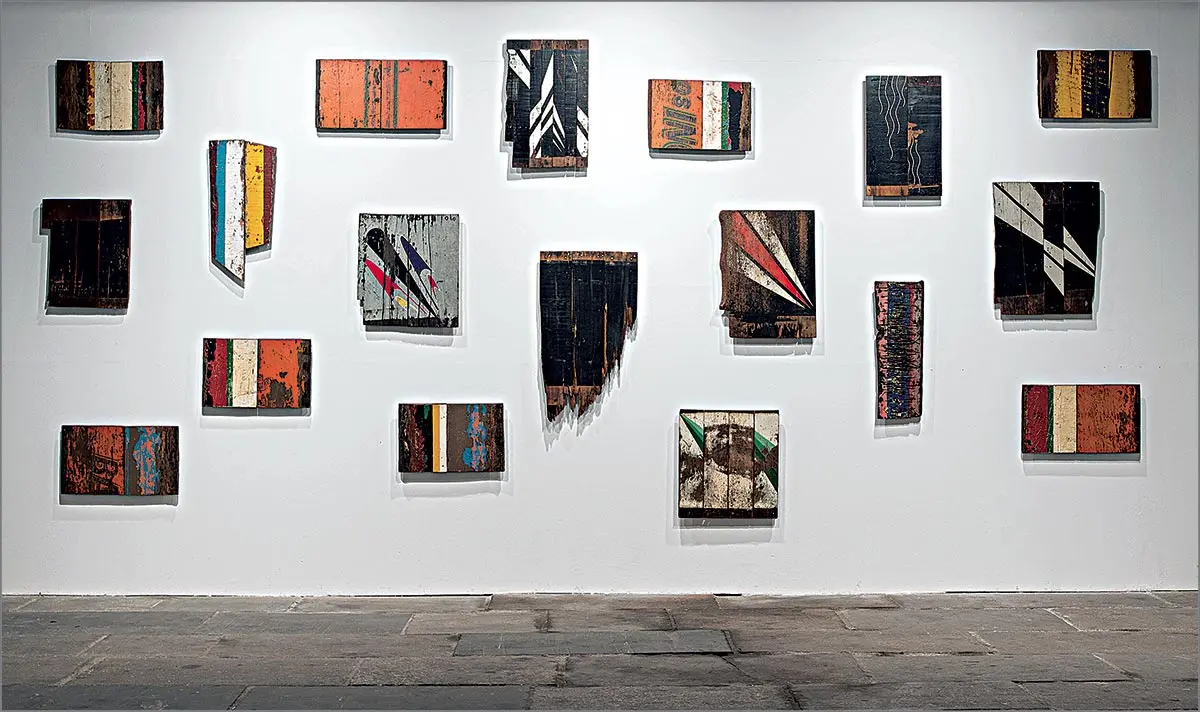
Following a Duchamp-inspired practice of the objet-trouvé, Moreira built a large part of his oeuvre on the basis of the composition of found objects: discarded parts of ship or trucks, and even beach chairs, on which he made no intervention. His attentive gaze was able to find the best possible arrangement for giving such debris new meaning, transforming it into works of art. In time, he adopted a variety of procedures, incorporated drawing, video, and performance, and involved members of the general public in the construction of his works. This was the case with Visualidade Ambulante (Roaming Visuality), a process work that starts with the artist offering street vendors an exchange of their used colorful ribbon-decorated polystirene planks for new ones that he would propvide. Then, Moreira arranges the boxes and lids into formations that vary according to the specifics of each exhibition space. In each new city, the installation acquires new elements and stories. In the same way, the arabesques and flowers in the driver’s seats and canoes speak of anonymous individuals who would not even suspect the artistic potential of their own creations, Visualidade Ambulante brings forth the social realities of groups that depend on the inormal economy for their subsistence, and who, willingly or out of necessity, devote a degree of care to the decoration of their implements as a way of differentiating themselves from their competitors, peddlers of the same merchandise at the same price and in the same locations.
The flows of the economy run under Moreira’s entire oeuvre. Território (Territory) speaks of possession, and brings to the fore as a theme the activity that launched the concept of private property: agriculture. The work features four gates, each from a different region in Brazil, joined to form a quadrangle that demarcates a space as arbitrary as the first piece of land ever marked as belonging to a single owner.
On display on the sides of one of the building’s arches are two objects that create a force field, as if marking a passage from one galley to the next: two cudgels. In their everyday functions, these tools are designated with the same name and serve the same purpose, but their stories are different. One of them, made of silicone, was used in street markets in Rio de Janeiro to beat fish. The other one came from the interior of Maranhão, where it was used in the harvesting of babaçu palm seeds. Worn out, sculpted by use, they bring into contrast tradition and modernity, the industrial and the handcrafted, elements that coexist readily in a continent-sized country filled with multiple realities. Realities such as those experienced by the peasant victims of the El dorado dos Carajás massacre, to which Moreira’s diptych Ausente presença (Absent Presence) makes reference. One side of this work displays a mud mold of a peasant’s bare feet; the other, a plaque commemorating the execution of 19 workers by the police in 1996.
Moreira’s works in this solo show at Paço Imperial speak of economic transitions and relationships of power; they could not have found a better location, since one of the main functions of the Paço’s Eighteenth-Century building was to house the Mint, which operated there, along with the Royal Warehouse, until the Portuguese Royal Family’s relocation to Rio de Janeiro in 1808. After that, the Paço functioned as Governor’s House, Viceroy Palace, King’s Palace (used by Don Pedro I and Don Pedro II for their offices), and—following Brazil’s independence—Imperial Palace. The site was the stage for numerous memorable events in the history of the country. The stories of the many anonymous individuals to whom Marcone Moreira gives new visibility are no less important. Brought inside a palace where only the eminent and the powerful used to tread, these are the “nobodies” who actually built Brazil.
SYLVIA WERNECK