
In the early 1990s, Félix González-Torres referred with enthusiasm to a new type of art where the meaning of the work derived precisely from emotions.1 It was, at the same time, art capable of communicating to its viewers sensations that did not turn away from the political, finding, as Deleuze foresaw, the signs of an object via the senses rather than its didactic or logical recognition.2 Prompting in viewers critical thoughts that were induced involuntarily rather than semantically, the emotions were in fact, for González-Torres, what led to understanding, or, in Deleuze’s words: “More important than thought, there is what leads to thought […] impressions which force us to look, encounters which force us to interpret, expressions which force us to think”.3
“Impressions,” “encounters,” “expressions”: these concepts, sensible pathways for the interpretation of art lucidly inhabit the work of Monika Bravo, an artist born in Bogotá in 1964 who has lived and worked in New York City since 1994. Indeed, in our long conversations in her Long Island City (Queens) studio and her Williamsburg (Brooklyn) apartment, Monika Bravo insisted, and not without reason, on her intention to prompt deep meanings in her viewers with a series of aesthetic decisions that are sensations in themselves, instead of via maneuvers that adhere to a logic of truth. In this way, by means of fixed and moving images, digital assemblages, sounds, and the interactivity of such forms as they are imaginatively installed in and with space through a variety of materials, the issue for Monika Bravo is, as in Deleuze, to deconstruct the conventional opposition between thought and sensation, interrupting the independence and superiority of reason that has been so forcefully imposed on Western culture since the Enlightenment. Interweaving thought and sensation as non-hierarchical categories, Bravo’s work generates, from the senses, a communal context between object and viewer that can function as the platform for a new semantics of the main subject of her art: time.
“I believe that canonical Western culture conceives time as a linear narrative that always has a beginning and an end. What I propose, then, is that time be perceived as a circular material, with intangible cycles that give shape both to time and to space. Based on this idea, time for me becomes an essential artistic material,” the artist has said. In fact, many readings of her work have focused on the relationship between non-linear time and the viewer—a relationship that is, from the start, political, in the sense that it interrupts, on the one hand, the ascendant logic of a single, imperial time, and on the other the disciplined reception of such a time. In 2000, for example, Robert Blake wrote that Bravo’s situational works unshackle viewers from their supposed “obligation” and “confinement” to the canonical regulation of time,4 while Deborah Cullen, focusing on the exchange that takes place between the works and the viewer, put it this way: “The most essential element in her effort is the encounter with the viewer that the work fosters. To experience one of Monika Bravo’s works, since they possess a durative character, requires a transaction in time: the author proposes the space, the tone, and the images; with their entrance, viewers tacitly agree to get involved.” 5
Specifically, Bravo’s interest in this relationship originates in her desire for photography, which was first conceptualized in 1998, in terms of an exchange of affections, with For the time being, yet began long before in material terms, when at the age of nine Bravo received her first camera as a gift from her mother. It was then that the artist began to capture portraits and landscapes of her native Colombia, accumulating on the walls of her childhood room the positive prints produced by her 35mm camera. For Monika Bravo, who retains as part of her philosophy ownership of memory, which is to say, the selection of a reality that surpasses, as Proust thought, the spatial and temporal limitations of photography, such editing exercises are nothing other than the starting point of her method of work, where montage and fiction function as sensible vessels for understanding. Yet the truth is that, for Bravo, photography was not a discipline to be studied in school but a mode of approaching the senses that resulted in a set of diverse experiences. Thus, her early relationship with the camera, her work and her teaching around photography, her fashion-design studies in Rome and Paris, and her many travels—which respond to an insatiable drive to understand and often speak many languages—took Bravo, at the age of 30, from her nomadic days in Europe to New York City, where between 1994 and 1995 she enrolled in the International Center of Photography (ICP). Since then, Monika Bravo has devoted herself in full to art.
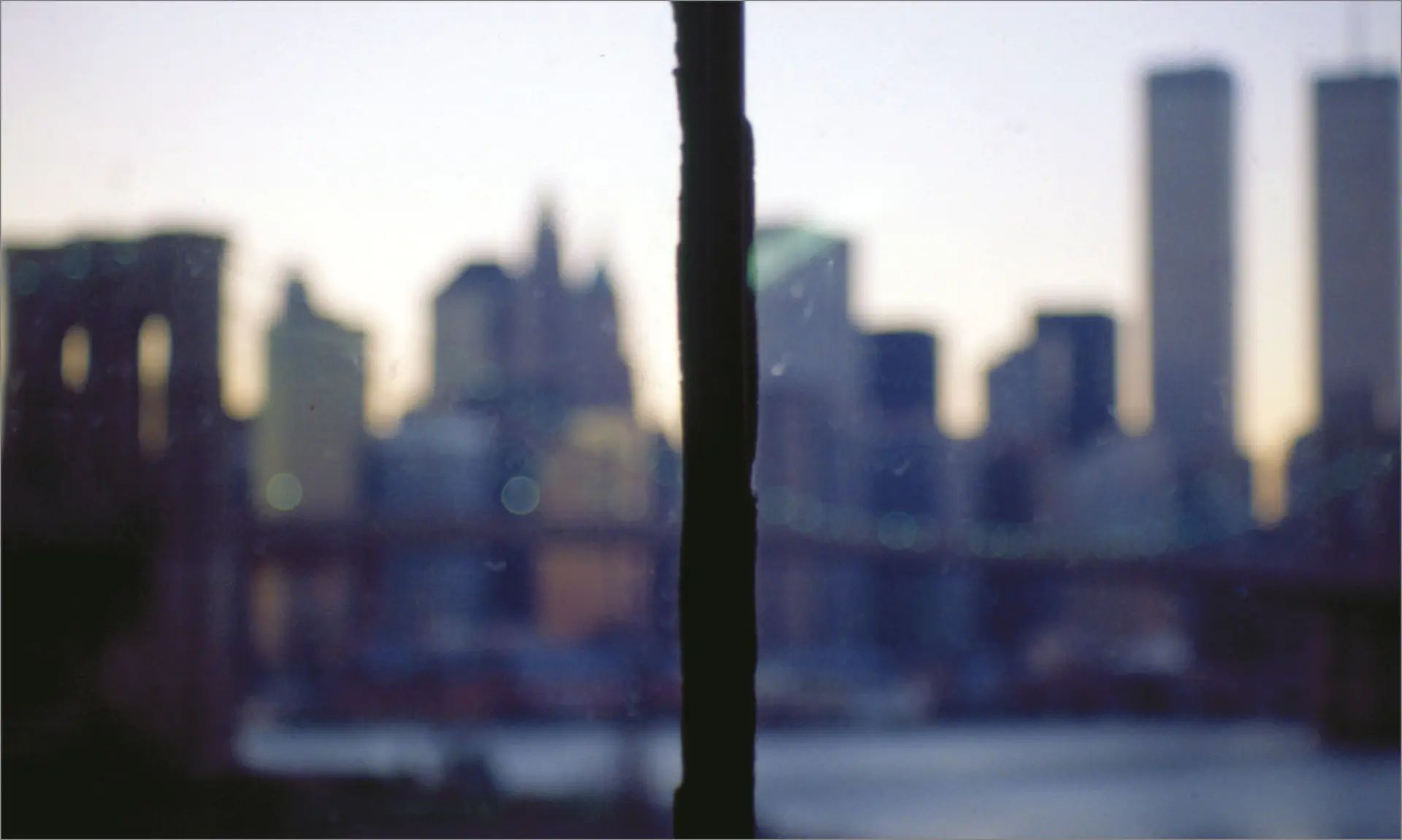
In For the time being (1998), a 28-minute video, the static lens of Bravo’s camera observes the suspension of time over the course of a year, recording from her window how storms, air, and light juxtapose poetically against the emblematic Brooklyn Bridge. The artist’s voice recites verses from Ecclesiastes—verses that, as happens throughout her oeuvre, relate to the notion of time: “A time to be born and a time to die/ a time to be silent and a time to speak/ a time for war and a time for peace [...]”. The viewer is then submerged in the verses and the sensorial time of the leaves and their repetition, as the montage’s invisible shadows time and again overtake reason, science, and the law. In this way, as French cultural critic Roland Barthes wrote in Camera Lucida (1980),6 the punctum, which is always temporal, coexists both in the image and in its reception through the logic of the “supplement” rather than the “addition,” generating an affective exchange between the object and its observer. And then, as Alfred Stieglitz famously said in From the Back Window – 291 (1915-1916), Bravo continued to look through the window of her New York studio. Setting up her camera in position for long periods, in Interval(s), for example—a series of Plexiglas-mounted horizontal photographs taken through the same window, and during the same year, as For the time being—the artist presents the varied results of a scanned and superimposed image with respect to time and its interval(s), echoing the title of her work and in that way involving language as an aesthetic resource.
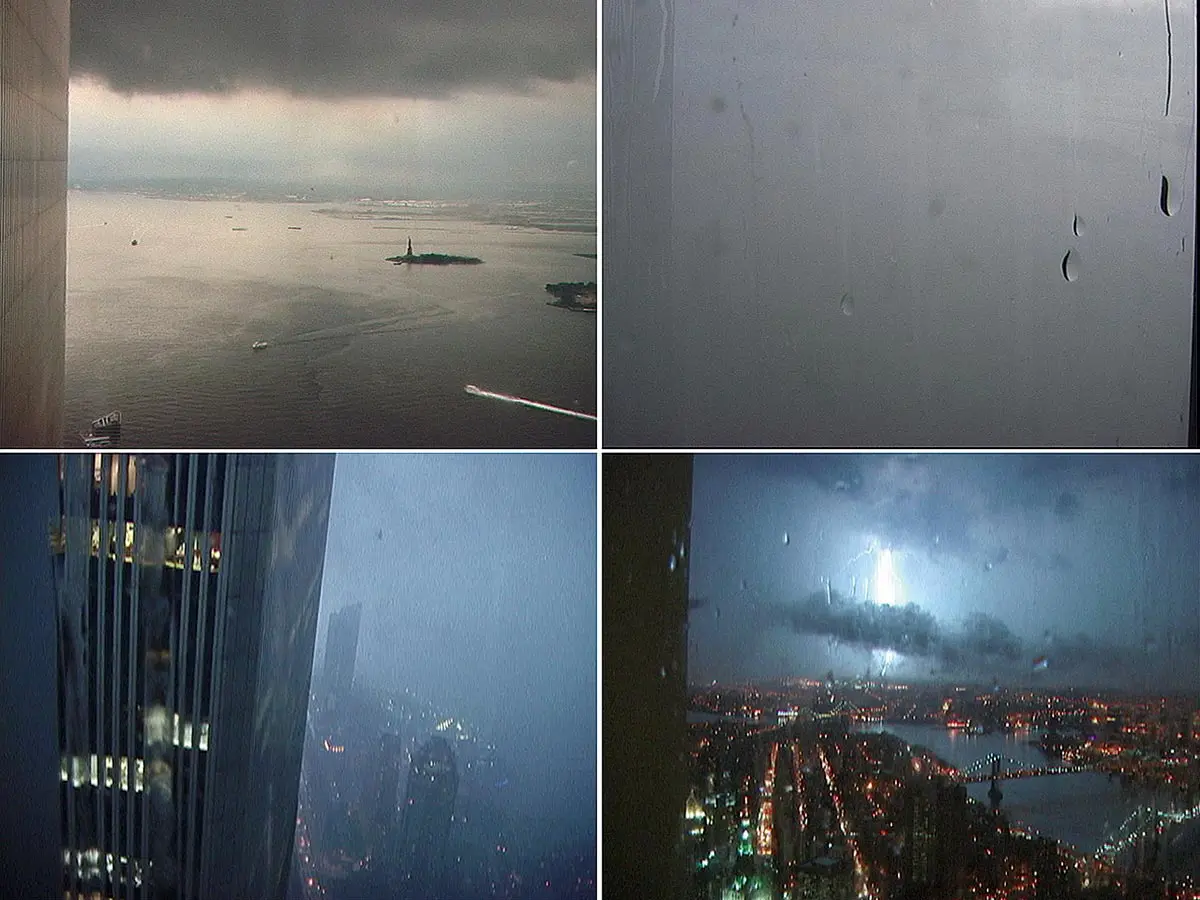
In 2001, Bravo’s fascination with generating the sensation of non-linear time, involving sound and language from the window—which is nothing more than a new semantics for the mimetic, Renaissance notion of a truth that is fixed in a given time and on a given architectural space—drove her to do a residency at the World Views Studio of the Lower Manhattan Cultural Council (LMCC). Her residence took place in the World Trade Center the day before 9/11. Bravo took panoramic shots for her work A Maze; that day, what she captured were storms fogging up her window, which became the distant, silent image of a mist-shrouded city. Bravo left her studio shortly before midnight; the next morning, the entire world saw those windows burning brutally and becoming a media icon. The artist decided to edit her panoramic shots into a five-minute video that she titled Uno nunca muere en la víspera (One Never Dies the Day Before). The video has captured the attention of many for its anecdote, the way it anticipates the 9/11 hecatomb through the sublime metaphor of the storm, yet in fact, it is an interruption of the normative of time: a fictional tale about and from the gaze that, as such, pays tribute to Michael Richards, an LMCC artist whom Bravo describes as “attentive to political realities” and who died that morning like so many others in one of the Towers.7
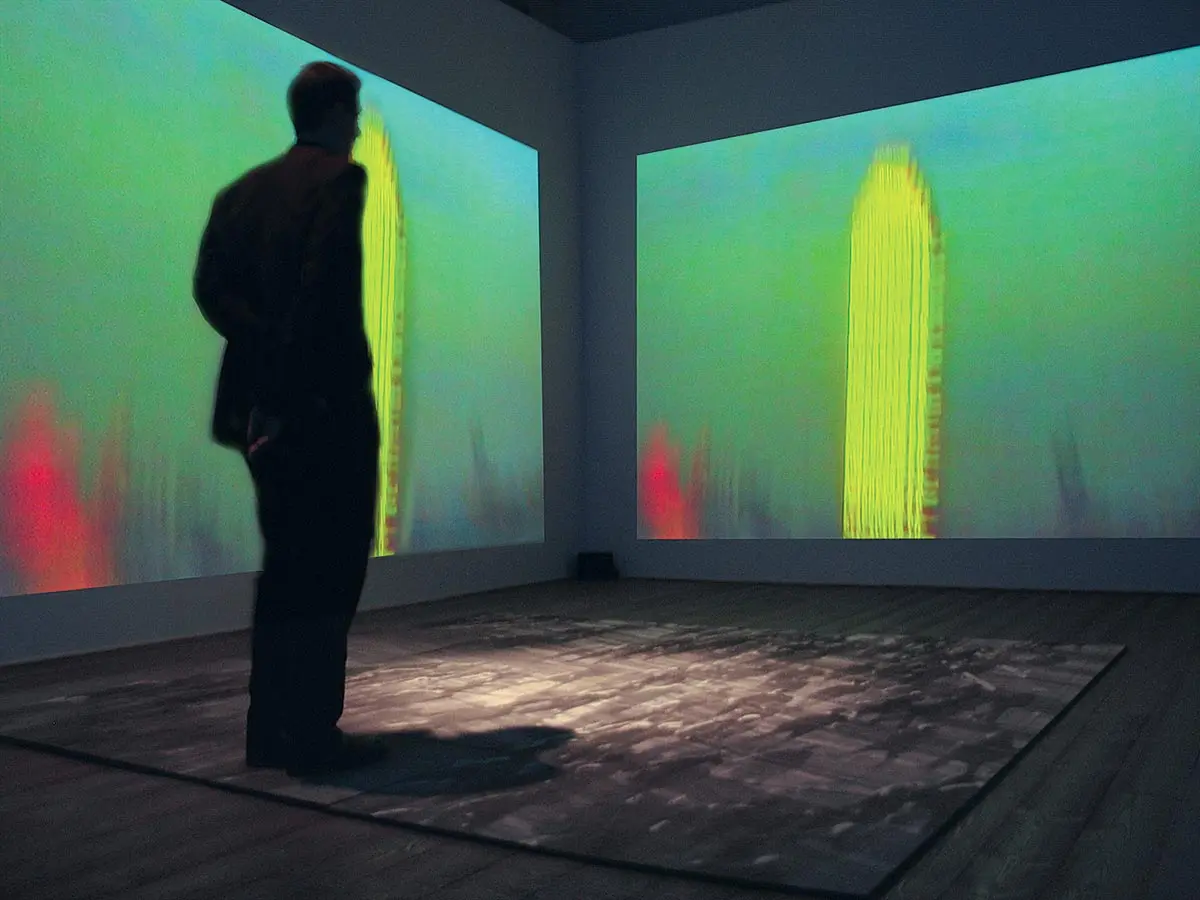
At the World Views, Studio Bravo had begun A Maze (2001), an interactive installation based on time, sound, and language. Taking from Borges the idea of the labyrinth in order to juxtapose the memory of random situations recorded during different trips, the artist groups such images in two-minute sequences. As the electronic music of FLORA & FAUNA is heard, viewers move, as if in a videogame, on a 3m x 3m surface comprised of 25-floor tiles. A sensor placed under each tile activates the sequences, and in that way the viewer participates in the images, making them appear and disappear from the screens. At the same time, labyrinthine images are created on the surface itself on the basis of words from Borges’ Arte Poética (Ars Poetica), as though words were, in line with Wittgenstein’s thinking, images in themselves. Viewers, then, perceive those images via the non-linear time to which the artist invites us; we can think of the poem’s opening line as an image: “Mirar el río hecho de tiempo y agua y recordar que el tiempo es otro río” (“To gaze at the river made of time and water. And recall that time itself is another river”).
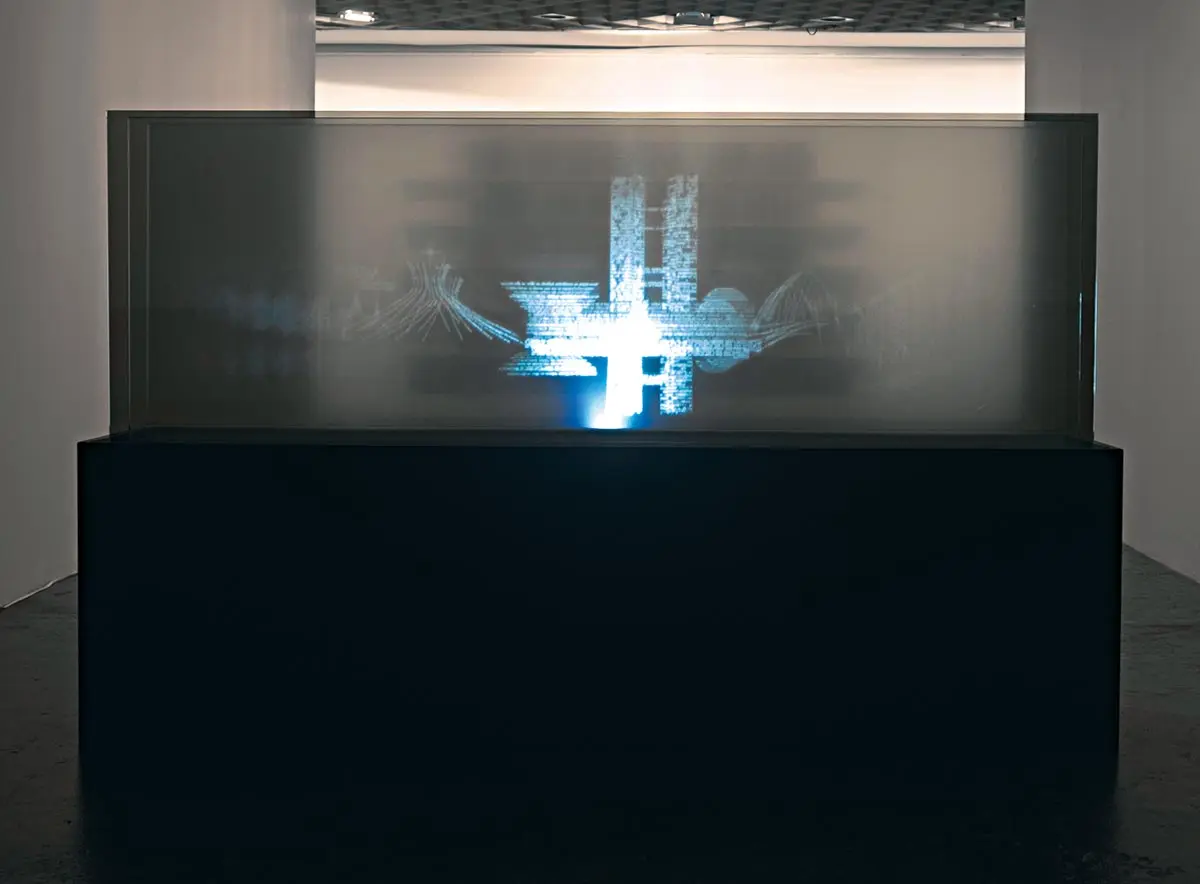
Indeed, like the river that flows and is never the same, time is also a river, not a progression. And this chronology-countering idea, which evokes the past, the present, and the future simultaneously, is found in the literary sources that Bravo so lucidly cites in her work. The Arte Poética is one example; Italo Calvino’s Invisible Cities is another. Bravo uses Calvino’s novel, based on chronicles of imaginary journeys that take place like a science fiction narrative, to create Landscape of belief (2012), a sculpture installation made of glass, mirrors, aluminum, projectors, a computer, and a software program. There, landscapes are taken from the novel, turning the text into the form: the outline of a city. “My intention is to create a parallel between literature and architecture, as they both define, translate and shape physical and mental structures,” Bravo wrote, alluding to a work that, in combining sensorially and imaginatively language and the representative, mutating architecture of cities like Paris, London, Venice, and New York, interrogates the cultural constructions that determine our experience of the urban environment. Thus, bridges, buildings, and plazas made from words appear and disappear slowly in front of the viewer’s eyes on the three glass panels of Landscape of belief, as happened, albeit with different materiality and in a more abstract way, with the images of A Maze and with the snow and light on the film exposed for a year on the artist’s New York window. To witness Landscape of belief—as all of Bravo’s works—as an experience rather than an archive or reproduction (this is to say, allowing an affective exchange through tangible and intangible materialities) is thus a key issue for the artist, inasmuch as she is intent on prompting understanding on the basis of the senses: an encounter with signs. And such an understanding could be thought, as we said, by means of fiction and imagination as vehicles for meaning, something that in Bravo’s thinking is connected to the photographic and its extension in the image in motion.
For Bravo, at the time she decided to devote herself to art in the mid-1990s, photography itself was changing but not—as some critics were arguing due to the arrival of digital media8—dying; the zeroes and ones processed in a computer, as opposed to the chemical processing of film and paper inside a dark room, were anything but melancholic. Monika Bravo defines herself, in fact, as a new media artist who approaches the pictorial from the digital in order to generate a reality build by means of fiction, as opposed to a truth framed by the logic of transparency dictated by the canonical photo-documentalism that operates in the arts as well as in the social and judiciary spheres. In his famous novel In Search of Lost Time (1913), Marcel Proust referred to the spatial and temporal limitations of photography to represent memory and, from there, a deeper reality, a time that is neither metric nor narrative about which Barthes, Borges, and Calvino also wrote. Bravo, for her part, has focused not on the death of the medium but on the pictorial characteristics of digital photography, the etymology of which reminds us of the deictic and induces us to touch. The artist creates the fiction of a narrative about the tangible and the intangible in a time that is a river: a narrative that, while impossible in science and in photo-document, gives the viewer’s sensations and emotions a deep reality that they end up making their own.
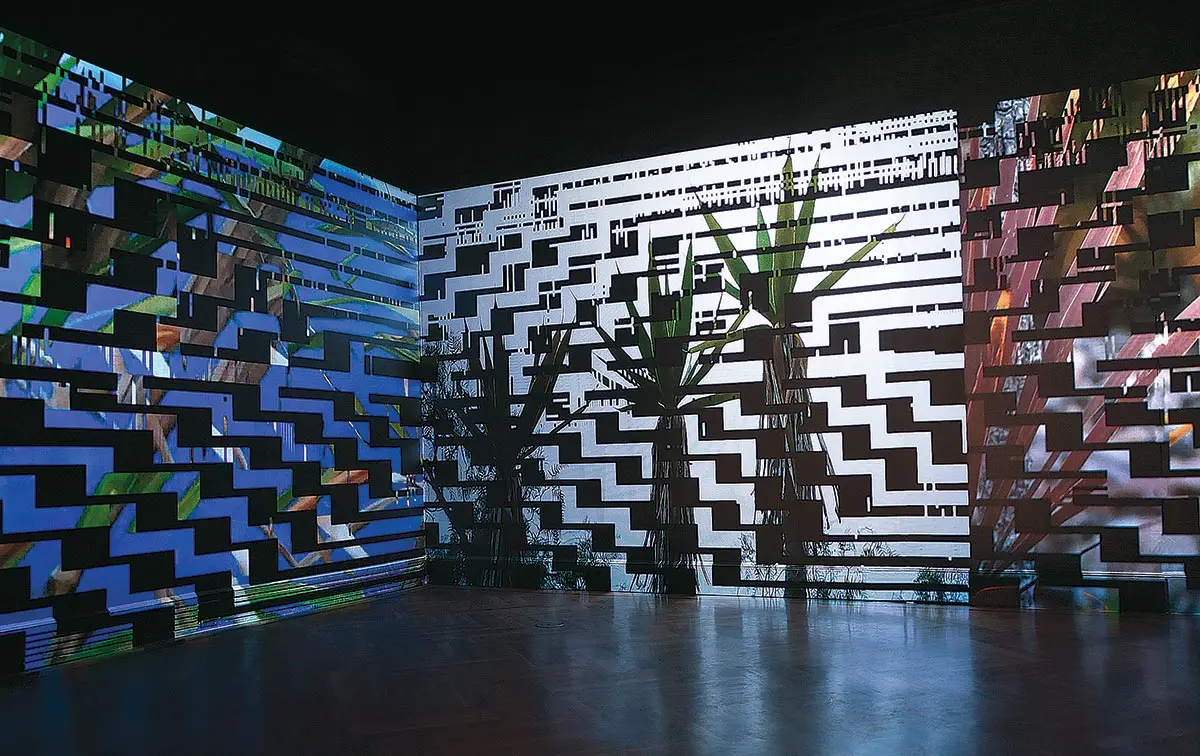
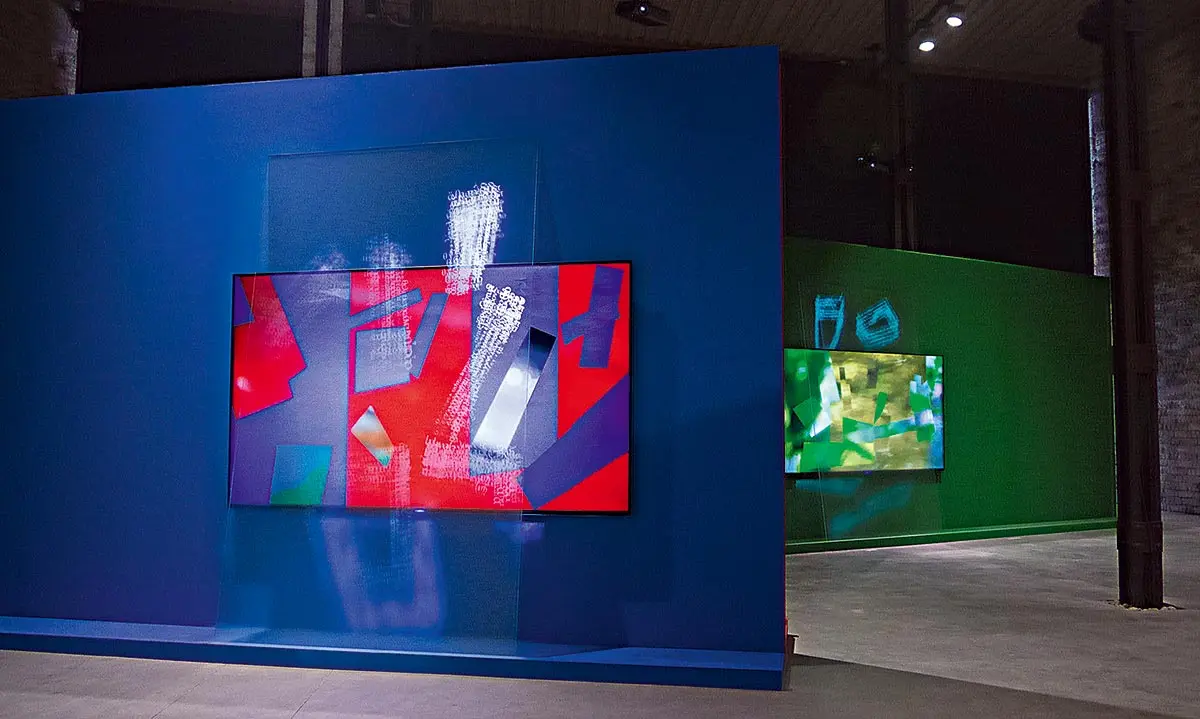
The video installation URUMU_WEAVING_TIME (2014), famously included in the group exhibition organized by José Roca and Alejandro Martín that brought together contemporary Colombian artists around, precisely, the subject of rivers9, is an example of this. Submerging the viewer in a narrative about textiles, about the threads that weave a time or a river, by means of an irregular rhythm that seems to create a text in an unknown language, this work, as Martín explains, derives in meanings that vary according to each viewer. On the one hand, for those unfamiliar with Colombia’s indigenous cultures and their signs, the virtual weaving projected in the videos has to do with abstract patterns that perhaps bring to mind generic South American indigenous motifs. On the other, for those who have some knowledge of the Sierra Nevada the images will evoke the backpacks carried by Arhuaco women, that “universe that shelters us (the Arhuaco people) in the bottom of our backpacks.”10 And the textile element, which, finding support in etymology, Bravo connects with the text, with the temporal process that prods imagination, gave rise in 2015 to a quote from the Gospel of St. John, which the artist exceeds in terms of language by giving new meaning to the origin of the word towards infinitude. Bravo presented this work, titled ARCHE-TYPES, at the Vatican Pavilion of the Venice Biennale, including, as in her previous work, the relationship between image, language, and sound. How do we interpret the texts beyond their religious aspect? Bravo wondered as she did about painting recalling Malevich’s meditations on the medium. And in this way—gathering a significant variety of sources that the artist translates into diverse materialities and sensorial mechanisms, alluding to a labyrinthine meaning that, as such, is never static, immanent, or finite—in her most recent work, TESSERAE (currently on exhibit at Johannes Vogt, the gallery that has represented the artist since 2016), Bravo executes an exercise in media archaeology, articulating a narrative in mosaics based on the archive of her own work. According to the artist, “the time of TESSERAE is a multiple-time that exists in a variety of probabilities, based on previous works. Time, then, is in itself the work’s materiality.” And it is precisely in that intangible materiality where understanding and sensibility coexist, alluding to the opposition between the schizophrenic images of Google Earth and those allegories of the river, or of time as a river in Bravo’s imaginary, of which, so imaginatively, she makes us part by means of the emotions.
NOTES
1. Felix González-Torres, “The Gold Field” (1990), in Felix Gonzalez-Torres, Julie Ault, Ed. (New York, Steidlangin Publishers, 2006), p. 150.
2. Gilles Deleuze, Proust and Signs, trans. Richard Howard (New York: Braziller, 1964), cited in Ernest Van Alphen, “Affective Operations of Art and Literature,” RES 53/54 (Spring/Fall, 2008): 20-30.
3. Deleuze (ibid.), p. 161.
4. See Robert Blake, “Symphasis,” 2000. In http://www.monikabravo.com/2011-1998-ARCHIVE/TEXTS. Accessed on January, 2017.
5. See Deborah Cullen, “Lo que ocurre,” 2005. In http://www.monikabravo.com/2011-1998-ARCHIVE/TEXTS.
6. Roland Barthes, Camera Lucida: Reflections on Photography. Richard Howard, Transl. New York, Hill & Wang, 2010 (Reprint Edition).
7. For an excellent review of Uno nunca muere en la víspera, see Rodrigo Miranda, “La última noche de las Torres Gemelas”, Qué pasa. September 9, 2016. http://www.quepasa.cl/articulo/cultura/2016/09/la-ultima-noche-de-las-torres-exto gemelas.shtml/
8. For more on the debates about the death of photography, see Douglas R. Nickel, “History of Photography: The State of Research,” Art Bulletin v. 83, 3 (September 2001), pp. 548-558.
9. The exhibition, co-curated by José Roca and Alejandro Martín, was titled Waterweavers: The River in Contemporary Colombian Visual and Material Culture, and was on view between 2014 and 2015 at the Bard Graduate Center Gallery; the Art Museum of the Americas in Washington. D.C.; and the Conde Duque Cultural Center in Madrid.
10. See http://www.monikabravo.com/WEAVING_TIME
FLORENCIA SAN MARTÍN
Art critic and curator. Ph.D. candidate in Art History, Rutgers University.