
That there is a large Cuban community in Miami is no secret. There is even a joke about the Cuban population being responsible for Miami’s standing as the “second-largest city in Cuba.” But, what is the connection that led a Cuban artist to exhibit his work at the Centro Cultural Español in Miami? Actually, there are many reasons. First of all, Cuban artist Néstor Arenas (Holguin, 1964) developed his professional career between Bilbao, Zaragoza, Barcelona, and Madrid. By the way, Arenas and the curator of the exhibition, his compatriot Dennys Matos, are both Spanish citizens. But the strongest connection with Spain in both cases is that in Europe they witnessed the transformation of the communist states from the Eastern Bloc. And that process was associated with the proposals in the personal works by Néstor Arenas and Dennys Matos1. The exhibition titled Paisajes Transformers III by Néstor Arenas, under the curatorship of Dennys Matos, is undoubtedly one of the best-executed exhibitions of 2016. It represents the culmination of a series of earlier shows, explorations, and critical inquiries of phenomena unfolding for nearly twenty years.
It is interesting that during the beginning of the last decade of the previous century, Néstor Arenas and many other artists who walked away from a stagnant socialist system while still living in Cuba eventually went to the other side of the Atlantic to witness the repercussions and postmortem melancholy of that very system; only that this time it was through the prisms of the German and Slavic cultures. During this period (1990-1995), they made a leap forward to become free from the local narrowmindedness and paternalism, in search of Cuban visual art developed in a more universal plane, this time around through their own efforts and means, without help from the state; in an attempt to reach individual recognition in the international art scene. But this never meant leaving behind the Cuban themes that drove their artistic discourses.
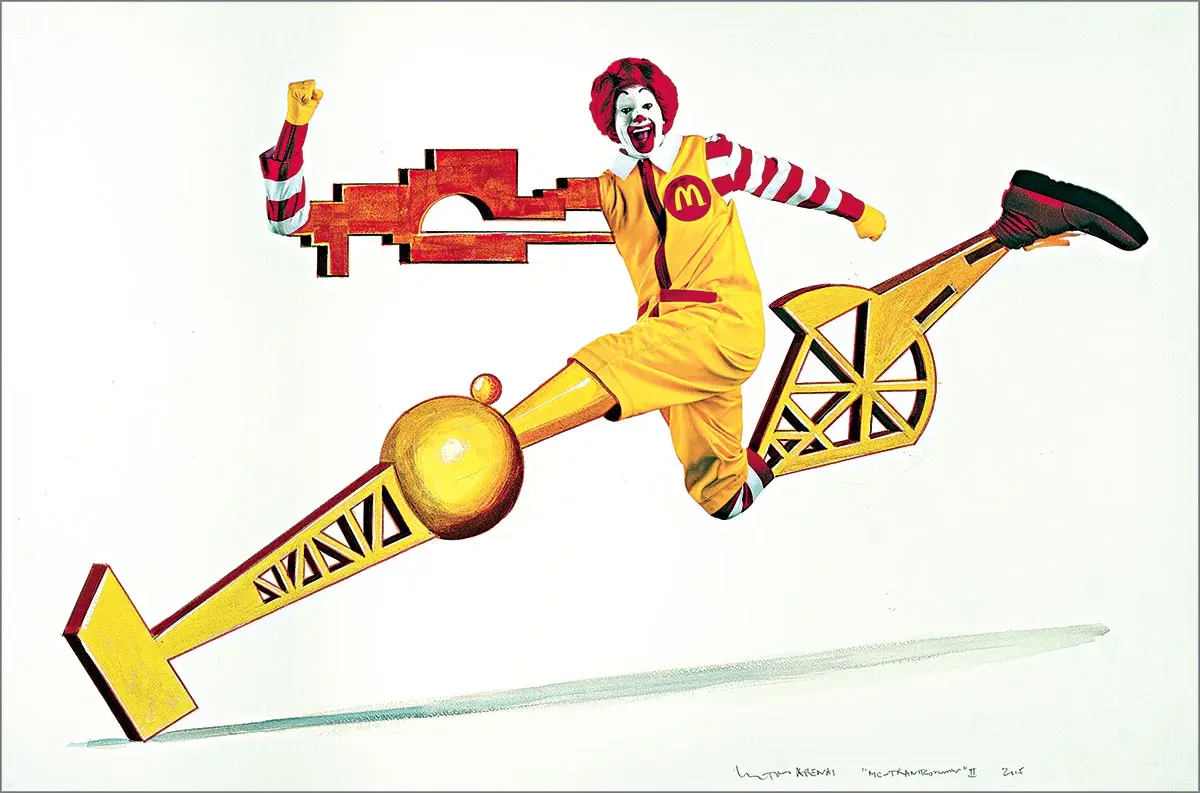
Since then, Néstor Arenas’s artistic production centers on a naturalist style reinvigorated by the influences of pop and neo-pop. Arenas rely on a photomechanical base and digital support that showcases the graphic aspect of the work as well as a metaphysical landscape designed with the connotations of a surrealist theatrical curtain. But his style must also be associated with the so-called lowbrow painting2, a very general term that since the late 1970s has been adopted to express the opposite of sophisticated and elitist—Something that, in my opinion, stems from the cultural decline of the west.
But Néstor Arenas’s explorations of this “low-intensity culture” consist of formal appropriations of postmodern signs that he takes a step further, in an attempt to somehow transcend the decay of the ideological systems and the loss of the great utopias. He collects and classifies fragments of those processes—without trying to resurrect them—in order to build something new. He extracts from the two extinctions (communism and post-industrial capitalism) psychological ghosts, products of consumption, and architectural styles and makes them interact with one another.
Soon, his focus becomes charged with that which Germans call Ostalgie, in reference to the time and existence of the German Democratic Republic (GRD)3, which can be applied to a more general nostalgia for real communism. His work also draws from post-industrial capitalist mutations that announced the global adoption of a new way of functioning, under the most liberal economic and technological reorganization, which nonetheless, carries that nostalgia for the past that is so profitable for some. Consequently, the paintings by Néstor Arenas somehow resemble a “theme park” in which to receive his proposals and receive a futuristic message. Arenas admit that his landscapes in the background are “scenes in which a purposely place beings and things, like in a diorama where I must provoke an occurrence like if it were a game.”
It is a pretty textual universe because it relies on precise iconography. Each piece has a past that represents things that cannot be overtly stated but can inhabit the present lightly. To elevate their ability to impact, the mishmash of styles adopted in the works, as well as in the converging things and figures that they contain, the architectural configuration and purpose generally disappear behind sculptures, absolute forms, volumes, and dynamic perspectives on almost flat backgrounds.
Memories of a neocolonialist hodgepodge combined by Arenas, which just as well could insinuate the outline of Mickey Mouse’s head or the design of the Pravda Tower in Leningrad, cram structures and lines from the Soviet Union’s productivist current together with monuments and skyscrapers created before the revolution during the Havana of the republican period. Likewise, Néstor Arenas humorously destabilizes his “superheroes”4 by intervening them in ridiculous ways with mechanical prostheses, crane arms, or an oil pump used in prospecting.
In sum, like Dennys Matos points out: It is about “ a new artistic dialect developed from the combination of two sentiments with antithetic temporalities: nostalgia and hope.” Through this work, Néstor Arenas allows for the coexistence of remnants from old and confronted powers within an artistic imaginary. It is a resolute no to the preservation of imperial ruins, replaced by changing entertainment, within a system understandable to all that is probably influenced by an eagerness to unify that is part of the new dominant technostructures.
NOTES
1. Also preoccupied with the analysis of those phenomena, Dennys Matos approaches them in his book titled Paisajes/Metáforas de Nuestro Tiempo (Landscapes/Metaphors of Our Time), published in Barcelona in 2009 by Ediciones Linkgua.
2. Today, the lowbrow style has evolved into various versions like the elaborated realism of John Currin, or another based on illustration, as well as those known as urban art, gothic art, pattern art, and character-based art—which incorporates a combination of caricature and comic, even the one, is known as Manga (NA).
3. Ostalige: acronym formed by the words ost (east) and nostalgie (nostalgia).
4. Arenas’ superheroes include Captain America, the Soviet toy Uncle Stiopa, Fidel, Stalin, Ronald McDonald, Dragon Ball, Cuban toy soldiers, Iron Man, etc.
ALDO MENÉNDEZ