Nicolás González (Cali, 1989) is a recent graduate of Universidad Javeriana in Cali, and his work as an artist has evolved in connection with problems of sculpture and the polysemy of objects. Hábito (Habit), his most recent exhibition at lugar a dudas, provided an opportunity to provoke a series of reactions around the installation of “deceitful objects” at a different locations inside the house. González found the subject of this exhibition in his travels around the city, where he saw motorcycles covered by black plastic. The idea that interests him, with regard to these objects, is the mutability of symbolic conditions, once things are covered by a membrane that hides them from view; in this case, the motorcycles, which are seen as versatile and speedy, become heavy, static, cumbersome objects once under cover. In this way, González’s sculptures are a series of solid empty shells that give the sensation of being motorcycles covered by waterproof material; the folds and the sheen of the fiberglass match with exactitude the real object, and for that reason produce a feeling of weight and presence.
When we see something that is under wraps, our impulse is to fantasize about its contents and to project a series of possibilities, as if our eyes wanted to see beyond the packaging. We can mention Christo’s most famous works, where he covered different objects with fabric to achieve the difficult feat of showing by hiding, a gesture that could be considered a trope within the visual arts and can also be seen, for example, in Fernell Franco’s photographic series Amarrados (Tied Up), which features images, taken in La Galería (central market) and in downtown Cali, of street vendor stalls and carts wrapped in fabric by their owners, stowed away and at rest as they await the arrival of a new workday. These images, like Christo’s works, reveal that it is possible to highlight something by covering it, and they generate a deep feeling of mystery about what is implicit in them.
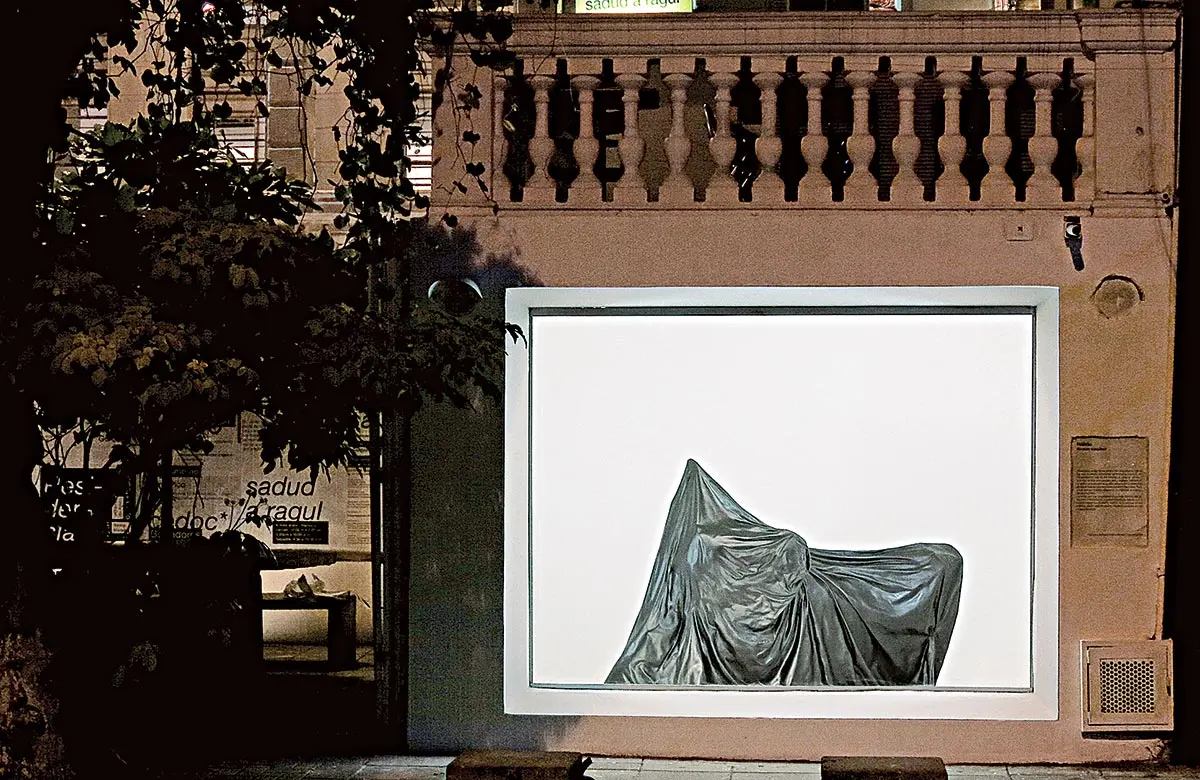
Hábito consists of two untitled encasements installed in the house, one of them exhibited inside the display window that faces the street, lighted like a commercial product, and set against an intensely white background to generate a scene of daydreaming and unreality, as befit commodities and merchandise. This installation de-contextualizes the image by severing its connection from its (social) background, all the while augmenting its presence and enhancing the possibility that a casual observer or a passer-by, unable to imagine that what they are seeing is not a plastic-covered motorcycle but a hyper-realist hull, will take them for the real thing. The distance between artwork and observer produces a certainty about what is seen; deprived of the possibility of touching, most will even consider the possibility of error. It is worth noting, even, that the absence of proper titles resulted in the shells being called “motorcycles” all throughout the exhibition, one on the lugar a dudas window and the other in the yard. This brings to the fore issues regarding the packaging, the aura, and the dressings of things, since a motorcycle was precisely what was not there.
One of González’s intentions with these sculptures was to cause discomfort and disquiet; the placement of one of them inside the window is complemented by the other one’s installation inside the building, which had to be moved around constantly since it impeded the place’s daily activities. Unlike the former, the latter could be touched, and many people tested its solidity with light taps on the shell. The discomfort that his work produces is reflected in everyday life, for example, if one thinks of the public space invaded by vehicles, of old houses turned into parking lots, or individuals who have to shift around their living room furniture in order to stow away their motorcycle. Perhaps the weight and the invariant character of these sculptures are a reflection of the immobility of the work of art and the presumption that the aura can be preserved intact.
With this exhibition, Nicolás González prompts a large number of situations, from an emotionally irate letter that, in the conviction that he was exhibiting “imply” a motorcycle covered by black tarp, remonstrates the artist for his superficiality, to indifferent reactions on the part of people who enter the space and don’t even notice the artwork, assuming it is nothing but a covered “planter”. These small situations provoked by the “motorcycles” reveal that the circumstances of the exhibition, the frame, and the device on the basis of which the work of art manifests itself are vital for the dynamics of art. Perhaps everyday life conceals the structural processes of things, and life itself continues with certain inertia that attempts to establish the nature of its environments and its elements as facts, even if deceptions often filter though unwittingly. The aura, which is also a form of wrapping, has its own folds and its own sheen that we perceive directly in the symbolic plane—and that plane can also deceive us.
BREYNER HUERTAS